


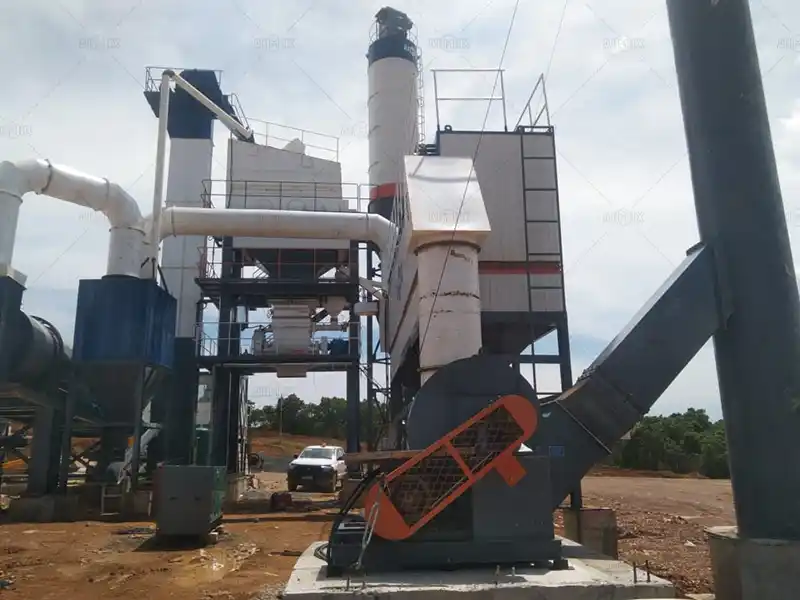
In many road construction projects across Ghana, one challenge keeps appearing again and again: unstable power supply. Contractors often face sudden outages, voltage drops, and unpredictable grid performance. These issues directly affect asphalt production, project timelines, and operating costs.
So the real question is not just about choosing an asphalt plant. It is about choosing a system that can keep running even when the power grid cannot be trusted. In this article, we will look at practical asphalt plant options that work well under unstable power conditions in Ghana. We will also explain what construction companies should consider before investing.
If you are planning road projects in urban areas, rural regions, or long highway stretches, this guide will help you make a more stable and cost-effective decision.
Before choosing any asphalt plant, it is important to understand the real situation on construction sites in Ghana. Power supply is often inconsistent, especially outside major cities. Even in urban areas, sudden outages can happen during peak construction hours.
This creates several practical problems. First, asphalt mixing requires continuous heating and precise temperature control. Second, interruptions during mixing can lead to material waste. Third, restarting a cold system increases fuel consumption and delays production.
Therefore, contractors are not just looking for high capacity. They are looking for stability, flexibility, and independence from the grid.
With this context in mind, let’s move to the types of asphalt plants that can handle such conditions more effectively.
To operate successfully in Ghana’s unstable power environment, an asphalt plant must meet several key conditions. These requirements are not optional. They directly affect project efficiency and profitability.
The plant should be able to run on diesel generators or hybrid power systems. This ensures continuous operation even when grid electricity fails.
Some asphalt plants require high electrical power at startup. In unstable regions, this becomes a risk. A suitable plant should have optimized energy consumption and gradual startup systems.
Interruptions during production cause overheating or material rejection. Therefore, the system must support stable and continuous mixing cycles.
In Ghana, many road projects are located far from reliable infrastructure. Mobility becomes an important advantage because it reduces dependency on fixed power facilities.
Now that we understand the requirements, we can compare different plant types in a practical way.
Not all asphalt plants perform equally under unstable power conditions. Some are designed for large-scale infrastructure with stable grids, while others are more flexible and field-oriented. Let’s compare the most suitable options.
Mobile asphalt plants are one of the best choices for Ghanaian construction environments. They are designed for quick installation and relocation. More importantly, they can be powered by diesel generators, which makes them independent from the grid.
In addition, mobile asphalt mixing plants for sale reduce downtime between project sites. Contractors can move the plant closer to road construction zones, which reduces transport costs and improves efficiency.
However, mobile plants usually have medium production capacity. So they are ideal for municipal roads, rural highways, and short-to-medium term projects.
As we move from mobility to production stability, another option becomes relevant: drum mix plants.
Drum mix asphalt plants are widely used for continuous production. They are simpler in structure and often require less electrical complexity compared to batch plants.
This makes them more stable under fluctuating power conditions. When connected to a reliable generator, they can run continuously without frequent stops.
Another advantage is lower maintenance complexity. Fewer interruptions mean fewer risks during unstable power conditions.
However, counter flow drum mix plants offer less precision in mix design compared to batch plants. So they are better suited for standard road construction rather than highly customized mixes.
Next, let’s look at a more advanced option that combines control and flexibility.
Containerized asphalt plants are gaining popularity in developing regions like Ghana. These plants are designed in modular units, which makes them easier to transport and install.
They also support hybrid power systems. For example, operators can use a combination of diesel generators and grid electricity when available. This flexibility is very important in unstable power environments.
In addition, modular systems allow phased investment. Contractors can start small and expand capacity later, depending on project demand.
As we can see, each plant type has strengths. But the final decision depends on project scale, location, and budget.
Choosing the right asphalt plant is not only a technical decision. It is also a business decision. Contractors should evaluate both short-term performance and long-term operating costs.
If your projects are in remote areas with no stable grid, mobile or diesel-powered systems are more suitable.
Small municipal projects may only need 40–80 TPH capacity. However, highway projects may require 120–200 TPH systems.
Since generator use is common in Ghana, fuel efficiency becomes critical. A more efficient plant reduces long-term operational cost.
Simpler systems reduce downtime. This is especially important when technical support is not always available on-site.
Once these factors are clear, contractors can match the right plant type with their project requirements more confidently.
Many contractors focus only on production capacity when choosing an asphalt plant. However, in Ghana, power stability often has a bigger impact on project success than raw output.
Even a high-capacity plant becomes inefficient if it stops frequently due to power failure. On the other hand, a slightly smaller but stable system can deliver better long-term productivity.
Therefore, reliability should always come before size in unstable power environments.
Based on real construction conditions, mobile asphalt plants and drum mix asphalt plants are often the most practical choices for Ghana. They combine stability, flexibility, and lower dependency on grid electricity.
For larger infrastructure projects, modular containerized systems can also be a strong option, especially when paired with reliable diesel generator systems.
Ultimately, the best choice depends on your project location, production target, and budget planning.
Unstable power conditions in Ghana create real challenges for asphalt production. However, with the right plant selection, these challenges can be controlled and even turned into operational advantages.
If you are planning road construction projects and want to avoid downtime, material waste, and energy inefficiency, choosing the right asphalt plant is critical.
Whether you are working on municipal roads, highway rehabilitation, or remote infrastructure projects, a well-designed asphalt plant system can significantly improve your productivity and reduce risks.
If you want a tailored asphalt plant solution for your project in Ghana, contact us today. We can help you match the right capacity, power system, and plant type based on your real construction conditions.

© 2025 Crivva - Hosted by Airy Hosting Managed Website Hosting.