Organizations in the healthcare sector, financial institutions, and entities fulfilling government contracts need to comply with regulatory compliance requirements as well as reduce their exposure to potential legal and financial liabilities. A critical aspect of compliance is conducting a sanction check prior to hiring employees or engaging with vendors, patients, or business partners.
Sanction checks allow organizations to verify that individuals and entities are not on any government exclusion and/or sanction list. Failure to conduct sanction checks within the healthcare sector can lead to a variety of consequences, including penalties, significant financial losses, and negative reputations.
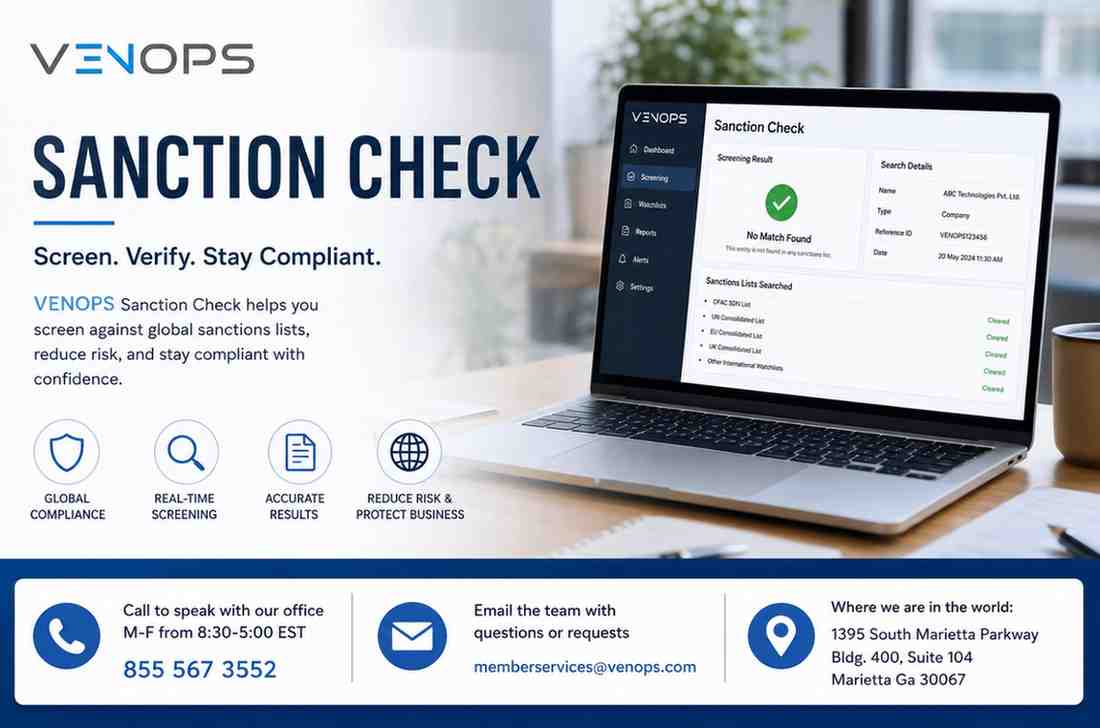
At Venops, we assist organizations with compliance-related concepts through the use of efficient and accurate sanction screening processes that align with regulations.
A sanction check is the process of conducting a background screening of an individual or entity against government-issued sanction/exclusion lists. Conducting sanction checks protects your organization from doing business with individuals or entities restricted from participating due to fraud, criminal conduct, financial fraud, or regulatory issues.
Some common use cases for performing sanction checks include:
Employee Hiring
Vendor Onboarding
Supplier Verification
Customer Screening
Credentialing of Healthcare Service Providers
Ongoing Compliance Monitoring
Maintaining regular sanction checks reduces compliance risk and demonstrates to the public that your organization conducts itself in a responsible and compliant manner.
The OFAC Sanctions List is maintained by the U.S. Department of the Treasury’s Office of Foreign Assets Control (OFAC). It identifies individuals, organizations, vessels, and entities subject to U.S. economic and trade sanctions.
Businesses use OFAC screening to avoid transactions with sanctioned parties and to comply with U.S. sanctions laws. The list is updated regularly, making continuous screening an important part of an effective compliance program.
The U.S. Sanctions List consists of several sanction and exclusion databases from the U.S. Government that organizations use to determine whether a party is restricted.
Depending on which industry an organization is in, some organizations may screen periodically against multiple federal lists for stronger compliance programs and reduced operational risk. The screening of restricted parties is particularly crucial for healthcare providers, financial institutions, pharmaceutical companies, and government contractors.
By taking a risk-based approach using regular monitoring and documented screening processes, organizations can maintain compliance with all relevant regulations.
There are multiple important benefits associated with performing sanctions checks:
Aids in the prevention of regulatory infractions
Promotes compliance within the health care industry
Minimizes the risk of fraud
Maintains the integrity of the organisation
Increases the level of due diligence applied to vendors
Encourages patient safety
Enhances the implementation and maintenance of internal compliance programs
Licences to ensure that an organisation is ready for audits and will be able to defend itself if a regulatory body reviews its compliance program will be better prepared than those organisations that do not conduct regular sanction screenings.
Healthcare providers use OIG checks as an integral component of their compliance programme. Healthcare providers regularly screen their employees and vendors against the OIG exclusion list prior to hiring employees or entering into a contract to provide services, in order to identify individuals and entities that have been excluded from participating in federally funded healthcare programmes, as published in the List of Excluded Individuals and Entities (LEIE), by the Office of Inspector General.
Failure to identify excluded individuals and entities can result in financial penalties and compliance deficiencies for healthcare providers.
An effective sanction screening program should include:
Following these practices helps organizations maintain accurate and consistent compliance processes.
Modern compliance platforms have made sanction screening faster and more reliable.
Automation can help organizations:
At Venops, organizations can streamline sanction screening workflows while supporting regulatory compliance through efficient screening processes.
Many organizations still rely on manual processes to perform sanction checks. While this may work for a small number of records, it becomes difficult as businesses grow.
Some common challenges include:
Using automated compliance solutions can help reduce these challenges and improve accuracy.
Modern compliance programs are increasingly using automation. Instead of manually screening thousands of names, organizations now have access to technology to streamline their screening process.
The benefits of using automation include:
Faster turnaround times for screening results
Improved accuracy
Less manual effort
Easier to generate compliance reports
Constantly monitoring for potential risk
More easily preparing for audits
Lower operational risks
Greater confidence in compliance decisions
By using automation, compliance teams can spend less time on repetitive tasks and more on actually reviewing potential matches.
Compliance is more than just being compliant with regulations; compliance is also about maintaining your organization’s and its employee’s reputation.
Venops provides solutions to make sanction screening easier and to help organizations with compliance across all industries (including healthcare).
By partnering with Venops, organizations receive the following benefits:
More efficient sanction screening processes
Reliable Compliance Support
Easier to understand reporting
Scalable Solutions
Improved Operational Efficiency
Better Risk Management
Having a structured compliance process can lower the risk your organization faces and improve your confidence in compliance, whether your organization performs one-off sanction screenings or manages thousands of records.
Sanction checks play an important role in helping organizations maintain compliance and reduce regulatory risk. Screening against the OFAC Sanctions List, U.S. Sanctions List, and performing OIG checks in healthcare compliance helps organizations identify restricted individuals and entities before establishing business relationships.
A strong compliance program combines regular screening, documented processes, staff training, and reliable technology. As regulations continue to evolve, organizations that invest in efficient sanction screening are better prepared for audits, regulatory reviews, and long-term success.
With Venops, businesses can strengthen their compliance efforts through streamlined screening processes that support accuracy, efficiency, and peace of mind.
Sanction checks are the process of screening people or organizations against government sanctions and exclusion lists to support compliance.
The OFAC Sanctions List is maintained by the U.S. Department of the Treasury and identifies sanctioned individuals, organizations, and entities.
It helps organizations avoid prohibited transactions and comply with U.S. sanctions regulations.
It refers to government-maintained sanctions and restricted-party lists used for compliance screening.
OIG checks involve screening against the List of Excluded Individuals and Entities (LEIE) to ensure healthcare organizations do not employ or contract with excluded individuals.
Healthcare providers, financial institutions, pharmaceutical companies, government contractors, and businesses working with regulated industries should perform sanction screening.
Organizations commonly screen during onboarding and then conduct regular ongoing monitoring based on their compliance policies.
Failure to screen may increase regulatory, financial, and reputational risks.
Yes. Many organizations use automated compliance solutions to improve speed, accuracy, and reporting.
Vendor screening helps organizations reduce third-party compliance risks before entering business relationships.
Healthcare compliance involves following laws, regulations, and industry standards to protect patients and maintain ethical operations.
Venops supports organizations with efficient sanction screening workflows that help strengthen compliance and reduce operational risk.
Yes. Government agencies update sanctions and exclusion lists periodically, so organizations should monitor changes as part of their compliance program.
No. It is also important for financial services, insurance, life sciences, government contractors, nonprofits, and other regulated industries.
Regular screening helps reduce compliance risks, improve audit readiness, protect organizational reputation, and support informed business decisions.

© 2025 Crivva - Hosted by Airy Hosting Managed Website Hosting.