

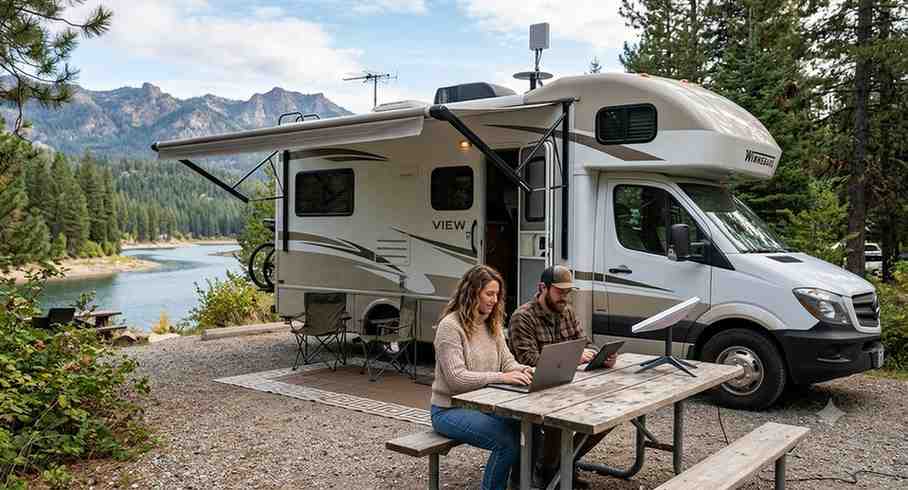
You’re parked at a stunning campsite somewhere between the desert and the mountains, and your hotspot is crawling at 1 bar of LTE while you’re trying to join a work call, stream a movie, or just check the weather for tomorrow’s route. Sound familiar? Staying connected on the road used to be an afterthought, but for full-timers, weekend warriors, and work-campers alike, reliable internet has become as essential as a fresh water hookup. The good news? The RV internet has gotten significantly better. The not-so-great news? There are more options than ever, and picking the wrong one wastes money fast.
A few years ago, tethering your phone or grabbing a prepaid hotspot was “good enough.” That era is quietly fading. Streaming quality has gone up, remote work demands have grown, and the places RVers want to park, national forests, BLM land, and rural state parks, are exactly where mobile data gets weak or disappears entirely.
The core challenge isn’t just speed. It’s consistent across different locations. What works great in a well-covered suburban campground might leave you completely offline on a mountain pullout two states away. That’s why savvy RVers are now building layered setups, multiple solutions that back each other up depending on where they are.
Before comparing specific RV internet options, it helps to understand the three basic delivery methods and what each one is good (and not good) at.
This is the most common starting point. You’re using the same 4G LTE or 5G networks your phone runs on, but through a dedicated hotspot device or router with a data plan. The advantage is that the setup is minimal and it works in many places. The disadvantage is that data caps on most “unlimited” mobile plans still throttle you once you hit a certain threshold, which can make video calls choppy and streaming unwatchable.
Multi-carrier routers are a game-changer here. Rather than being locked to one carrier’s towers, these routers pull a signal from whichever network is strongest at your location. For RVers who move around frequently, this flexibility matters a lot.
Satellite internet for RV users has changed dramatically in recent years. The older geostationary satellites had high latency (think 600ms+), which made real-time video calls, gaming, and VoIP painfully laggy. Low Earth Orbit (LEO) satellite networks have flipped that script.
Modern satellite options can deliver latency in the 20–60ms range, which is genuinely usable for video conferencing and streaming. The trade-offs are cost (equipment and monthly plans aren’t cheap), and performance can dip during peak hours or in inclement weather. But for people regularly camping in remote areas with no cell signal at all, satellite internet for RV travel has gone from a niche workaround to a legitimate primary option.
This is the category that doesn’t get talked about enough. Rather than relying on traditional cellular networks or orbiting satellites, some providers operate networks of fixed wireless towers specifically designed to serve rural and semi-rural areas. Because the infrastructure is purpose-built for breadth of coverage rather than urban density, these networks often reach locations where your Verizon or AT&T signal has already given out.
UbiFi is one of the better-known providers in this space. UbiFi delivers internet through rural 4G LTE towers that are already scattered across agricultural and remote areas of the country, the same towers that serve farming communities, rural towns, and off-grid properties. For RVers traveling through the interior of the country, that coverage map can overlap nicely with common travel routes. UbiFi is best for RVers who frequently pass through or park in areas underserved by the major carriers.
Here’s a thing that trips up a lot of people: the phrase “best unlimited internet for RV living” is everywhere in marketing materials, but “unlimited” is used very loosely. Most plans that advertise unlimited data include:
True unlimited plans with no throttling at any level are rare and usually expensive. When evaluating any plan, look for the fine print on “network management practices” rather than just the headline “unlimited.”
For most RV households consuming 100–300GB a month between work, streaming, and general browsing, you’ll want to know your priority data ceiling and what the real-world speed looks like after that ceiling is hit.
Here’s how the main categories stack up across the criteria that actually matter for life on the road: Cellular / Hotspot Coverage (Remote Areas):
|
Factor |
Cellular / Hotspot |
Satellite (LEO) |
Fixed Wireless (Rural Towers) |
|
Coverage in remote areas |
Variable |
Very broad |
Strong in rural corridors |
|
Latency |
Low (20–50 ms) |
Low–moderate (20–60 ms) |
Low (30–60 ms) |
|
Setup complexity |
Easy |
Moderate (dish required) |
Easy to moderate |
|
Monthly cost |
$50–$150 |
$100–$150+ |
Varies by plan |
|
Equipment cost |
Low |
High |
Low to moderate |
|
Best for |
Suburban / highway travel |
Deep backcountry |
Rural road trips |
No single option wins across every column. That’s exactly why experienced RVers rarely rely on just one.
The most reliable RV internet setups combine two sources: one primary connection and one backup. Common pairings include:
The goal isn’t to find the one perfect plan; it’s to build a setup where you’re rarely without something workable, no matter where you park.
Before spending money, run through these:
The RV internet has come a long way, and the options available today make it genuinely possible to stay connected almost anywhere without sacrificing the freedom that drew you to life on the road in the first place. The key is being realistic about where you travel, how much data you use, and what you’re willing to spend. Start with a solid primary connection, layer in a backup to cover gaps, and don’t be afraid to adjust as you learn your usage patterns. The road changes, and your setup should be able to change with it.
There’s no single best answer, but most full-timers find success by combining a multi-carrier cellular router with either a satellite plan or a fixed wireless option like UbiFi to fill rural coverage gaps. The right mix depends on where you travel most.
Modern LEO satellite options have improved enough to handle video conferencing and VoIP in most conditions. Expect occasional slowdowns during peak usage hours or heavy weather, but day-to-day work use is generally manageable.
Usage varies widely, but household streaming video, video calls, and general browsing typically land between 100GB and 300GB per month. Heavy streamers or households with multiple people can easily exceed 500 GB.
Not always, but often worth it. If you’re relying on cellular data and frequently find yourself in 1–2 bar situations, a signal booster can meaningfully improve speeds and reliability without adding a second monthly bill.
Most home internet plans (cable, fiber, DSL) are tied to a fixed address and won’t work while traveling. Mobile-specific plans, satellite plans with RV-friendly terms, or fixed wireless services designed for mobile use are the appropriate choices for life on the road.

© 2025 Crivva - Hosted by Airy Hosting Managed Website Hosting.