

In 2026, emission compliance is no longer a side issue for asphalt plant owners. It directly affects whether you win projects, pass inspections, and maintain stable production. Governments tighten environmental policies. Infrastructure projects require cleaner production. Communities expect better air quality. As a result, every asphalt plant investor and contractor must clearly understand what emission standards must asphalt plants meet in 2026.
If you plan to invest in a new asphalt production plant or upgrade an existing one, you need more than general information. You need practical guidance. You need to know what regulators inspect. You need to understand how emission limits affect equipment selection. Most importantly, you need to see how compliance supports your long-term profitability.
This article explains the key emission standards, core pollutants, control technologies, and strategic considerations that matter in 2026. We focus on what contractors and plant owners truly care about: operational stability, bidding qualification, and return on investment.
First of all, environmental regulation has become a core qualification factor in public and private projects. Many government tenders now require proof of compliance before awarding contracts. In addition, large developers demand environmental documentation as part of supplier evaluation.
At the same time, enforcement has become stricter. Environmental authorities conduct surprise inspections. They monitor stack emissions in real time. They impose heavy fines or even shut down non-compliant plants.
Therefore, emission standards are no longer theoretical limits written in policy documents. They directly influence your daily operation and your project pipeline.
In many countries across Southeast Asia, the Middle East, Europe, and Africa, authorities place tighter limits on plants operating near residential areas. Urban expansion brings communities closer to industrial zones. Consequently, asphalt plants must reduce visible smoke, odor, and dust.
This trend pushes plant owners to adopt higher-efficiency dust collection systems and cleaner fuel options.
Moreover, financial institutions increasingly link funding to environmental performance. If you seek project financing or long-term credit, banks may require environmental compliance reports. In this context, meeting emission standards becomes a strategic advantage, not just a regulatory obligation.
Now that we understand the regulatory pressure, we must look at the specific pollutants regulators focus on. Asphalt plants generate several types of emissions during drying, heating, and mixing. Each pollutant has defined limits under national or regional standards.
Particulate matter remains the primary concern. Dust forms during aggregate drying and material handling. If you operate without efficient dust control, visible emissions appear at the stack or material transfer points.
In 2026, many jurisdictions require stack dust concentration below 20–30 mg/Nm³ for modern plants. Some regions even demand levels under 10 mg/Nm³ for urban installations. Therefore, high-performance baghouse filters become essential.
NOx forms during high-temperature combustion in the dryer burner. Regulators control NOx because it contributes to smog and ground-level ozone. Emission limits vary by country. However, many regions require advanced burner control systems and optimized combustion to reduce NOx formation.
Low-NOx burners and precise fuel-air ratio management help hot plant owners meet these requirements.
SO2 emissions depend largely on fuel type. Heavy fuel oil generates higher sulfur emissions. As a result, many countries encourage the use of low-sulfur fuel, natural gas, or clean diesel.
If you plan to operate in 2026 and beyond, fuel selection directly affects compliance risk.
VOCs originate from asphalt binder heating and mixing. Although they are less visible than dust, regulators increasingly monitor them. Odor complaints from nearby communities often relate to VOC emissions.
Blue smoke control systems and proper temperature management significantly reduce VOC release.
Although emission principles remain similar worldwide, specific limits differ by region. Therefore, before investing, you must review local environmental regulations carefully.
In the European Union, asphalt plants must comply with the Industrial Emissions Directive (IED). Authorities typically require advanced filtration systems, continuous emission monitoring, and strict reporting procedures.
Consequently, European projects often demand highly automated batch plants with integrated environmental control systems.
In Gulf countries, governments increasingly align with international environmental benchmarks. Large infrastructure projects require modern dust collection and low-emission burners. Moreover, projects funded by public authorities often include environmental audit clauses.
In countries such as Indonesia, Malaysia, and the Philippines, authorities tighten emission monitoring year by year. While limits may vary between provinces, urban projects apply stricter controls. Therefore, contractors working in metropolitan areas must prepare for higher standards than those in remote regions.
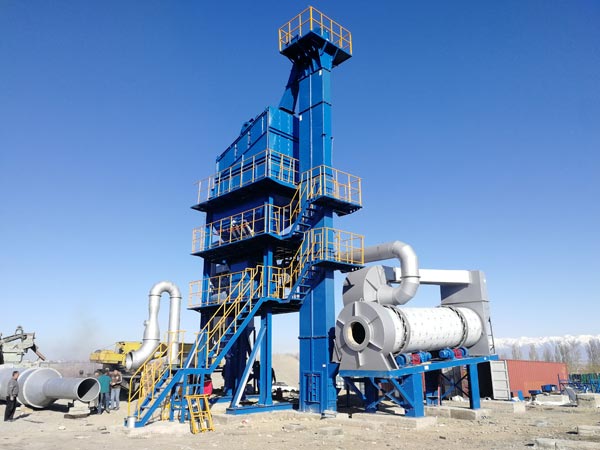
Understanding emission limits is only the first step. Next, you must evaluate whether your equipment configuration supports compliance. Modern asphalt plants integrate several key technologies to reduce emissions effectively.
A high-quality baghouse system captures fine particles from exhaust gases. Modern systems use heat-resistant filter bags and pulse-jet cleaning. They maintain stable filtration efficiency even under high production loads.
Importantly, regular maintenance ensures consistent performance. Even the best baghouse cannot function properly if operators neglect inspection and cleaning schedules.
Advanced burners optimize the fuel-air ratio. They reduce flame temperature peaks. As a result, NOx formation decreases. Intelligent control systems adjust parameters in real time according to aggregate moisture and production rate.
This combination improves both emission performance and fuel efficiency.
Modern asphalt plants install blue smoke capture devices near the mixer and storage silo. These systems collect fumes and redirect them to the burner for re-combustion. Consequently, the hot plant asphalt can reduce odor and visible emissions significantly.
Open transfer points generate fugitive dust. Therefore, fully enclosed conveyors and sealed loading systems play a crucial role in meeting stricter urban requirements. Simple structural upgrades can dramatically improve environmental performance.
Emission compliance does more than prevent penalties. It strengthens your market position.
First, you qualify for more government projects. Many tenders require environmental documentation at the prequalification stage. Without compliant equipment, you cannot even submit a bid.
Second, you reduce operational risk. Sudden shutdowns due to inspection failures cause severe financial losses. By investing in compliant systems from the beginning, you protect project timelines.
Third, you enhance your brand image. Clients prefer contractors who operate responsibly. In competitive markets, environmental performance becomes a selling point.
At this point, many investors ask an important question: should we upgrade an old plant or purchase a new low-emission model?
The answer depends on your current configuration, production capacity, and target market.
If your plant structure remains in good condition, you can upgrade the burner, replace filter bags, and install additional emission monitoring devices. This option reduces capital expenditure in the short term.
However, if your equipment lacks structural sealing, automation, and efficient dust collection design, retrofitting may not solve all issues. In that case, a modern batch-type asphalt plant designed with environmental compliance in mind offers better long-term stability.
Although the initial investment is higher, fuel savings, lower maintenance, and stable compliance often justify the cost.
Before finalizing your investment, ask your supplier several practical questions:
• What is the guaranteed dust emission level at the stack?
• Does the burner support low-NOx operation?
• Can the system integrate real-time emission monitoring?
• How does the plant manage blue smoke from the mixer and silo?
• Has the model passed environmental inspections in similar markets?
Clear answers help you avoid future compliance surprises.
In 2026, emission standards for asphalt plants continue to tighten worldwide. Regulators focus on particulate matter, NOx, SO2, and VOCs. At the same time, project owners demand cleaner production.
However, instead of viewing compliance as a burden, smart contractors treat it as an opportunity. By investing in modern dust collection, advanced burners, and intelligent control systems, you not only meet regulations but also improve fuel efficiency and operational stability.
If you plan to expand your asphalt production capacity this year, evaluate your emission strategy carefully. Choose equipment that supports your long-term goals. Work with experienced suppliers who understand regional standards and real project conditions.
The right decision today will protect your projects tomorrow. More importantly, it will position your business as a reliable, responsible partner in the evolving construction industry.

© 2025 Crivva - Hosted by Airy Hosting Managed Website Hosting.