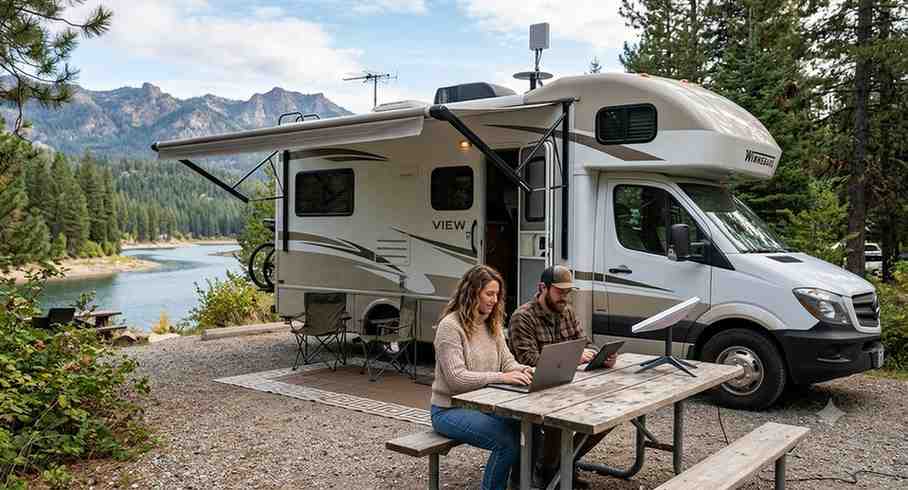


You’re parked at a stunning campsite somewhere in the Southwest, no hookups, no neighbors, no Wi-Fi sign on a wooden post, and your satellite internet dish is throwing latency numbers high enough to make a video call feel like a slideshow. You’ve been told satellite is the “only real option” for off-grid RV life, but that’s simply not true anymore, and if you’ve been paying a hefty monthly bill while dealing with weather interference and upload speeds that crawl, this guide is going to change how you think about staying connected on the road.
Traditional geostationary satellite internet, the kind that bounces your signal 22,000 miles up to a fixed satellite and back, hasn’t changed much in a decade. High latency (300–600ms round trips), strict data caps, and painful performance during rain or heavy cloud cover made it a grudging choice rather than a happy one.
Even low-earth-orbit satellite internet for RV, which is genuinely impressive compared to legacy satellite internet, comes with its own trade-offs for RV users: the dish is bulky, the upfront equipment cost is steep, and the “best effort” priority in mobile or roaming mode means your speeds can drop significantly in congested areas. It’s a great tool, but it’s not always the best tool.
Worth Knowing: The average full-time RVer rarely needs satellite-grade coverage every day. Most travel corridors and campgrounds are well within reach of cellular networks, and modern cellular internet is faster, cheaper, and far more practical for daily use.
The honest answer is: it depends on where you go. But for the majority of RV travelers who stick to established campgrounds, national parks with cell service, and highway-accessible boondocking spots, cellular LTE/5G internet consistently outperforms satellite in the ways that matter most: speed, latency, cost, and convenience.
Here’s a side-by-side look at how these options actually compare in real-world RV use:
|
Feature |
Cellular (LTE/5G) |
LEO Satellite (RV Mode) |
Legacy Satellite |
|
Latency |
20–60 ms |
30–80 ms |
300–700 ms |
|
Avg Download Speed |
25–300 Mbps |
25–220 Mbps |
5–25 Mbps |
|
Weather Impact |
Minimal |
Moderate |
High |
|
Setup |
Plug & go |
Dish alignment needed |
Dish alignment needed |
|
Monthly Cost (est.) |
$50–$150 |
$150–$165 |
$70–$180 |
|
Best For |
Most traveled routes |
Remote/off-grid stays |
Very remote, fixed |
A dedicated mobile hotspot router paired with data plans from two or more major carriers is the bread-and-butter setup for most full-time RVers. The key is to run multiple SIM cards simultaneously so you always fall back to the carrier with the strongest signal at your location. Setup takes minutes, there’s no dish to wrestle with, and you can find the best unlimited internet plans for RVs that offer deprioritized data thresholds well above what most travelers actually use in a month.
LEO satellite on a mobile or roaming plan is genuinely the right call when you’re spending weeks in places where cell signals go to die, deep desert, remote mountain sites, rural Alaska. You’re paying for coverage in those gaps, not for everyday performance. Many full-timers pair it with cellular as a hybrid: cellular handles 80% of daily use, and satellite covers the gaps.
A quality cellular signal booster or directional antenna can turn a weak two-bar signal into a fully usable connection in fringe coverage areas. This isn’t a standalone internet solution, but as a layer on top of your cellular plan, it dramatically extends the range where cellular becomes viable, and it costs a fraction of satellite.
None of this is to say satellite internet is useless. There are specific scenarios where it genuinely earns its keep:
The smartest full-timers don’t pick one solution; they stack two or three that cover different scenarios. Here’s a framework that works:
Start with a cellular router and two SIM cards on different major carriers. Most of the big national networks offer prepaid hotspot or data-only SIM plans that work well in a dedicated router. The router automatically routes traffic through whichever connection is stronger. This handles 70–85% of typical RV travel without you having to think about it.
A high-quality external antenna mounted on the roof delivers a stronger signal to your router in fringe areas. There are several well-regarded options designed specifically for RV use. This significantly extends your cellular coverage window and requires a one-time investment of $150–$400.
If your travel routes frequently take you into genuinely remote territory, add a LEO satellite mobile plan on a pause-when-not-needed basis. Most LEO providers now let you pause your service in months you don’t need it, which makes it much easier to justify financially as a supplement rather than a primary solution.
Satellite internet earned its reputation in an era when cellular coverage was spotty and low-powered. That era is over for most of the country. A well-configured cellular setup, ideally with a signal booster and a backup plan for deep remote stays, will give you faster speeds, lower latency, easier setup, and a lower monthly bill on most RV routes across North America.
Satellite still has a role, but it’s increasingly a niche tool for a niche situation, not the default recommendation it once was. Know where you’re going, match your gear to those conditions, and you’ll spend far less time troubleshooting and far more time actually enjoying wherever you parked.
For full-time RVers who regularly visit remote locations with little or no cell coverage, a LEO satellite mobile plan is worth it, especially if you use the pause feature during months you’re in well-covered areas. If you mostly travel established highway corridors and campgrounds, a solid cellular setup will give you better everyday performance for less money.
It depends on how rural. For light fringe coverage (1–2 bars of LTE), a signal booster combined with a multi-carrier cellular router is usually enough. For true dead zones with no cellular at all, LEO satellite internet is currently the most practical option for RVers. Legacy geostationary satellites are rarely recommended anymore due to their latency and data limitations.
Technically, most home internet plans are designed for a fixed address and may have terms that restrict mobile use. A smarter approach for RVers is to use a data-only or hotspot SIM plan from a major carrier and slot it into a dedicated mobile router. It’s more flexible, more portable, and doesn’t tie you to a single service location.
A smartphone hotspot works in a pinch but drains your phone battery, generates heat, and is limited by your phone plan’s hotspot data cap. A dedicated cellular router is built for sustained use; it accepts multiple SIM cards, connects to external antennas, supports more simultaneous devices, and doesn’t throttle your phone’s performance.
Usage varies widely, but a solo remote worker typically consumes 100–300 GB per month. A family with streaming, video calls, and gaming can push 400–600 GB or more. Most cellular plans marketed for RV use handle 100–200 GB at full speed before deprioritization kicks in, so it’s worth checking the actual throttle thresholds before committing to a plan.

© 2025 Crivva - Hosted by Airy Hosting Managed Website Hosting.