

In modern software development, DevOps and continuous testing practices have reshaped how quality assurance is approached. The traditional boundaries between development, testing, and operations are increasingly blurred, requiring QA teams to adopt more integrated and automated testing strategies. Within this context, understanding the distinction between verification vs validation is critical to ensure software quality throughout the delivery pipeline.
Verification and validation are complementary activities in the software testing process:
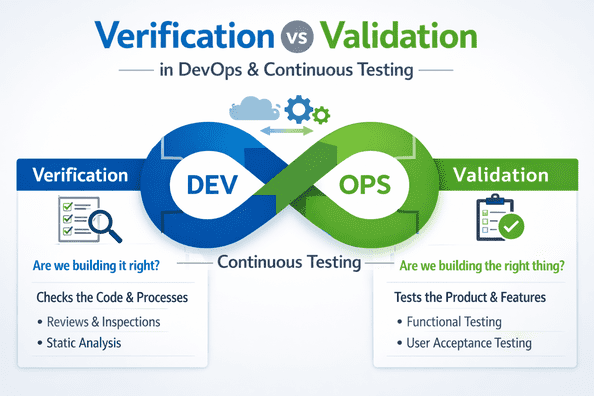
Verification answers the question: “Are we building the product right?” It ensures that the software conforms to specified requirements and design documents. Verification activities include reviews, walkthroughs, inspections, static analysis, and unit tests. It focuses on process adherence and correctness of deliverables before execution.
Validation answers the question: “Are we building the right product?” It ensures that the software meets end-user needs and intended business objectives. Validation involves executing the software under real-world conditions through functional, system, integration, acceptance, and user testing. Its focus is on evaluating whether the software delivers the expected value to users.
While verification is primarily preventive, focusing on ensuring correctness early in the development process, validation is more corrective, identifying gaps between expectations and actual outcomes.
DevOps emphasizes automation, continuous integration, and rapid delivery of features. In this fast-paced environment, both verification and validation play crucial roles in maintaining quality without slowing down development.
Verification activities ensure that code changes align with standards, guidelines, and design specifications before deployment. This includes:
Code Reviews and Pair Programming: Ensuring coding standards and best practices are followed.
Static Analysis and Linting Tools: Detecting code smells, vulnerabilities, and potential defects automatically.
Unit Tests: Validating individual components function correctly before integration.
By catching defects early, verification reduces the likelihood of failures downstream, making deployments more reliable.
Validation ensures that the software meets functional requirements and user expectations. Common validation practices in DevOps include:
Automated Functional and End-to-End Tests: Ensuring features behave as expected across the system.
Performance and Load Testing: Confirming the application performs well under expected workloads.
User Acceptance Testing (UAT): Validating the software satisfies business requirements and user needs.
Security Testing: Ensuring applications are secure and compliant with regulations.
Together, verification vs validation help teams identify both technical and functional issues before they impact users, forming a dual layer of quality assurance.
Continuous testing integrates automated testing at every stage of the development lifecycle. It ensures that defects are identified as soon as they occur, supporting faster releases without sacrificing quality.
Verification in Continuous Testing: Automated checks such as static code analysis, code quality assessments, and unit tests run on every commit. This guarantees that code meets standards before integration.
Validation in Continuous Testing: Automated functional, regression, and performance tests validate that the system behaves correctly in a production-like environment. Continuous feedback ensures issues are addressed immediately.
This dual approach ensures that both process compliance and functional correctness are maintained throughout development.
Consider a financial application being developed using DevOps practices:
Verification Step:
A developer commits a new feature to the repository.
Automated unit tests validate core logic.
Static analysis tools check for security vulnerabilities and coding standard violations.
Code reviews confirm adherence to architecture guidelines.
Validation Step:
The CI/CD pipeline automatically triggers regression and functional tests.
End-to-end workflows simulate user transactions, ensuring the application performs as expected.
Performance tests measure transaction throughput under peak load conditions.
Security validation ensures sensitive data handling complies with regulations.
By integrating verification and validation, the team can confidently deploy the new feature to production, reducing risk and improving release reliability.
Several tools help QA teams implement verification and validation effectively:
Verification Tools: SonarQube, ESLint, Checkmarx, StyleCop, JUnit, NUnit
Validation Tools: Selenium, Cypress, Postman (API testing), LoadRunner, JMeter, Keploy (for automated API behavior testing)
These tools can be embedded into CI/CD pipelines, providing automated feedback and helping QA teams scale testing across multiple environments and releases. Using these tools strategically ensures that teams catch defects early while validating that features meet user expectations.
Implementing verification and validation within DevOps pipelines provides multiple benefits:
Early Defect Detection: Verification prevents code-level issues; validation identifies functional gaps.
Improved Release Confidence: Continuous verification and validation reduce the risk of production failures.
Faster Time-to-Market: Automation and continuous testing reduce manual effort and speed up release cycles.
Reduced Cost of Defects: Early detection and correction of issues reduce rework and associated costs.
Enhanced Collaboration: Shared visibility into verification and validation results improves communication between QA, developers, and operations.
Better User Satisfaction: By ensuring software meets both technical and functional expectations, end users experience fewer defects and higher reliability.
Automate Testing Wherever Possible: Include both verification and validation tests in CI/CD pipelines.
Maintain Traceability: Link requirements to both verification and validation tests to ensure comprehensive coverage.
Focus on High-Risk Areas: Prioritize critical modules to maximize impact.
Use Analytics and Metrics: Track coverage, defect trends, and test effectiveness.
Foster Team Collaboration: Encourage developers, QA, and operations to actively participate in verification and validation activities.
Continuously Update Test Suites: As requirements evolve, regularly review and update verification and validation tests to reflect system changes.
As software development evolves, verification and validation practices continue to adapt to new technologies and delivery models. AI-powered test automation tools are increasingly being used to predict potential defect areas, prioritize test cases, and even generate automated tests based on system behavior. Tools like Keploy, for instance, capture real API traffic and generate validation tests automatically, helping QA teams scale efficiently while maintaining accuracy.
Additionally, cloud-based testing environments allow teams to run verification and validation tests in parallel across multiple configurations, improving coverage without delaying releases. Continuous monitoring and feedback loops from production also contribute to validation by providing real-world insights into system behavior, helping teams identify gaps that were not caught during pre-production testing.
By embracing these trends, organizations can further enhance their verification and validation practices, ensuring faster, more reliable software releases while keeping up with the demands of DevOps and continuous delivery.
Verification vs validation are both essential components of modern QA in DevOps and continuous testing environments. Verification ensures the product is built correctly according to design and coding standards, while validation confirms it meets user requirements and business objectives. By integrating both into continuous testing pipelines, organizations can detect defects early, maintain high-quality releases, and deliver software faster and more reliably. In today’s fast-paced development landscape, understanding and applying verification and validation effectively is crucial for building scalable and resilient QA processes.

© 2025 Crivva - Hosted by Airy Hosting Managed Website Hosting.