

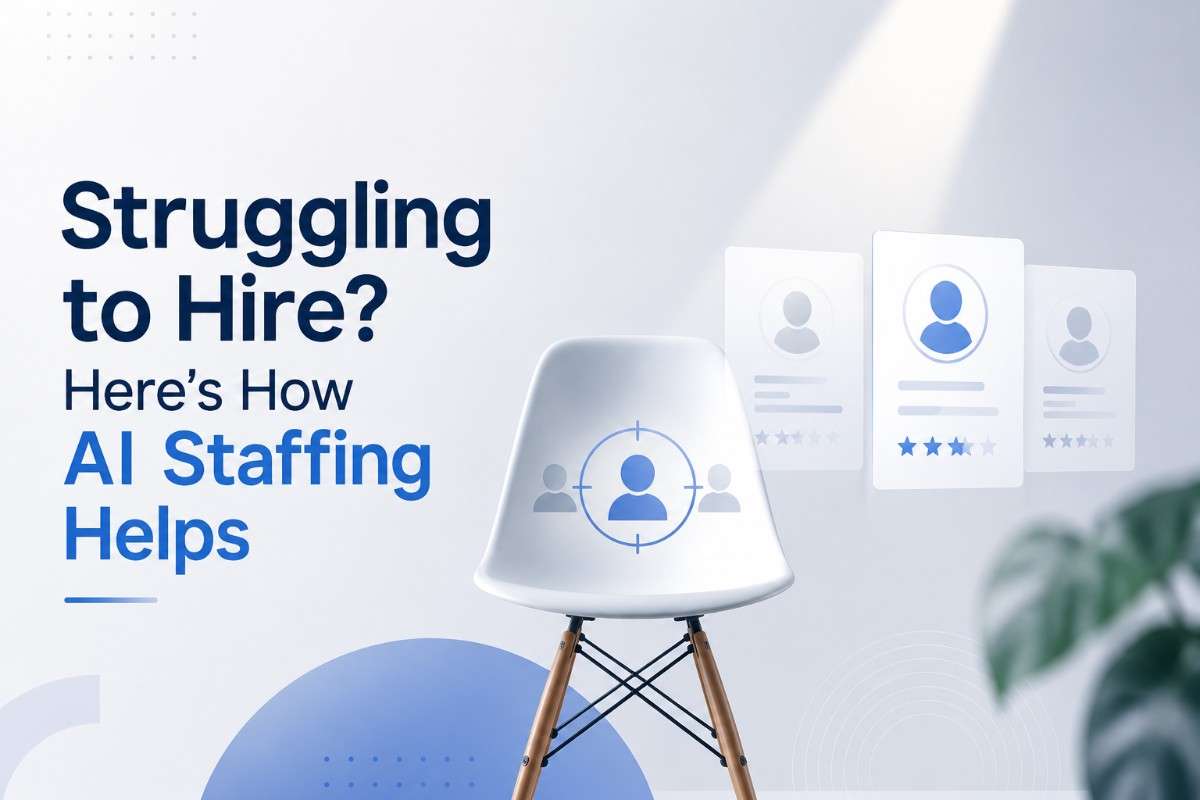
Hiring has become one of the biggest challenges for modern businesses.
Companies are receiving thousands of applications, struggling to find qualified candidates, and spending weeks trying to fill positions that remain open for months. At the same time, recruitment teams are under pressure to hire faster while maintaining quality.
This is one reason why businesses across industries are now exploring AI staffing solutions to improve recruitment efficiency and simplify the hiring process.
But despite the growing popularity of AI in recruitment, many businesses still do not fully understand how it actually helps in real world hiring.
Some assume AI will completely replace recruiters. Others believe it is only useful for large corporations with massive hiring budgets.
The reality is far more practical.
AI staffing refers to the use of intelligent technology and automation tools to support recruitment and workforce management.
Instead of manually handling every stage of hiring, businesses now use AI driven systems to help with:
The goal is not to remove human recruiters from the process. Instead, AI staffing helps recruitment teams save time, reduce repetitive tasks, and focus more on candidate quality and decision making.
Hiring today is very different from what it was a few years ago.
Recruiters now face challenges such as:
Manual recruitment processes often slow everything down. HR teams may spend hours reviewing resumes that are not even relevant to the role.
This is where AI staffing becomes valuable.
Instead of manually filtering every application, businesses can use intelligent systems to identify candidates based on:
This significantly reduces screening time and improves hiring efficiency.
One of the biggest benefits of AI staffing is speed.
Many companies lose strong candidates simply because the hiring process takes too long. Delayed communication, slow screening, and scheduling gaps often frustrate applicants.
AI powered recruitment systems can automate many repetitive processes, helping businesses move candidates through hiring stages much faster.
For example:
This allows hiring teams to spend more time interacting with qualified candidates instead of managing repetitive administrative tasks.
Many growing companies struggle during periods of rapid expansion.
A business hiring for 50 positions may receive thousands of applications within days. Reviewing each application manually becomes difficult, especially for small HR teams.
This is where AI staffing is becoming increasingly useful for businesses trying to scale efficiently.
Instead of expanding recruitment teams aggressively, companies can improve hiring workflows using automation and intelligent screening systems.
Several businesses are now combining traditional recruitment expertise with modern workforce technology to improve both speed and candidate quality. This approach is becoming common among firms like Rubixe.
One important misconception about AI recruitment is that technology alone can hire the right employees.
That is not true.
Hiring still depends heavily on:
Technology can help identify suitable candidates faster, but final hiring decisions still require human judgment.
That is why successful AI staffing strategies usually combine automation with recruiter experience instead of replacing recruitment teams entirely.
Different industries are using AI staffing in different ways depending on hiring needs.
Many companies are also exploring intelligent hiring solutions that combine automation, workforce analytics, and scalable recruitment support for growing teams
Some common applications include:
Technology companies, customer support firms, healthcare organizations, and enterprise businesses are increasingly adopting intelligent hiring systems to improve operational efficiency.
Many modern workforce technology companies are now focusing on scalable recruitment systems that improve operational efficiency without removing human decision making from the hiring process.
|
Hiring Process |
Traditional Recruitment | AI Assisted Recruitment |
|
Resume Screening |
Manual review |
Automated candidate matching |
|
Hiring Speed |
Slower processing |
Faster shortlisting |
|
Application Handling |
Limited manual capacity |
Large scale screening support |
|
Scheduling |
Manual coordination |
Automated interview scheduling |
| Recruitment Analytics | Basic tracking |
Data driven insights |
Modern hiring is not only about filling positions quickly.
Candidates now expect:
Poor recruitment experiences can damage employer reputation and increase candidate drop off rates.
AI staffing tools can improve communication workflows and ensure applicants receive quicker updates throughout the hiring process.
This creates a better experience for both recruiters and candidates.
The conversation around recruitment technology is changing. Businesses are increasingly looking for enterprise technology services that improve hiring efficiency while supporting long term workforce planning
Businesses no longer want hiring systems that only automate tasks. Companies like Rubixe are also focusing on scalable hiring workflows. They want solutions that help improve:
That is why AI staffing is becoming more focused on practical business outcomes rather than simply reducing manual work.
Companies are becoming more interested in intelligent hiring support systems that improve long term recruitment efficiency instead of relying only on short term automation trends.
This shift is influencing how workforce technology providers, including Rubixe, approach recruitment and staffing solutions today.
Even though AI staffing offers major advantages, businesses still face some concerns around implementation.
Common concerns include:
This is why responsible implementation matters. Firms such as Rubixe are seeing growing demand for practical hiring systems.
Businesses need recruitment systems that support decision making without removing the human side of hiring completely.
Hiring is becoming more competitive, more complex, and more time consuming for businesses across industries.
That is why more companies are exploring how AI staffing can help simplify recruitment, improve efficiency, and reduce operational pressure on HR teams.
From automated screening to smarter workforce planning, AI staffing is helping businesses manage hiring challenges more effectively while allowing recruiters to focus on what matters most finding the right people.
As recruitment continues evolving, businesses that combine technology with strong human decision making will likely build stronger and more scalable hiring systems for the future.

© 2025 Crivva - Hosted by Airy Hosting Managed Website Hosting.