


Road construction in Mongolia is never simple. Contractors face long distances, extreme weather, and limited infrastructure. At the same time, mining zones, rural highways, and border roads continue to expand, which creates strong demand for flexible asphalt production solutions. In this context, many project owners ask a key question: Is a mobile asphalt plant for sale suitable for remote road construction in Mongolia?
The short answer is yes, but the real value comes from understanding why it works, how it works, and what conditions it can handle. In this article, we will break down real project challenges, technical advantages, and practical selection tips so you can make a more informed decision for your next project.
Before we evaluate the equipment, we must first understand the working environment. Mongolia is known for its vast land area and low population density. This creates unique construction difficulties that directly affect asphalt production and paving efficiency.
Mongolia experiences harsh winters and large temperature differences between day and night. In many regions, temperatures can drop below -30°C. These conditions make asphalt production and transportation more complex because mix temperature control becomes critical for quality.
Many road projects are located far from urban centers. Transporting asphalt from fixed plants can take hours. As a result, heat loss and material segregation become serious risks, which increases project cost and reduces road quality.
Remote construction sites often lack stable power supply, fuel access, and maintenance support. Therefore, equipment must be self-sufficient and easy to operate with minimal technical resources.
As we can see, these challenges create strong pressure on traditional asphalt supply methods. This naturally leads us to consider more flexible solutions such as mobile asphalt plants.
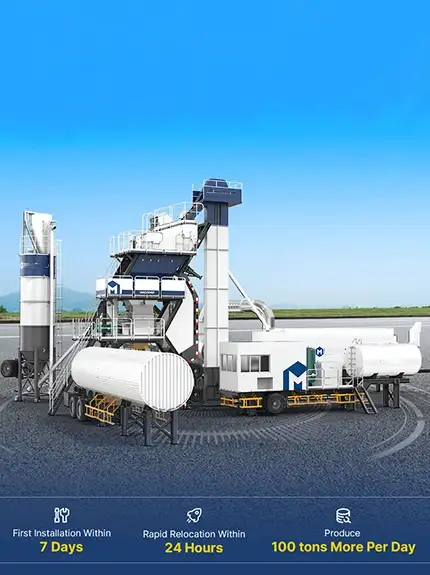
A mobile asphalt plant is a compact and transportable asphalt mixing system designed for fast relocation and quick installation. Unlike stationary plants, it can be moved from one project site to another with reduced downtime.
A typical mobile asphalt plant includes cold aggregate bins, drying drum, burner system, mixing tower, and control system. All components are designed on modular skids or trailers. This allows fast assembly and disassembly at the job site.
The workflow is simple. Aggregates are heated and dried in the drum. Then they are mixed with bitumen in the mixing unit. Finally, hot asphalt is stored or directly loaded into trucks for paving.
The biggest advantage is relocation speed. Contractors can move the plant closer to the construction zone. This reduces transport distance and keeps asphalt temperature stable. As a result, paving quality improves while operational cost decreases.
Now that we understand the structure and function, we can connect it to Mongolia’s real project conditions.
Mobile asphalt plants are not just convenient. In Mongolia, they directly solve multiple field problems. This is why many contractors are shifting toward mobile solutions for remote infrastructure projects.
When asphalt is produced near the construction site, trucks travel shorter distances. This reduces heat loss and improves compaction quality. It also lowers fuel consumption and transport costs.
Portable asphalt plants for sale can often be installed within a short time compared to stationary plants. This is very important for Mongolia, where construction windows are limited by seasonal weather conditions.
Many road projects in Mongolia operate in short seasonal cycles. A mobile asphalt plant allows contractors to complete one section, dismantle the plant, and move to the next site quickly. This flexibility increases equipment utilization rate.
Because mobile plants are designed for field operation, they require less permanent infrastructure. This makes them suitable for mining roads, rural highways, and temporary government projects.
These advantages clearly show why mobile asphalt plants match the needs of remote Mongolian construction. However, performance still depends on proper technical selection.
Not all mobile asphalt plants perform the same. In Mongolia, environmental and logistical conditions require careful configuration choices. Contractors should focus on key technical parameters before investing.
Most remote projects in Mongolia range from small to medium scale. A capacity between 40 TPH and 120 TPH is often suitable. Choosing the right capacity helps balance fuel consumption and production efficiency.
Insulation systems, burner efficiency, and heating stability are critical. A well-designed plant should maintain consistent asphalt temperature even in low ambient conditions.
Fuel supply can be limited in remote areas. Therefore, efficient burners and optimized drying systems are important. Lower fuel consumption directly reduces operational cost per ton of asphalt.
Even in remote regions, environmental standards are becoming stricter. A reliable dust collection system helps ensure compliance and improves working conditions for operators.
With these technical requirements in mind, contractors can better evaluate both performance and long-term project value.
Investment decisions in construction equipment always come down to cost efficiency and return on investment. Mobile asphalt plants offer several financial advantages in Mongolia’s construction environment.
By moving the plant closer to the project, contractors significantly reduce trucking distance. This leads to immediate savings in fuel, labor, and vehicle maintenance.
Fast installation reduces idle time. Contractors can start production sooner and complete projects within tighter deadlines. This improves cash flow and project turnover.
Since mobile plants can be reused across multiple projects, they reduce the need for multiple stationary installations. This increases long-term ROI and equipment efficiency.
Therefore, while the initial investment may be similar to fixed plants, the overall lifecycle cost is often lower in remote project environments.
To better understand real usage, let’s look at common project types where mobile asphalt plants are widely applied in Mongolia.
Mongolia’s mining industry requires continuous road development. Mobile asphalt plants allow quick deployment near mining zones, ensuring stable road quality for heavy transport vehicles.
Government infrastructure projects often involve long-distance rural roads. Mobile plants help reduce logistics pressure and improve paving consistency across remote regions.
Border roads require fast construction and flexible relocation. Mobile asphalt plants provide the mobility needed to support multi-section projects efficiently.
These real-world applications clearly show the practical value of mobile systems in Mongolia’s construction landscape.
Choosing the right asphalt concrete plant is not only about price. It is about matching project conditions with machine capability.
Do not oversize or undersize your plant. Analyze daily production needs, truck capacity, and project timeline before selection.
Ensure the plant can operate in low temperatures and remote environments without frequent breakdowns.
Remote projects need reliable technical support. Fast spare part supply and remote troubleshooting are essential for continuous operation.
With the right selection strategy, contractors can avoid unnecessary downtime and maximize project efficiency.
Many project delays come from poor planning rather than equipment failure. Here are common mistakes that should be avoided:
First, some contractors underestimate transport logistics. Second, others choose capacity based only on price instead of project demand. Third, many ignore climate adaptation features, which leads to performance issues in winter conditions.
Avoiding these mistakes will significantly improve project success rates and reduce unexpected costs.
In summary, a mobile asphalt plant is not just suitable for remote road construction in Mongolia—it is often the most practical solution. It reduces transport distance, improves flexibility, and adapts well to harsh environmental conditions.
For contractors working in mining, rural infrastructure, or government road projects, mobile asphalt plants offer a strong balance between efficiency, cost control, and operational flexibility.
If you are planning a road construction project in Mongolia and want to improve efficiency while reducing logistics pressure, a well-configured mobile asphalt plant can be a strategic investment.
Contact us today to discuss your project requirements. Our team can help you select the right mobile asphalt plant configuration based on your capacity needs, climate conditions, and project timeline. Let’s build a more efficient and reliable road construction system together.

© 2025 Crivva - Hosted by Airy Hosting Managed Website Hosting.