

Across Ethiopia, road development continues to play a key role in economic growth. Provincial governments are improving regional highways, upgrading rural access roads, and strengthening transport links between agricultural areas and cities. As these projects expand, contractors must choose equipment that balances production capacity, investment cost, and operational flexibility.
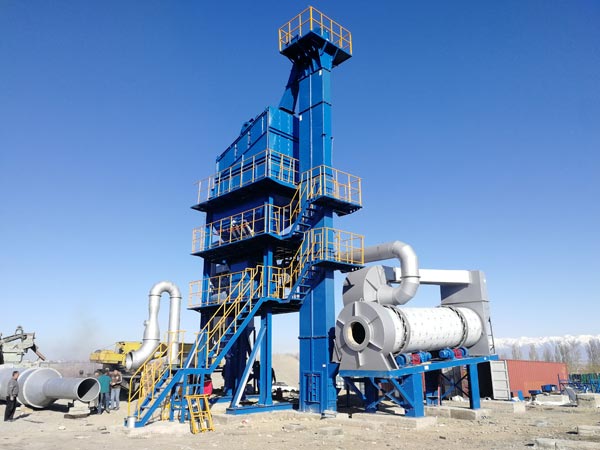
Among the available options, a 100 TPH asphalt mixing plant often appears as a practical solution. It sits between small mobile units and large highway-scale plants. However, many contractors still ask an important question: Is a 100 TPH aggregate asphalt plant suitable for provincial road projects in Ethiopia?
To answer this question, it helps to look at the realities of Ethiopian road construction. Project scale, climate conditions, logistics, and budget constraints all influence equipment decisions. In the following sections, we will examine whether a 100 TPH asphalt plant can meet these demands and how contractors can benefit from this capacity.
Before selecting any asphalt plant, contractors must understand the production demand of the project. Provincial road construction in Ethiopia often differs from large national highway projects. Instead of extremely high daily output, these projects require steady production over several months.
Most provincial road upgrades fall into the following categories:
Many regional highways require resurfacing or strengthening. These projects often involve 30 km to 80 km of road sections. The asphalt layer usually ranges between 5 cm and 10 cm in thickness.
Under these conditions, daily asphalt demand typically ranges from 600 to 1,200 tons. This level of demand fits well with a mid-sized asphalt plant.
Some regions build new two-lane asphalt roads to connect rural towns with major trade corridors. These projects may extend from 20 km to 60 km. Contractors must produce consistent asphalt mix for base and surface layers.
Here again, a medium-capacity plant often meets the production target without creating unnecessary investment pressure.
Local governments also upgrade urban access roads. These projects require smaller asphalt volumes but demand reliable supply and quality control.
Because of this mixed demand, contractors need equipment that adapts to different project sizes. This is where the 100 TPH hmp plant becomes an attractive option.
Now that we understand project demand, we can evaluate whether a 100 TPH asphalt plant delivers sufficient production. In practical construction scenarios, plant output rarely runs at the theoretical maximum all day. However, even with normal operating conditions, this capacity provides strong performance.
If the plant operates for 8 to 10 hours per day, it can produce approximately:
700 to 1,000 tons of asphalt mix per day.
This output level aligns well with the daily needs of most provincial road projects in Ethiopia. Contractors can maintain continuous paving without waiting for material supply.
A 100 TPH asphalt plant allows operators to adjust production according to site conditions. For example:
Because of this flexibility, contractors avoid over-investing in oversized plants while still meeting construction deadlines.
Beyond capacity alone, several operational factors also influence plant suitability. Therefore, the next step is to examine why a 100 TPH plant works well in Ethiopia’s construction environment.
Contractors often choose equipment based not only on production capacity but also on project realities. In Ethiopia, logistics, terrain, and budget all affect plant selection. Fortunately, a 100 TPH asphalt mixing plant matches many of these conditions.
Large asphalt plants, such as 200 TPH or 300 TPH units, require significant capital investment. These plants also demand high production volume to remain profitable.
However, provincial road projects rarely require extremely high output every day. If contractors install an oversized plant, they may struggle to recover the investment.
A 100 TPH asphalt plant offers a balanced approach. The initial cost remains manageable, and the plant still produces enough material for medium-scale projects.
Many Ethiopian road projects occur in mountainous regions or remote provinces. Transporting large industrial equipment into these areas can create logistical challenges.
Compared with larger plants, a 100 TPH asphalt mixing plant usually requires:
As a result, contractors can begin production sooner and reduce pre-construction delays.
Another advantage lies in equipment mobility. After completing one provincial road project, contractors often move their plant to another location.
Because a 100 TPH plant maintains moderate size and weight, relocation becomes easier. This flexibility helps contractors serve several government contracts over time.
However, production capacity alone does not guarantee project success. Quality asphalt mix also depends on plant technology and control systems.
To deliver durable roads, contractors must produce consistent asphalt mixtures. Modern asphalt mixing plants provide several features that help ensure this quality.
Precise weighing systems allow operators to control the ratio of aggregates, filler, and bitumen. This accuracy ensures that each batch meets the required mix design.
Consistent mix quality directly improves pavement durability. As a result, roads resist cracking, rutting, and early damage.
The drying drum plays a key role in asphalt production. It removes moisture from aggregates and heats them to the proper temperature.
In Ethiopia, aggregates often contain variable moisture levels depending on the rainy season. Therefore, an efficient burner and drying system help maintain stable production conditions.
Environmental requirements continue to increase across many African infrastructure projects. Modern asphalt plants often include baghouse dust collectors that capture fine particles during production.
This system improves environmental performance while also recycling mineral powder back into the mixing process.
While technical features ensure quality, project success also depends on operational efficiency and cost management.
From a contractor’s perspective, equipment must deliver long-term value. A 100 TPH asphalt mixing plant provides several operational advantages that support profitable road construction.
Large plants often consume significant amounts of fuel because they operate at higher thermal capacity. If production demand remains moderate, fuel efficiency may drop.
A 100 TPH plant typically achieves better fuel efficiency for medium-scale production levels. Contractors therefore control operational costs more effectively.
Modern control systems allow operators to manage production through centralized automation. As a result, fewer workers are needed for daily plant operation.
Lower labor requirements help contractors manage project budgets, especially in remote construction zones.
In some cases, contractors also sell asphalt mix to nearby projects. For example, municipal road repair or private developments may require additional asphalt supply.
A 100 TPH asphalt plant can support both internal construction needs and limited commercial production. This dual function improves equipment utilization.
After reviewing production, technology, and operational advantages, we can now evaluate the overall suitability of this plant size.
Provincial road construction in Ethiopia requires reliable asphalt supply, but it rarely demands extremely large production capacity. Contractors must therefore choose equipment that matches project scale while controlling investment risk.
A 100 TPH asphalt mixing plant offers a strong balance between productivity, cost efficiency, and operational flexibility. It produces enough asphalt for most provincial highway projects. At the same time, it remains easier to transport, install, and relocate compared with larger plants.
For contractors working on regional road rehabilitation, new provincial highways, or municipal infrastructure upgrades, this capacity often provides the ideal solution.
If you are planning road construction projects in Ethiopia and want to evaluate the most suitable asphalt plant capacity, professional guidance can help you make the right decision.
AIMIX provides customized asphalt mixing plant solutions for contractors worldwide. Our team can analyze your project scale, expected production demand, and site conditions. Based on this information, we recommend equipment configurations that support efficient and profitable road construction.
Contact AIMIX today to discuss your upcoming road project and explore how a 100 TPH asphalt mixing plant can support your success in Ethiopia’s growing infrastructure market.

© 2025 Crivva - Hosted by Airy Hosting Managed Website Hosting.