

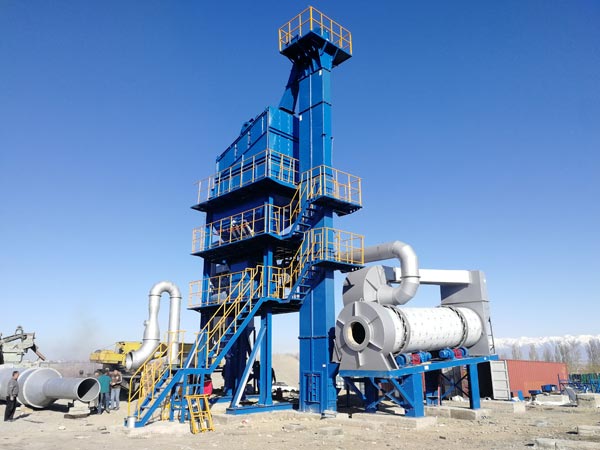
When planning a 15 km regency road maintenance contract, selecting the right asphalt plant is crucial. Many contractors face the same question: can a 40–60 tph mini asphalt plant for sale handle the project’s demand? Choosing the wrong plant can result in delays, higher costs, and reduced paving quality. This article provides a detailed, practical guide to help you make an informed decision from a contractor’s perspective.
Before selecting any asphalt plant, understanding the project’s scope is the first step. A 15 km regency road maintenance project typically includes resurfacing, pothole repairs, shoulder repairs, and occasionally minor widening. Each task requires a certain amount of asphalt, and the total volume depends on road width, overlay thickness, and paving strategy.
For example, if the road width is 7 meters and you plan a 5 cm overlay, the total asphalt volume can be estimated as:
Volume (m³) = Road Length (m) × Road Width (m) × Layer Thickness (m)
Calculating: 15,000 m × 7 m × 0.05 m = 5,250 m³ asphalt. Considering asphalt density at 2,350 kg/m³, the total tonnage is approximately 12,337 tons. Understanding this helps to determine whether a 40–60 tph mini asphalt plant can meet the project’s demand efficiently.
After estimating the total asphalt volume, calculating daily production is critical. Suppose the contract spans 30 working days. Dividing 12,337 tons by 30 days gives roughly 411 tons per day.
With a 40 tph small asphalt plant producing 40 tons per hour and a 60 tph plant producing 60 tons per hour, here’s how daily production looks assuming an 8-hour working day:
From this, a 40 tph plant barely meets the daily requirement, leaving little room for delays. A 60 tph plant provides a buffer for unexpected downtime, traffic issues, or weather delays.
Different sections may require thicker overlays or lane widening. For example, a 7 m × 10 cm thick overlay doubles the required asphalt volume to 10,500 m³, roughly 24,675 tons. In such cases, a 40 tph plant will be insufficient without extended working hours or multiple shifts, whereas a 60 tph plant can handle the task more efficiently.
Contractors must evaluate peak daily requirements rather than average daily volumes. Mini asphalt plants are best suited for projects where peak demand aligns with their output capacity.
Capacity alone is not enough. Efficiency depends on:
Mini asphalt plants are compact and mobile, ideal for regional projects with limited space. They reduce fuel consumption and allow on-site asphalt production. However, downtime due to maintenance or feed issues directly reduces output. Planning preventive maintenance and operator training is critical.
Transporting asphalt from plant to paving site is a key factor. For a 15 km road, each truck trip can take 20–30 minutes depending on traffic and road conditions. Coordinating truck rotation, storage, and on-site feeding is essential to match plant output with paving speed. Delays in logistics can nullify the nominal production capacity of the plant.
Many contractors use tipper trucks or dump trucks. Scheduling multiple trucks ensures continuous paving without waiting for asphalt. For example, a 60 tph plant producing 480 tons/day requires roughly 24 truck trips if each truck carries 20 tons.
Using a mini asphalt plant reduces upfront investment and operational costs compared to a large stationary plant. On-site production minimizes transportation losses, and fuel consumption is lower. However, if the plant is too small, overtime work or additional shifts may increase labor and fuel costs.
For instance, a 40 tph plant may require a 10-hour workday or additional trucks to meet targets, increasing operational costs. Contractors should weigh plant size, cost, and project schedule to find the optimal solution.
Contractors in Java, Sumatra, and Sulawesi often rely on mini asphalt plants for regency road projects ranging 10–20 km. They report:
Mini asphalt plants can also produce different asphalt types, including HMA and WMA, supporting diverse road standards.
When choosing a mini asphalt plant, consider:
Selecting the right plant reduces operational risk and ensures smoother project execution.
Mini asphalt plants face challenges such as:
Proper planning and risk management ensure the plant meets project goals even under unforeseen conditions.
In conclusion, a 40 tph mini asphalt plant can technically handle a 15 km road maintenance project but leaves minimal room for delays. A 60 tph plant offers better reliability, operational buffer, and flexibility. The decision should consider daily production needs, road conditions, workforce efficiency, and logistical capabilities.
Even with a 60 tph mini asphalt plant, the efficiency of your project heavily depends on how the construction team is organized. Clear role assignments, synchronized operations, and proper communication between plant operators, truck drivers, and paving crews are essential. For example, having a dedicated team for material loading, another for transport coordination, and a paving crew that works in shifts ensures continuous asphalt laying without downtime.
Furthermore, implementing simple workflow strategies, such as pre-staging asphalt near paving points and maintaining a continuous feedback loop between plant and site, can prevent bottlenecks. In practice, projects with well-coordinated teams often complete 10–15% faster than those relying solely on plant capacity.
Modern mini asphalt plants are designed to reduce environmental impact, but contractors must still prioritize dust control, emission management, and worker safety. Installing dust collectors, controlling hot mix temperature, and maintaining proper exhaust systems are essential steps. Additionally, providing personal protective equipment (PPE) and regular safety training ensures workers operate safely and efficiently.
By integrating environmental and safety management into daily operations, contractors not only comply with regulations but also reduce the risk of accidents, delays, and community complaints. Efficient safety practices directly support plant performance and overall project success.
If you plan a 15 km regency road maintenance project, a 60 tph mini asphalt plant is often the most practical choice. Our mini asphalt plants are designed for mobility, efficiency, and consistent mix quality, making them ideal for regional road projects. Contact us today to discuss how we can help you complete your contract on time, within budget, and with superior asphalt quality.

© 2025 Crivva - Hosted by Airy Hosting Managed Website Hosting.