


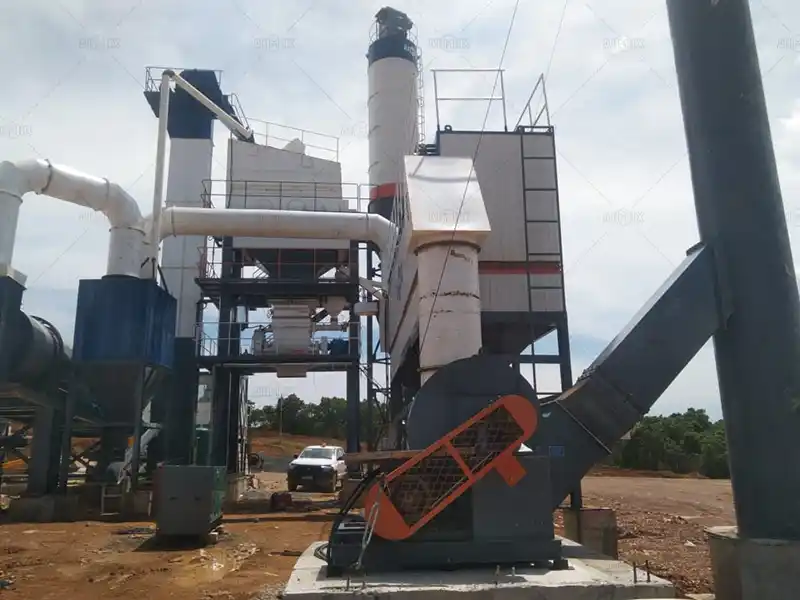
Oman’s coastal highway development is growing fast, driven by tourism expansion, port connectivity, and national logistics upgrades. Contractors working in these projects often face a key question: is a 120 TPH asphalt plant enough to handle the real production demand on site? The answer is not a simple yes or no. It depends on project scale, paving schedule, logistics efficiency, and environmental conditions along the coastal corridor. In this article, we break down the real construction logic behind this capacity choice so you can make a more informed investment decision.
Oman’s coastal highway projects are not uniform. Some sections involve urban expansion near Muscat, while others stretch across long desert-coastal corridors with limited access points. Because of this, asphalt demand changes significantly from one package to another. In many EPC contracts, daily paving output ranges from 1,000 tons to over 3,500 tons depending on lane width, layer thickness, and construction speed requirements.
At this stage, many contractors start evaluating whether a 120 TPH asphalt mix plant for sale can match these demands. To answer that, we must first translate “120 TPH” into real construction output instead of theoretical numbers.
Now let’s move from project demand to plant capacity logic, so we can better understand how production actually works on site.
A 120 TPH asphalt plant means the plant can theoretically produce 120 tons of asphalt per hour under ideal conditions. However, real job sites rarely operate at 100% efficiency. Maintenance stops, truck availability, weather conditions, and material handling delays all reduce effective output.
If we assume a realistic working efficiency of 70% to 80%, a 120 TPH plant produces around 80 to 95 tons per hour in real conditions. If the plant runs for 10 productive hours per day, the actual daily output becomes:
800 to 950 tons per day in stable operation.
This number is critical because coastal highway projects in Oman often require continuous paving to maintain surface quality and temperature stability. So, production stability matters more than peak capacity.
With this understanding, we can now evaluate whether this output matches real project requirements.
In many cases, a 120 TPH asphalt plant is not only enough but also highly efficient for mid-scale highway sections. However, this depends on how the contractor organizes the project workflow.
A 120 TPH plant works well when daily paving demand stays within 800–1,000 tons. This often happens in:
– Secondary coastal highways – Maintenance and rehabilitation projects – Urban coastal road expansions – Segmented EPC projects with phased construction
In these scenarios, the plant can supply continuous asphalt without creating large stockpiles or unnecessary fuel consumption. Moreover, contractors can reduce idle capacity and improve ROI per ton.
However, suitability changes when project scale increases. Let’s move to that scenario next.
Although 120 TPH can handle many projects, Oman coastal highway development sometimes includes high-speed, large-volume construction packages. In such cases, production pressure increases significantly.
A 120 TPH hot mix plant near me may struggle when:
– Daily paving demand exceeds 1,200–1,500 tons – Multiple paving crews operate simultaneously – Long continuous highway segments require uninterrupted supply – Tight project deadlines reduce operational flexibility
In these situations, production bottlenecks appear quickly. Even small delays in asphalt delivery can stop paver operations. This leads to temperature loss in asphalt mix and increases rework risk.
So, contractors must evaluate not only plant capacity but also logistics coordination.
Oman’s coastal highways introduce unique environmental and logistical challenges. These factors directly affect whether a 120 TPH asphalt plant can perform efficiently in real construction conditions.
Coastal heat can exceed 40°C in peak seasons. Asphalt temperature control becomes critical. If trucks travel long distances, heat loss increases and compaction quality decreases. Therefore, production must synchronize closely with paving speed.
Aggregate and bitumen supply consistency also matters. If material delivery slows down, even a high-capacity plant cannot maintain stable output. This is why many contractors in Oman prioritize supply chain planning alongside plant selection.
Now that we understand environmental constraints, we can evaluate how to maximize a 120 TPH plant in real operations.
Instead of immediately upgrading capacity, many contractors improve efficiency first. This approach reduces cost while maintaining output performance.
Reduce idle time between batches. Keep drum heating, aggregate feeding, and mixing cycles synchronized. This alone can increase real output by 10–15%.
Truck scheduling is often the hidden bottleneck. If trucks arrive late, the plant stops. If trucks arrive too early, congestion happens. A balanced dispatch system keeps production stable.
Coastal climates demand precise temperature control. Insulated storage silos and proper transfer timing help maintain mix quality from plant to paver.
Once these improvements are in place, a 120 TPH plant can perform close to its theoretical capacity in many cases.
From a financial perspective, a 120 TPH asphalt plant often provides a strong balance between investment cost and output capability. Larger plants increase capital expenditure, fuel consumption, and maintenance complexity.
For contractors in Oman who operate multiple medium-scale projects, a 120 TPH configuration often delivers better equipment utilization rates. This improves ROI per project cycle, especially when demand fluctuates across different highway packages.
However, if a contractor consistently handles mega highway corridors, scaling up to higher capacity becomes necessary to avoid delays and penalties.
To simplify the decision, contractors can evaluate three key factors before selecting plant capacity:
First, estimate peak daily asphalt demand across all active projects. Second, evaluate logistics distance and truck cycle time. Third, consider contract deadlines and penalty risks.
If most projects fall under 1,000 tons per day with manageable logistics, a 120 TPH asphalt plant is usually sufficient. If demand consistently exceeds that level, upgrading capacity or adding parallel plants becomes a better strategy.
So, is a 120 TPH asphalt plant enough for Oman coastal highway development projects? In many mid-scale and segmented highway projects, the answer is yes. It provides stable output, reasonable investment cost, and flexible deployment. However, in large continuous highway corridors with high daily demand, it may become a limiting factor without strong logistics and production coordination.
Ultimately, success does not depend only on plant capacity. It depends on how well production, transport, and paving operations work together on site. Contractors who optimize this system can achieve high efficiency even with a 120 TPH setup.
If you are planning an Oman coastal highway project and want to evaluate the right asphalt plant configuration for your specific demand, we can help you analyze your daily output needs, project schedule, and logistics conditions in detail. Contact us to get a tailored solution that matches your project scale and timeline.

© 2025 Crivva - Hosted by Airy Hosting Managed Website Hosting.