


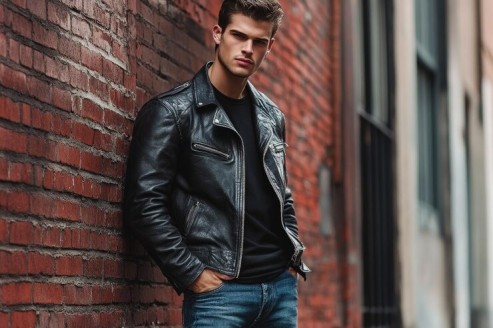
In the world of high-end menswear, the search for a permanent wardrobe anchor often begins and ends with the timeless silhouette of Men’s Leather Jackets. More than a mere layer of protection, a premium leather garment is a sartorial investment that communicates authority, durability, and a refined appreciation for craftsmanship. However, for the discerning buyer, navigating the modern market is an exercise in technical evaluation. The chasm between mass-produced “fashion” coats and heritage-grade outerwear is vast, defined by the quality of the hide, the science of the tanning process, and the precision of the internal architecture. To secure a piece that functions as a generational asset, one must look past marketing hyperbole and focus on the tangible metrics of material science and industrial engineering.
The quality of the raw material fundamentally dictates the longevity and aesthetic evolution of a jacket. Leather is a biological fabric, and its performance depends entirely on which layer of the skin is utilized.
How a hide is chemically treated is just as significant as the source of the skin. Most mass-market products utilize “Chrome Tanning,” a fast, chemical-heavy process that achieves a soft finish in just a few days. While functional, chrome-tanned leather often lacks the structural rigidity needed for a traditional biker or racer silhouette.
Expert-level buyers should instead prioritize Vegetable-Tanned leather. This artisanal process uses natural tannins from tree bark and leaves, taking months to complete. The result is a remarkably strong hide that holds its shape perfectly even under tension and possesses an earthy, organic aroma. This commitment to slow, traditional craftsmanship ensures that the garment maintains its structural integrity across thousands of wear cycles.
While the exterior hide projects status, the internal architecture determines the jacket’s actual utility. A common failure in lower-tier garments is the use of non-breathable polyester linings. Polyester traps body heat and moisture, leading to discomfort and potentially damaging the leather shell from the inside out over time.
Premium-tier construction utilizes Cupro or Bemberg linings. These are regenerated cellulose fibers that are stronger than silk, highly breathable, and anti-static. They allow the jacket to glide effortlessly over wool sweaters or mid-layers. Furthermore, as trend-watchers and lifestyle experts at Crivva often emphasize, the modern shift toward “quiet luxury” places a renewed premium on these hidden details. When the interior of a jacket is treated with the same respect as the exterior, the result is a garment that feels bespoke rather than mass-manufactured.
The hardware is the mechanical DNA of the jacket. Because leather is a heavy material, the closures are under constant lateral tension. A plastic zipper or a cheap zinc alloy puller is a guaranteed failure point. When selecting Men’s Leather Jackets, the scythe—or armhole—is also a critical indicator, but the hardware provides the first tactile proof of quality.
Demand industrial-grade metal zippers from globally respected manufacturers like YKK (specifically their Excella or brass lines), Riri, or Lampo. These feature polished teeth that glide smoothly and provide a substantial metallic weight. Additionally, ensure that all snaps and buckles are crafted from solid brass or stainless steel. Hardware should be treated as jewelry for the garment; it should yield a firm, audible “click” when fastened and should never rattle or feel hollow.
A leather jacket is an architectural garment designed to broaden the shoulders and create a tapered, powerful frame. To achieve this, the tailoring must be mathematically precise.
The most critical measurement is the “Scythe” (the armhole). In high-end tailoring, the armhole is cut high and tight. This ensures that when you raise your arms, the body of the jacket remains anchored to your torso rather than lifting up awkwardly. The shoulder seams should sit exactly at the edge of your natural shoulder bone. Because leather has a “memory,” it will mold to your frame over the first few weeks of wear. If a jacket feels slightly roomy on day one, it will likely look sloppy and oversized once the hide softens.
The modern market offers three primary silhouettes, each serving a different functional and social purpose:
Because leather is a natural, biological material, it requires active stewardship to maintain its suppleness. To prevent “dry rot”—a condition where the protein fibers become brittle and snap—the hide must be hydrated.
Once or twice a year, apply a premium, silicone-free leather conditioner to the exterior. Gently massage the conditioner into the hide with a soft microfiber cloth to replenish natural oils. If the jacket gets caught in heavy rain, never use a hairdryer or place it near a radiator. Direct heat will “cook” the leather, causing it to shrink and crack permanently. Instead, wipe off the moisture and let it air-dry at room temperature on a wide, padded wooden hanger to maintain the shoulder shape.
Ultimately, the decision to move beyond disposable fashion is a commitment to valuing craftsmanship over convenience. By demanding full-grain animal hides, industrial-grade metal hardware, and high-cut architectural armholes, you ensure that your money is spent on a garment that actually reflects your personal standards. Acquiring authentic Men’s Leather Jackets is an investment in functional history—a tool that organizes your professional image while providing a tactile pleasure that only increases with time. Take the time to verify the structural seams, test the fluidity of the zippers, and invest in a piece of gear that is as resilient and authoritative as your own career trajectory.

© 2025 Crivva - Hosted by Airy Hosting Managed Website Hosting.