

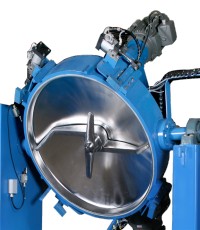
If your mixing process were truly efficient, would your team still be firefighting every other batch?
Think about it.
Rework piles.
Color inconsistencies.
Powder segregation.
Unexpected downtime.
Customer complaints.
None of these start on the production floor. They usually begin inside the mixer.
And yet, mixing is still treated as a “basic” step in manufacturing, until it becomes the most expensive bottleneck in the entire operation.
In many facilities, these issues are often misdiagnosed as operator errors or raw material inconsistencies. However, the root cause frequently lies in inadequate mixing performance or outdated equipment that cannot handle modern material complexities. As formulations become more advanced and production speeds increase, even minor inefficiencies in mixing can cascade into major operational challenges.
Across powder processing, plastics compounding, pharmaceuticals, and coatings, manufacturers quietly battle the same challenges:
Uneven dispersion
Inconsistent batch quality
Pigment streaking
Overheating during high-speed mixing
Long cleaning and changeover cycles
Cross-contamination risks
For teams relying on powder blending container mixers, achieving perfect homogeneity without particle damage is a daily struggle. In regulated environments, pharmaceutical container mixers must balance precision, hygiene, and compliance, leaving zero margin for error.
While using container mixers for powder coating operations, even slight inconsistencies in pigment blending can show up instantly on the final surface, turning entire production runs into costly rejects.
In addition, increasing demand for customization and smaller batch production adds further pressure. Manufacturers are expected to switch between formulations quickly while maintaining consistent quality, which many traditional systems are not designed to handle efficiently.
So the real question becomes:
Is your mixing system helping your production line or silently holding it back?
Most manufacturers calculate losses in terms of scrap and downtime. But poor mixing quietly impacts far more:
Inconsistent product performance
Higher warranty claims
Increased material waste
Longer production cycles
Reduced customer trust
Over time, these inefficiencies compound, affecting profitability, capacity planning, and even brand reputation.
There are also indirect costs that are often overlooked, such as increased labor involvement for rework, higher energy consumption due to repeated processing, and delays in order fulfillment. These hidden factors can significantly reduce overall operational efficiency without being immediately visible in standard reports.
Ironically, many of these issues persist because traditional mixing systems were never designed for today’s complex formulations, tighter tolerances, and faster production demands.
To overcome these challenges, manufacturers are rethinking how materials move through their plants, and that’s where powder blending container mixers are reshaping production strategies.
Instead of repeatedly transferring material between vessels, container-based systems allow blending, transport, storage, and discharge to occur in a single controlled unit.
Lower contamination risk
Faster batch changeovers
Reduced material handling
Improved operator safety
Better process consistency
In short, less chaos. More control.
Additionally, container-based systems support better traceability and process documentation, which is especially critical in regulated industries. By minimizing handling steps, manufacturers can maintain stricter control over material integrity and reduce variability between batches.
For manufacturers juggling multiple formulations, SKUs, and production schedules, this flexibility becomes a serious competitive edge.
One of the biggest myths in industrial mixing is that faster mixing means better mixing.
In reality, excessive shear and friction often lead to overheating, material degradation, and pigment breakdown, especially in specialty polymers and fine powders.
Modern mixing systems are engineered to create controlled vortex flow, ensuring deep dispersion without destroying material integrity. The result?
Uniform blending
Stable thermal profiles
Shorter cycle times
Higher batch repeatability
This balanced approach enables manufacturers to increase throughput without sacrificing quality, a combination every production manager wants, and few achieve.
Moreover, advanced control systems now allow operators to monitor and adjust mixing parameters in real time. This level of precision ensures that even complex formulations can be processed consistently, reducing variability and improving overall product reliability.
At this point, most operations realize that mixing challenges aren’t solved by machines alone; they’re solved through engineering.
That’s where solution-driven manufacturers like Reliance Mixers enter the picture. Known for designing application-focused container mixing systems, their approach emphasizes material behavior, process dynamics, and long-term operational reliability rather than just mechanical speed.
Their advanced container-based solutions are engineered to deliver consistent dispersion, precise thermal control, and efficient material handling across powder, plastics, pharmaceutical, and specialty material applications.
Manufacturers exploring high-performance container mixers can see how modern engineering is redefining industrial mixing here on Reliance Mixers.
This engineering-first approach ensures that each solution is tailored to the specific challenges of the application, rather than forcing a generic system to fit complex requirements. As a result, manufacturers can achieve better alignment between their process goals and equipment capabilities.
When mixing systems finally align with process demands, production teams notice immediate changes:
Smoother workflows
Fewer quality deviations
Faster batch turnaround
Reduced cleaning time
Lower rejection rates
Instead of firefighting every batch, teams shift their focus to optimization, scaling, and innovation.
Operators also experience improved ease of use and reduced manual intervention, allowing them to focus on higher-value tasks rather than troubleshooting recurring issues. This shift not only boosts productivity but also improves workplace efficiency and morale.
That’s the difference between managing production and mastering it.
In today’s manufacturing landscape, consistency is no longer a quality goal; it’s a survival requirement.
Whether you’re blending powders, compounding plastics, formulating pharmaceuticals, or producing specialty materials, your mixing process determines far more than product uniformity. It shapes production efficiency, cost control, scalability, and ultimately, customer trust.
The manufacturers pulling ahead are no longer asking, “Is your mixer fast enough?”
They’re asking, “Is your mixing system intelligent enough to adapt, scale, and perform without compromise?”
Container-based industrial mixing solutions represent the next evolution, delivering the control, flexibility, and reliability modern production demands. For operations ready to move beyond firefighting and into performance-led manufacturing, the right mixing strategy becomes a long-term growth lever, not just a process upgrade.
Because in competitive markets, you don’t win by producing more, you win by producing better, every single time.

© 2025 Crivva - Hosted by Airy Hosting Managed Website Hosting.