

The demand for lightweight yet high-strength metal components is reshaping the future of manufacturing. Industries such as automotive, aerospace, electronics, and industrial engineering are continuously searching for casting technologies that deliver better durability, precision, and performance without compromising production efficiency.
In this evolving manufacturing landscape, vacuum die casting has emerged as a breakthrough solution in high-pressure die casting (HPDC). By reducing trapped gases and improving metal density, vacuum-assisted casting significantly enhances the strength and reliability of aluminum components.
At Raga Group, advanced HPDC technologies are helping manufacturers achieve superior casting quality with reduced defects and improved structural performance. In this blog, we explore how vacuum die casting strengthens aluminum parts and why it is becoming essential for modern engineering applications.
Aluminum die-cast components are widely used because they offer:
However, the true value of a casting depends on its internal integrity.
Even visually perfect castings can fail if they contain hidden porosity or internal air pockets. Structural weaknesses caused by trapped gases often reduce the mechanical performance of the final component.
This becomes a major concern in applications such as:
To meet these growing performance expectations, manufacturers are increasingly adopting vacuum die casting technology.
One of the biggest enemies of casting strength is gas porosity.
During standard HPDC operations, molten aluminum enters the die cavity at extremely high speed. If air inside the cavity cannot escape efficiently, it becomes trapped within the solidifying metal.
These microscopic gas pockets weaken the structure in several ways:
In structural applications, even small porosity levels can affect long-term reliability.
This is why controlling porosity has become one of the most important goals in modern die casting production.
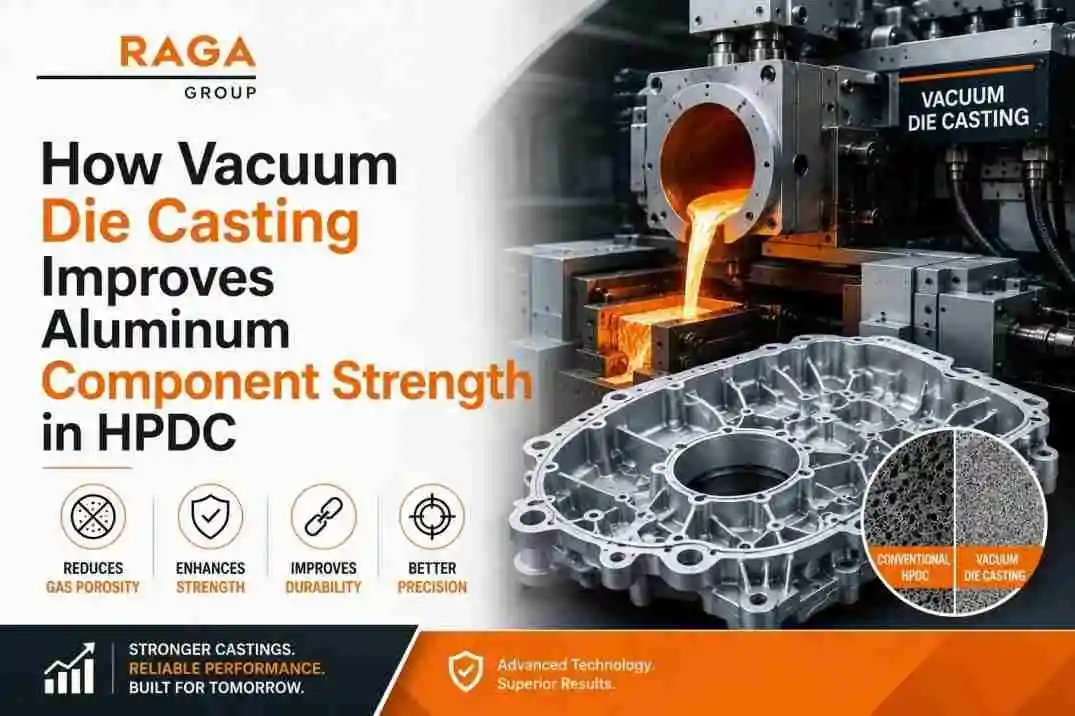
Vacuum die casting is an advanced HPDC process designed to remove air from the die cavity before molten metal enters the mold.
Instead of depending only on vent channels, vacuum systems actively evacuate air using specialized valves and vacuum pumps.
The result is a denser and stronger casting with improved internal quality.
The shot sleeve plays a critical role in determining casting quality and strength.
Before metal reaches the cavity, molten aluminum is poured into the shot sleeve where it is pushed forward by the injection plunger. If turbulence occurs during this stage, air mixes with the molten metal and increases porosity risks.
These issues directly impact final component strength.
In vacuum-assisted HPDC, shot sleeve control becomes even more important because the goal is to maintain smooth, controlled metal flow from injection to cavity filling.
Proper shot sleeve optimization helps:
A well-controlled injection system combined with vacuum technology creates stronger and more reliable castings.
The biggest advantage of vacuum systems is lower gas entrapment inside the casting.
Less porosity means:
Vacuum-assisted filling produces denser aluminum structures with fewer internal voids.
This increases:
Traditional castings often develop blistering during heat treatment because trapped gases expand under high temperatures.
Vacuum die casting minimizes this issue, allowing components to undergo advanced thermal processing safely.
Lower porosity improves welding quality and reduces cracking risks in structural assemblies.
Vacuum systems create more stable filling conditions, improving consistency across production batches.
Modern vehicles require lightweight structural components with exceptional strength.
Vacuum-assisted HPDC is commonly used for:
Aircraft components demand extremely low porosity and superior fatigue resistance.
Heavy-duty machinery requires durable aluminum parts capable of handling continuous stress.
Precision housings benefit from stronger, cleaner castings with better thermal performance.
As engineering standards continue rising, vacuum-assisted casting is becoming increasingly valuable across industries.
| Feature | Conventional HPDC | Vacuum Die Casting |
|---|---|---|
| Air Entrapment | Higher | Significantly Lower |
| Gas Porosity | Moderate to High | Very Low |
| Structural Strength | Standard | Superior |
| Heat Treatment Capability | Limited | Improved |
| Weldability | Moderate | Excellent |
| Casting Reliability | Variable | Highly Consistent |
For high-performance applications, vacuum systems provide a clear advantage.
The global shift toward electric mobility, lightweight engineering, and energy-efficient manufacturing is driving the demand for stronger aluminum components.
Manufacturers can no longer rely only on production speed — component reliability has become equally important.
This is why vacuum die casting is rapidly becoming a key technology in advanced HPDC manufacturing.
At Raga Group, continuous innovation in casting processes helps deliver aluminum components with improved strength, lower gas porosity, and superior dimensional precision for demanding industrial applications.
In modern HPDC manufacturing, strength starts from within.
Hidden porosity and trapped gases can significantly reduce the reliability of aluminum components, especially in structural applications. By actively removing air from the die cavity, vacuum die casting creates denser, cleaner, and stronger castings compared to conventional processes.
Combined with optimized shot sleeve performance and precise process control, vacuum-assisted HPDC offers manufacturers a powerful solution for producing high-integrity aluminum parts with minimal gas porosity.
As industries continue demanding lightweight yet durable components, vacuum technology will remain at the center of next-generation die casting innovation.

© 2025 Crivva - Hosted by Airy Hosting Managed Website Hosting.