


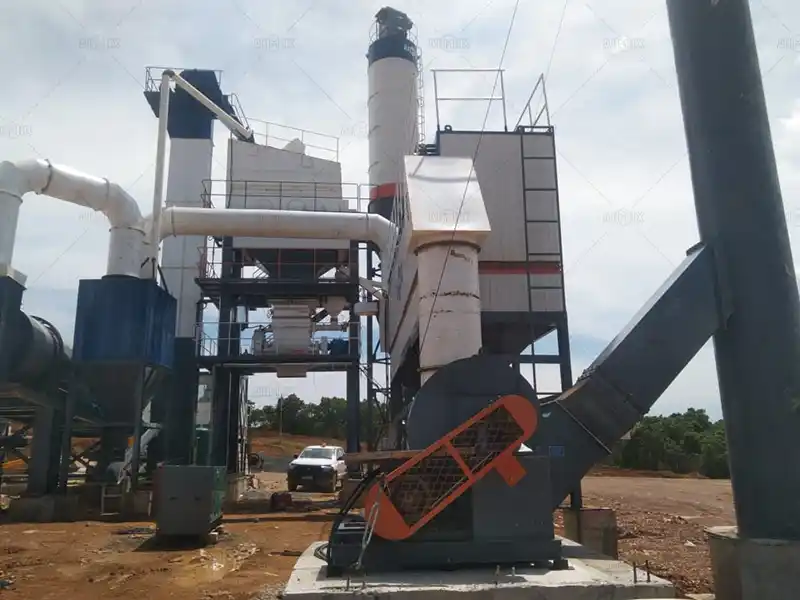
In many road construction projects across Ethiopia, contractors face a very real challenge: balancing production demand with limited fuel availability. At the same time, project owners expect stable output, tight schedules, and controlled operating costs. This raises a practical question—can a 90 TPH asphalt manufacturing plant reliably support a 700 tons/day production target under fuel constraints? The answer is not only about capacity. It also depends on planning, operating strategy, and real site conditions.
In this article, we will break down the production logic step by step. We will also look at fuel consumption, working hours, and practical operating methods. Most importantly, we will analyze this from a contractor’s perspective in Ethiopia, where fuel supply and logistics often become a key bottleneck in construction planning.
Before evaluating the plant capacity, we need to understand the actual demand. A target of 700 tons per day may sound simple, but in practice, it depends on how many working hours are available, how stable the fuel supply is, and how the project schedules paving activities.
In most Ethiopian road projects, contractors usually operate within 8 to 12 working hours per day. However, fuel shortages or delivery delays can reduce this window. Therefore, the real production requirement is not just total daily output. It is also about consistent hourly output.
If we assume a 10-hour working window, a 700 tons/day requirement translates into around 70 tons per hour. If the working time drops to 8 hours due to fuel limitations, the required output rises to about 87.5 tons per hour.
This calculation is important because it shows that the project is already close to the upper limit of a 90 TPH asphalt plant. However, capacity alone does not tell the full story. We need to examine real operating efficiency next.
A 90 TPH asphalt plant is designed to produce up to 90 tons per hour under ideal conditions. In theory, if the hot mix plant for road construction runs continuously for 8 hours at full capacity, it can produce 720 tons per day. This already meets the 700 tons/day target.
However, real construction sites are never ideal. Maintenance, material loading time, temperature control, and fuel interruptions all reduce actual output. Therefore, real efficiency often drops to 75%–85%.
If we assume 80% efficiency, the real production becomes:
90 TPH × 0.8 = 72 tons/hour effective output
Now, if the plant runs for 10 hours, the total output becomes 720 tons/day. This still meets the target. But if fuel shortages reduce working hours to 8 hours, the output drops to 576 tons/day, which is below the requirement.
This shows a clear conclusion: a 90 TPH plant can meet the demand, but only if operation time is stable and fuel supply is managed carefully.
Now that we understand the capacity side, we need to look deeper into the most critical constraint in Ethiopia—fuel availability.
Fuel plays a central role in asphalt production. It powers the burner system, drying drum, and heating process. Without stable fuel, production cannot continue, even if the plant has enough capacity.
In Ethiopia, fuel logistics can be affected by transportation delays, regional distribution issues, and price fluctuations. As a result, contractors often face interruptions during peak production periods.
When fuel supply becomes unstable, three main issues appear:
First, the plant cannot run continuously. This reduces daily output.
Second, repeated start-stop cycles increase energy waste and reduce efficiency.
Third, temperature inconsistency may affect asphalt quality, which leads to rework and material loss.
Therefore, even a well-designed 90 TPH plant can underperform if fuel planning is weak.
To solve this issue, contractors must focus not only on equipment selection but also on operation strategy.
Even under fuel constraints, a 90 TPH asphalt plant can still perform well if it is operated with a clear production strategy. The goal is not just maximum output, but stable and efficient output.
Instead of running the plant randomly, contractors should plan production in fixed cycles. For example, running the plant in two strong production blocks per day can reduce unnecessary fuel waste during idle periods.
This approach also helps align production with paving schedules, reducing storage pressure and material waste.
Many plants consume fuel even during idle heating or waiting periods. By optimizing startup timing, contractors can reduce unnecessary fuel burning.
For example, starting production only when trucks and paving teams are ready reduces wasted energy.
Fuel efficiency depends heavily on moisture control in aggregates. If materials are too wet, the burner consumes more fuel. Therefore, pre-drying or better storage of aggregates can significantly reduce fuel consumption.
This small operational improvement can lead to large cost savings over time.
Now that we understand optimization methods, we should also look at real-world project conditions in Ethiopia.
In Ethiopia, road construction projects often take place in remote areas. This creates challenges not only in fuel supply but also in material transportation and workforce coordination.
Altitude and temperature variations can also affect plant efficiency. In some regions, colder conditions require longer heating time, which increases fuel usage.
Fuel delivery may not always match production schedules. Therefore, contractors must maintain buffer fuel storage whenever possible. Without buffer planning, even a high-capacity plant may stop frequently.
In addition, transportation delays can also affect asphalt delivery timing, which impacts paving continuity.
This is why planning becomes as important as equipment selection.
From a technical point of view, a 90 TPH asphalt plant can meet a 700 tons/day requirement. However, this is only true under controlled and well-managed conditions.
If fuel supply is stable and operations run efficiently, the plant works perfectly for this scale. However, if fuel interruptions are frequent, production risk increases significantly.
Therefore, the real decision is not just about capacity. It is about risk management and operational control.
A 90 TPH plant is most suitable when:
• Fuel supply is planned in advance
• Project duration is medium-term and stable
• Production is managed in scheduled cycles
• On-site storage capacity is available
Under these conditions, the plant can safely support 700 tons/day output.
A 90 TPH asphalt plant can meet a 700 tons/day demand in Ethiopia, but only when fuel supply and operation planning are properly managed. Without these conditions, even the right equipment may fail to reach its target output.
For contractors, the key lesson is simple: success does not depend only on plant size. It depends on how well you manage fuel, schedule production, and control efficiency in real working conditions.
If you are planning a road construction project in Ethiopia and need a reliable asphalt production solution, choosing the right configuration and operational plan is critical. A well-designed system can help you reduce fuel risk, stabilize output, and keep your project on schedule.
If you want a tailored recommendation for your project scale, fuel conditions, and timeline, our engineering team can help you design a more efficient asphalt plant solution that fits your real construction needs.

© 2025 Crivva - Hosted by Airy Hosting Managed Website Hosting.