

Building a 3 km bridge is a major infrastructure challenge, especially in a country like Uzbekistan, where road and bridge construction projects are accelerating to support economic growth. For contractors and project planners, one critical question arises: can a 120 TPH asphalt mix plant near me provide sufficient capacity and efficiency for such a project? In this article, we analyze the practical considerations, production requirements, and operational efficiency of using a 120 TPH asphalt plant for a bridge construction project in Uzbekistan.
Before choosing an asphalt plant, it is crucial to assess the specific demands of a 3 km bridge project. Typically, a bridge of this length will require:
For example, if the bridge width is 12 meters and the pavement thickness averages 0.15 meters, the total asphalt volume can be estimated using the formula:
Volume = Length × Width × Thickness = 3,000 m × 12 m × 0.15 m = 5,400 m³
This volume highlights the substantial asphalt requirement. Therefore, the selected plant must not only meet this total volume but also ensure timely delivery throughout the project duration.
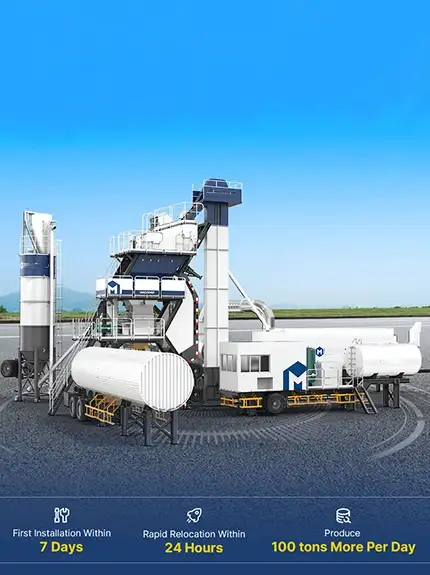
A 120 TPH (tons per hour) asphalt plant is considered medium-sized in the construction industry. Understanding its daily production potential is key to determining its suitability for a 3 km bridge project.
If the plant operates 8 hours per day, its maximum daily production is:
120 TPH × 8 hours = 960 tons/day
Assuming a typical asphalt density of 2.4 tons per cubic meter, the daily volume in cubic meters is:
960 tons ÷ 2.4 tons/m³ ≈ 400 m³/day
Given the total asphalt volume of 5,400 m³, the approximate duration required for production is:
5,400 m³ ÷ 400 m³/day ≈ 13.5 days
This calculation shows that a 120 TPH plant can complete the asphalt production within a reasonable timeframe, even allowing buffer days for logistics or unexpected delays.
Meeting production volume is only part of the solution. Operational efficiency is equally important for bridge projects. Several factors affect the plant’s performance:
By carefully managing these factors, contractors can maximize output and maintain the quality of asphalt required for a bridge deck, approach roads, and surrounding infrastructure.
Asphalt production is only one part of the project equation. Transporting hot mix asphalt efficiently to the bridge site is critical. For a 3 km bridge, the plant should ideally be located close to the construction site to reduce transport time and heat loss. Common practices include:
When these strategies are applied, a 120 TPH plant can provide a steady and reliable flow of asphalt to the construction site, minimizing downtime and paving delays.
Bridge construction requires multiple asphalt layers, including base, binder, and surface layers. A 120 TPH asphalt plant can typically produce different mix designs by adjusting:
This flexibility ensures the asphalt meets project specifications, enhances durability, and provides a smooth driving surface. Moreover, contractors can produce specialized mixes for critical sections such as expansion joints and ramps.
Another important consideration is cost-effectiveness. A 120 TPH asphalt plant balances moderate investment with high efficiency. Contractors can benefit from:
For a 3 km bridge project, the plant can produce the required asphalt without incurring excessive idle time or unnecessary capital expenses, making it a cost-efficient choice.
Uzbekistan has seen rapid infrastructure growth, with bridge projects connecting key trade routes and urban centers. Contractors using a 120 TPH asphalt plant for a similar project reported:
These outcomes confirm that, when managed properly, a 120 TPH plant is capable of meeting both volume and quality demands of medium-scale bridge projects in Uzbekistan.
To ensure a successful project, contractors should:
By addressing these considerations, contractors can maximize efficiency, reduce costs, and deliver high-quality bridge infrastructure.
From production capacity, operational efficiency, and flexibility to cost-effectiveness, a 120 TPH asphalt plant proves suitable for a 3 km bridge project in Uzbekistan. With proper planning, logistics management, and mix design control, contractors can rely on this medium-sized plant to deliver consistent, high-quality asphalt and support project timelines.
For contractors and project planners, choosing the right asphalt plant is not just about production numbers—it’s about matching plant capability with project scale, maintaining quality, and optimizing operations. A 120 TPH plant strikes a balance between these factors, making it an ideal solution for medium-scale bridge construction in Uzbekistan.
If you are planning a bridge or road project in Uzbekistan, our team can provide tailored solutions for asphalt plant selection, mix design, and project logistics. Contact asphalt equipment manufacturers today to discuss your project requirements and explore how a 120 TPH asphalt plant can help you complete your bridge project efficiently, on time, and within budget.

© 2025 Crivva - Hosted by Airy Hosting Managed Website Hosting.