

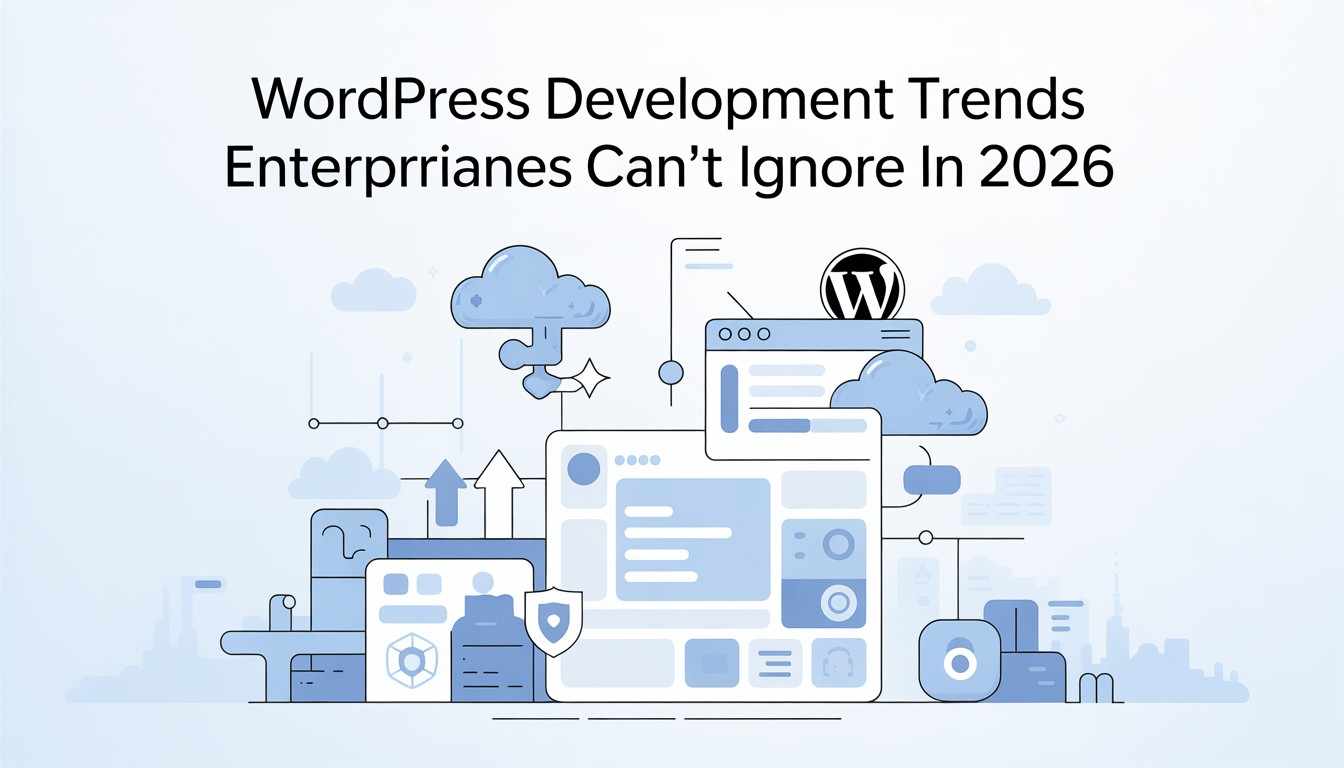
Let’s be honest, many enterprises are still running WordPress as if it were 2018.
Classic themes. Bloated plugins. Slow deployments. “It works, don’t touch it” mentality.
But here’s the uncomfortable question: will that setup still work in 2026?
WordPress powers over 40% of the web, but how businesses use it is changing quickly. Performance expectations are rising, security risks are increasing, and development teams are under pressure to deliver faster with fewer bugs. If you’re a decision-maker, lead developer, or looking into WordPress development trends, now is the time to take a fresh look.
This is not just a hype piece. It offers a practical view for developers on the WordPress trends that businesses cannot ignore in 2026. This information is based on what teams are actually building, not on marketing presentations.
WordPress didn’t survive this long by chance. Its ongoing success comes from constant innovation, a strong community, and the ability to adapt to changing web technologies.
Enterprises continue to choose it because:
That ecosystem allows enterprises to innovate, but even the strongest platform won’t compensate for outdated approaches.
Headless WordPress, where WordPress acts as the content backend and the frontend uses frameworks like React or Next.js, is quickly becoming standard for large organizations.
Why enterprises are adopting it:
In 2026, businesses that continue to rely solely on traditional WordPress themes will struggle, especially when competitors provide faster and more engaging user experiences.
Let’s acknowledge the truth: many developers hated Gutenberg at first. But enterprises are starting to see its real value.
Gutenberg has evolved into a full-site editing system that:
In 2026, companies will use Gutenberg more deliberately, with custom block libraries, locked patterns, and role-based editing. Ignoring this now will lead to technical challenges down the line.
Enterprise WordPress sites are finally treating performance as a first-class concern.
We’re seeing:
Google’s algorithm updates and user expectations leave little room for slow websites. In 2026, performance issues won’t just affect SEO; they’ll also impact revenue.
Enterprises learned the hard way: WordPress isn’t insecure; poor practices are.
In 2026, security trends include:
Security is no longer a post-launch checklist. It’s built into the workflow from day one. Ignoring it is no longer an option for enterprise-scale projects.
WordPress development has caught up with modern engineering standards, and enterprises expect it.
Key shifts:
This is one of the key WordPress development trends for businesses. Teams want reliable deployments and fewer late-night rollbacks. The era of “upload via FTP and hope for the best” is over.
AI isn’t replacing WordPress developers, but it is changing how they work.
In 2026, enterprises are using AI for:
This trend may not be flashy, but it has a strong impact. Forward-thinking teams are integrating AI thoughtfully, without complicating sites unnecessarily.
Accessibility is no longer “we’ll fix it later.”
Enterprises now face:
WordPress in 2026 is expected to be accessible by default:
This trend is driven more by responsibility than technology, and it’s long overdue.
Enterprises aren’t just looking for developers anymore.
They’re looking for:
Choosing the right WordPress development partner now focuses more on strategic collaboration than merely finishing a project. Teams are looking for teamwork, documentation, and a shared vision, rather than just task completion.
If you’re working with WordPress at an enterprise level, here’s the honest takeaway:
You don’t need to chase every trend, but you do need to evolve.
The most successful teams:
WordPress isn’t “just a CMS” anymore. It’s a foundation, and foundations need maintenance.
The WordPress landscape in 2026 is very different from what businesses adapted to years ago.
It’s faster. More secure. More flexible. More developer-friendly.
Ignoring these WordPress development trends won’t mean WordPress will fail; it will mean your implementation will. Businesses that change will continue to grow confidently. Those that don’t will gradually experience more issues with performance, security, and team morale.
The good news? The ecosystem is ready. The real question is whether your organization is ready to change.
Yes. Enterprises deal with higher traffic, stricter security requirements, and complex integrations. This makes modern WordPress trends essential, not optional.
While not always necessary, headless architecture can provide notable benefits for content-heavy or performance-focused platforms.
Look for partners with proven enterprise experience, strong DevOps capabilities, performance knowledge, and clear documentation processes.
For many businesses, yes, especially when Gutenberg is used with custom blocks and design systems.
Yes, when done properly. Security relies on architecture, plugin management, and development practices, rather than the CMS itself.

© 2025 Crivva - Hosted by Airy Hosting Managed Website Hosting.