

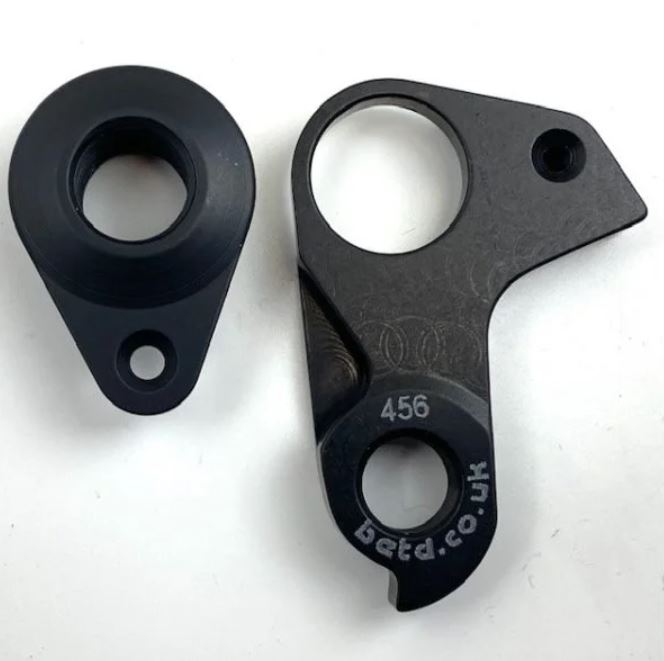
Of all the ways a ride can come to an abrupt stop, a snapped derailleur hanger is among the most frustrating and the most preventable. Whether you’re deep in the woods, hours from your car, or part way through a sportive, a damaged hanger turns a working bike into one you’re pushing home. It’s a small, inexpensive part, yet it’s also one of the most common reasons a ride ends early. Here’s why a spare belongs in every rider’s kit, not just a serious mechanic’s toolbox, and how to make sure you’re carrying the right one.
The Purpose of a Derailleur Hanger
Sometimes called a gear hanger or mech hanger, this small component connects your rear derailleur to the frame, and it’s built to fail. In the event of a crash or impact, the hanger is designed to bend or snap rather than transmit that force into the derailleur or, worse, the frame itself. Frames are expensive and difficult to repair; hangers are cheap and quick to replace. That sacrificial design is precisely why hangers are so valuable, and exactly why riders should always have a replacement on hand. Without one, even a fully rideable bike can be reduced to dead weight after a single hard knock, regardless of how minor the rest of the damage might be.
How to Tell If Your Hanger Is Damaged
Hanger damage isn’t always obvious at a glance, which is part of what makes it so disruptive. The most common sign is a sudden change in shifting quality, particularly difficulty reaching the largest cassette cogs or the chain skipping under load. Looking at the derailleur from behind the bike can also reveal a problem; if the derailleur cage sits at an angle rather than running parallel to the cassette, the hanger has likely bent. In more severe cases, the derailleur may make contact with the spokes, producing a sharp clicking or grinding noise that should never be ignored. A quick visual check after any fall, even one that seems minor, is good practice, since a slightly bent hanger can still shift acceptably for a short while before failing completely. Catching this early, and having a spare ready to fit, prevents a bent hanger from causing further damage to the derailleur or wheel.
Off-Road and On the Trail
A fall on a rocky section, a clipped root, or a low-speed tip-over at a technical feature is often enough to bend a hanger. The effect on shifting is immediate, with indexing thrown off and gear changes becoming unreliable or impossible. In more serious cases, the derailleur can be pulled into the spokes, risking damage well beyond the hanger itself, including a destroyed derailleur or a damaged wheel. Carrying a spare alongside a multi-tool means a trailside fix takes minutes rather than ending the ride. For most riders, this is the single most common scenario in which a spare hanger earns its place in a pack, and it’s worth practising the swap at home at least once so it isn’t unfamiliar when it matters.
Races and Timed Events
Crashes happen during practice runs and timed stages alike, and event day is the worst possible time to be without a fix. There’s no bike shop to fall back on, and borrowing a hanger from another rider rarely works, since hangers are frame-specific and won’t fit a different model, even within the same brand’s range across different years. Bringing your own spare removes that uncertainty before it becomes a problem. For riders competing in enduro or multi-stage events, a hanger failure between stages can mean missing a start time entirely, so having a known-compatible spare already in your kit bag is worth the minimal extra weight. Event mechanics, where available, can usually fit a hanger quickly, but only if you’ve supplied the correct part yourself.
Bikepacking and Multi-Day Routes
The further a route takes you from support, the more a single failed component can derail the whole trip. Resupply stops on multi-day routes are planned around food and water, not spare bike parts, and bike shops along remote routes are often few and far between. A snapped hanger on day two of a three-day route forces a choice between an improvised repair and cutting the trip short. Given how little a hanger weighs and how little space it takes up in a frame bag, there’s little reason to travel without one. The same logic applies to long-distance touring, where a single missing part can have an outsized impact on the success of the trip, particularly on routes that cross borders or remote regions where sourcing a specific part on short notice simply isn’t realistic.
Choosing the Right Spare Hanger
Because hangers are frame-specific, the most important step is identifying the correct part before you need it, not after. Checking the frame manufacturer’s documentation, looking at the original hanger for a model number, or comparing against a detailed reference catalogue are all reliable ways to confirm compatibility. It’s worth noting that some manufacturers update hanger designs between model years, so matching by brand alone isn’t always enough; two bikes from the same range a year apart can sometimes require different hangers entirely. A hanger that’s even slightly off in bolt spacing or mounting orientation won’t fit, which is why buying directly from a wide-ranging, well-catalogued supplier makes the process considerably easier than guessing from a generic part number.
What Else to Pack Alongside a Spare Hanger
A spare hanger is most useful when it’s paired with the basic tools needed to fit it. A compact multi-tool with the relevant hex sizes, a small amount of chain lube, and a rag to clean the mounting area are usually all that’s required for a trailside swap. Riders who frequently ride in remote areas often also carry a quick link and a chain tool, since a bent hanger and a damaged chain can sometimes occur together after the same impact, particularly if the derailleur was pulled into the wheel. None of this adds meaningful weight, but it can make the difference between a short pause and a long walk back to the car.
Shop Derailleur Hangers
BETD stocks one of the largest derailleur hanger ranges available anywhere, with over 400 CNC-machined options manufactured from 6082 T6 aluminium at our UK factory. Browse the full range online today, or get in touch with our team for help finding the right hanger for your bike.

© 2025 Crivva - Hosted by Airy Hosting Managed Website Hosting.