


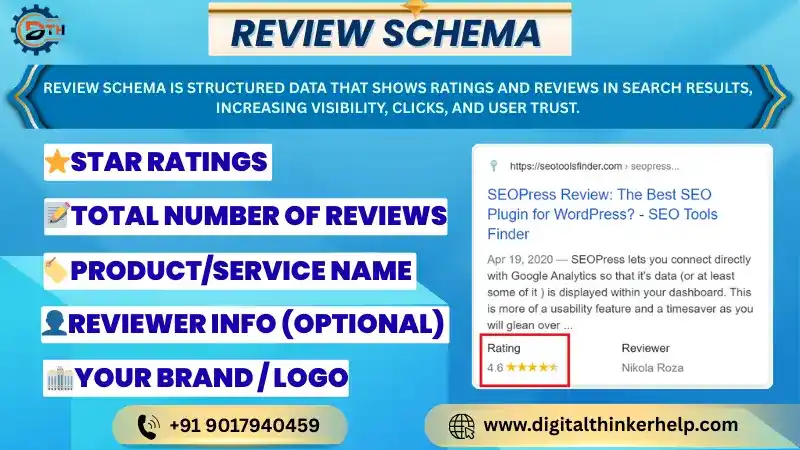
As you know, star ratings, high review counts, and honest feedback can make a website stand out in search results. These are the key elements of review schema markup on a page. Proper implementation helps increase online visibility, build trust, and attract more clicks in your SERP listing.
While organic search rankings grow slowly, pages often get pushed down over time. Review schema not only builds trust but also occupies valuable pixel space in search results, making your listing more noticeable.
Review schema is a type of structured data that tells search engines about reviews on your website. By adding extra code to your page, you can clearly provide information such as:
Who wrote the review
What was reviewed (product, service, book, course, or movie)
The rating or score given
Optional details like review date or a short description
Implementing review schema correctly allows your site to display rich results in Google search, including review counts, star ratings, and snippets. However, keep in mind that Google does not guarantee that schema markup will always appear as a rich result.
In a sea of plain text results, review schema helps your listing stand out, especially on mobile devices. Star ratings catch attention and increase clicks.
Trust begins in search results. Positive reviews and ratings displayed upfront build confidence and encourage users to click your listing. Rich snippets with stars often outperform plain listings in terms of click-through rate (CTR).
Although review schema is not a direct ranking factor, it helps search engines understand your content better. This increases the chances of your website appearing prominently in relevant searches.
Review schema can add social proof to your knowledge panel for businesses. It helps boost trust and brand authority, making your site more reliable in the eyes of potential customers.
There are two main types of review schema used for Google:
These focus on a single review. They are often found in user feedback or editorial reviews and include detailed comments along with the reviewer’s name.
This schema summarizes multiple reviews by showing the total number of reviews and the average rating. Aggregate ratings are ideal for businesses, products, or services with many customer reviews.
When implemented properly, review schema can make your listing more attractive and easier for users to notice:
Star ratings (1–5 scale)
Total review counts
Average scores
Individual reviewer names
This converts a normal search result into a standout snippet that attracts clicks.
If not implemented correctly, review schema can cause errors, penalties, or reduce your chances of appearing in rich results, which is why every Web Development Company in India must follow best practices to avoid common mistakes and fix them properly.
Issue: Many websites mix up aggregate ratings and single reviews.
Fix: Use aggregate schema for multiple reviews and simple review schema for individual reviews.
Issue: Adding reviews written by yourself or your team violates Google’s policy.
Fix: Only use real reviews from genuine customers. Avoid self-written content.
Issue: Adding review schema on pages without actual reviews, like homepages or category pages, violates Google rules.
Fix: Only implement review schema on pages with actual reviews, such as product or service pages.
Issue: Leaving out required fields like author, date published, or rating makes the schema invalid.
Fix: Always fill all required fields with accurate information.
Issue: Using ratings outside the 1–5 range or displaying different ratings on the page vs. schema.
Fix: Stick to a 1–5 rating scale and ensure schema matches visible ratings.
Issue: Incorrect placement of schema inside another type, like Product schema, can cause errors.
Fix: Follow Google’s structured data rules and nest schemas correctly.
This tool lets you test if your page is set up correctly for rich snippets, including star ratings. You can check your URL or paste your code to see errors and get hints for fixing them.
Previously called Schema Markup Validation Tool (SMV), this validator checks your markup against schema.org standards. It points out missing fields or wrong item types and reviews JSON-LD, Microdata, or RDFa.
Using these tools ensures your structured data is ready to perform well and helps your pages appear in rich results, improving visibility and engagement.
Go to WordPress Dashboard > Settings > Schema Pro and click Add New.
Choose the schema type as Review.
Select pages or posts to apply the schema. Set rules to exclude certain pages if needed.
Fill in all required schema properties carefully.
Make reviews visible on your web pages
Focus schema on specific items (products/services), not categories
Update ratings regularly with new reviews
Only use reviews from real customers, not external or self-written
Include reviewed by and published info to enhance trust
Consider adding editor schema if an editing process exists
Following these best practices improves clarity in search results, attracts more visitors, and builds trust.
How Does Review Schema Impact SEO?
It makes search results more attractive with star ratings and review summaries, increasing clicks and engagement.
Can Fake Reviews Harm SEO?
Yes. Fake reviews can result in penalties, damage trust, and harm your brand reputation.
Why Is Review Schema Important for SaaS Companies?
It shows customer feedback, builds trust, and makes listings stand out, increasing leads and conversions.
Review schema is a powerful way to make your website stand out in search results. When implemented correctly, it helps:
Increase visibility in SERPs
Build trust with users
Showcase ratings and reviews effectively
Improve click-through rates
Always use the right tools, follow structured data rules, and test your schema to ensure maximum results. By staying updated and careful, review schema can guide users to see the unique value your website offers.

© 2025 Crivva - Hosted by Airy Hosting Managed Website Hosting.