

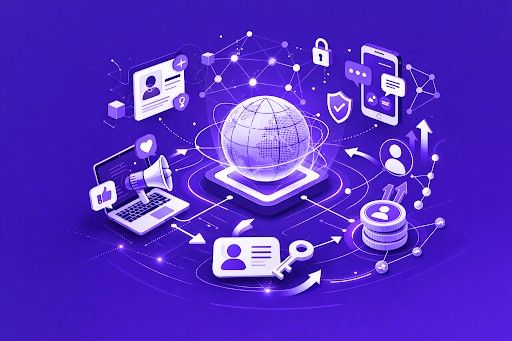
Social media has become a big part of our daily life. We use it to connect with friends, share photos, watch videos, follow celebrities, and learn new things. Platforms like Facebook, Instagram, X (Twitter), and TikTok have changed the way the world communicates.
But over time, people have started noticing some major problems with traditional social media. Many users feel that they don’t really control their own content. Creators feel they don’t get fair rewards. Communities feel they are controlled by algorithms and platform rules.
This is where Web3 social media comes in.
Web3 social media is a new type of social platform built using blockchain and decentralized technology. It aims to give users more control, better privacy, and real ownership over their content and identity. This shift is not just a trend – it may become the next big evolution of the internet.
In this article, we will explore what Web3 social media is, how it works, why it matters, and what the future looks like for decentralized social platforms.
Web3 social media refers to social platforms built on decentralized systems rather than a single company’s servers. In simple words, Web3 social media is designed so that users can own their content, identity, and even their digital assets.
In traditional social media (also called Web2), the platform owns:
Even though you create the content, the platform controls everything. It can remove posts, suspend accounts, change algorithms, and even reduce your reach without warning.
Web3 social media changes this idea. It focuses on giving ownership back to users. This is why many startups are now investing in web3 application development to build social platforms where users have more power.
Before understanding Web3 social media, it helps to know why people want a change.
Even if you post something original, the platform controls it. Your content can be removed or hidden anytime.
Creators work hard to build communities, but they earn mostly through ads, sponsorships, or platform-controlled monetization.
Traditional platforms collect a huge amount of user data. This data is often used for advertising and tracking.
Most platforms decide what content you see. Many users feel manipulated by algorithms.
Sometimes accounts are banned unfairly. Creators can lose years of work overnight.
These issues are pushing users toward new options, including decentralized platforms supported by web3 development services.
Web3 social media uses blockchain technology to store and manage important data. But it doesn’t mean everything is stored on the blockchain directly.
A typical Web3 social platform includes:
Many businesses partner with a web3.0 development company to design these systems correctly, because Web3 social platforms require strong security, scalability, and smart contract logic.
Let’s look at the main features that make Web3 social media different.
In Web3 social media, users often log in using a crypto wallet. This means:
This is a common part of web3 application development, especially when building social platforms that focus on security and user control.
One of the biggest problems in Web2 is that your followers are locked inside one platform.
For example:
If you have 100,000 followers on Instagram and your account gets banned, you lose everything.
In Web3 social media, platforms can support portable followers. This means your connections can be moved to another platform if needed.
This feature is often built using advanced web3 development solutions.
Web3 social media is more creator-friendly. Many platforms allow creators to earn through:
Instead of relying only on ads, creators can earn directly from their audience.
This is why many creators and startups are looking for web3 development services to build monetization tools that feel simple and user-friendly.
NFTs are not just for art anymore. In Web3 social platforms, NFTs can be used for:
This creates a new type of social experience where users can join communities based on ownership and participation.
A professional web3.0 development company can help brands and creators build these NFT-based social ecosystems.
Moderation is a major issue in traditional platforms. Users often complain about unfair bans, biased rules, or lack of transparency.
In Web3, moderation can be handled through:
This does not mean Web3 platforms have no rules. It simply means rules can be more open and community-driven.
Popular Examples of Web3 Social Media
Web3 social platforms are still growing, but the ideas are becoming popular.
Some common Web3 social formats include:
Many of these platforms require strong web3 application development to ensure the user experience feels smooth like Web2, while still keeping the benefits of decentralization.
Now let’s explore why Web3 social media matters and how it benefits users and creators.
In Web3, your identity is not controlled by a company. Your wallet becomes your digital identity.
This can reduce the risk of:
It also gives users more freedom to move between platforms.
Creators are the heart of social media, but Web2 platforms often take most of the value.
Web3 aims to reward creators more fairly by enabling:
This is one of the biggest reasons creators support decentralized social platforms.
Web3 platforms can be designed to collect less data. Instead of tracking users for ads, many Web3 platforms use alternative monetization models.
This helps users feel safer and more respected.
Since blockchain data is verifiable, Web3 platforms can provide transparency in areas like:
This creates more trust between users and the platform.
Many brands and startups are entering the Web3 social space because it offers strong long-term benefits.
Instead of depending on Facebook or Instagram algorithms, brands can create their own communities where users have a real stake.
This is why web3 application development is becoming a growing industry for companies building the next generation of social experiences.
The internet is moving from platform ownership to user ownership.
This shift can create a more fair digital world where people are rewarded for their contributions.
In the future, we may see:
To build this future, startups will continue working with a web3.0 development company and adopt reliable web3 development solutions for long-term growth.
Web3 social media is not just another trend. It represents a major shift in how people interact online. Instead of being controlled by centralized platforms, users can own their content, identity, and communities.
While Web3 social platforms still have challenges like scalability and user experience, the direction is clear. People want more privacy, fairness, and ownership.
As blockchain technology improves, decentralized social platforms will become easier, faster, and more popular.
For brands, creators, and startups, now is the perfect time to explore Web3 social media with the help of expert web3 development services and modern web3 application development strategies.
Because the future of social media is not just about posting content—it’s about owning it.

© 2025 Crivva - Hosted by Airy Hosting Managed Website Hosting.