

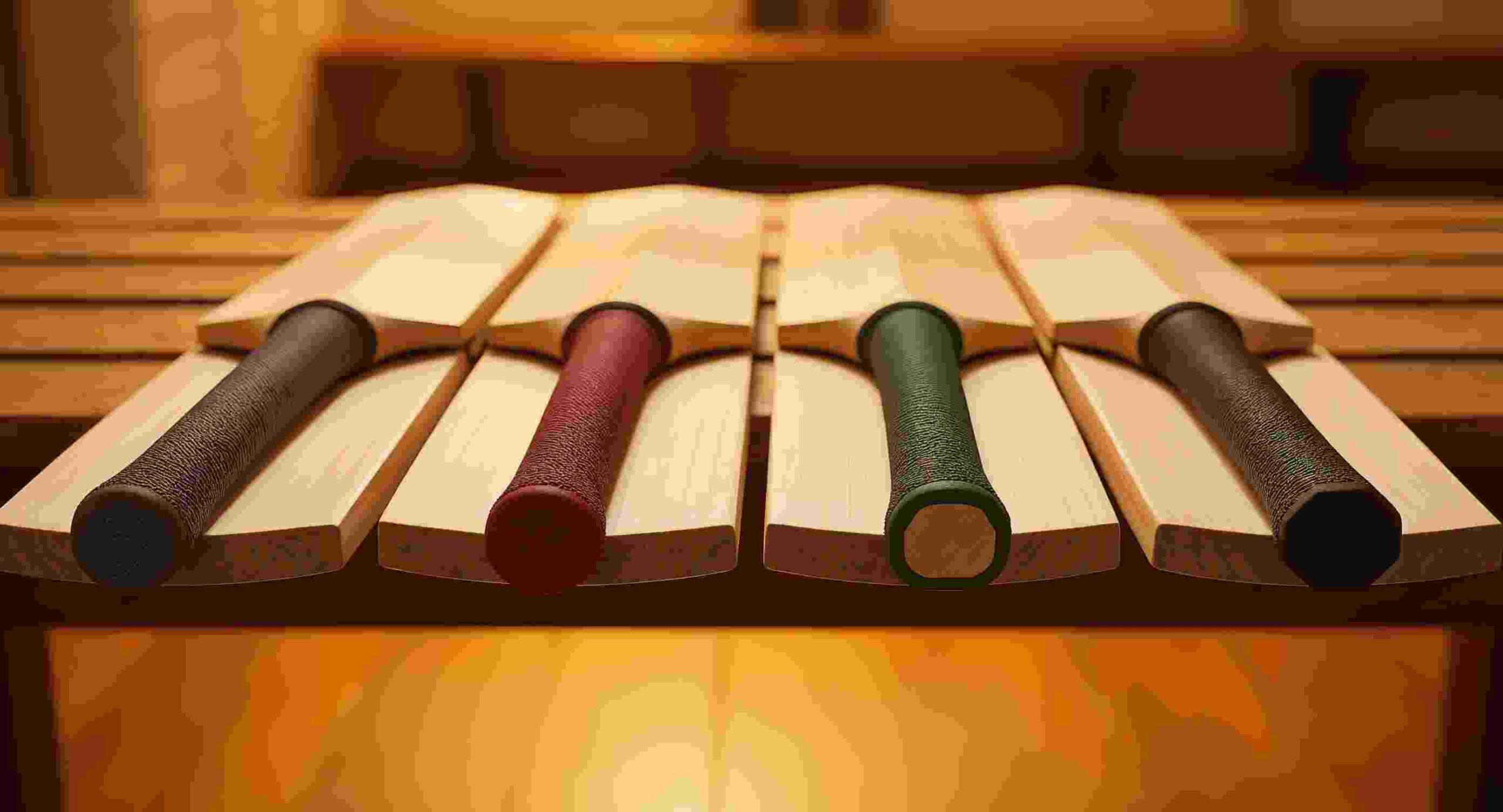
Walk into a well-stocked cricket shop and the sheer variety can be overwhelming. Blades in different grades, profiles for different styles, bats built for pace pitches and others tuned for spin — it’s a lot to process. Understanding the types of cricket bats available in today’s market is the first step toward making a purchase you won’t regret before the season is out.
This guide covers everything — from willow grades to bat profiles, from format-specific choices to what’s actually available across the Indian market and beyond.
Before anything else, there’s one distinction that underpins all different types of cricket bats: the species of willow used for the blade.
English willow is grown primarily in Essex, England, and is the gold standard for cricket bat manufacturing. Its unique cellular structure — fine-grained, fibrous, and relatively soft — gives it the combination of shock absorption, responsiveness, and durability that serious players demand.
All professional and high-performance bats are made from English willow. At the upper end of the market, a Grade 1 English willow bat is a genuinely beautiful piece of sporting equipment.
Ideal for: Club players, regional players, professionals, serious recreational cricketers.
Grown in the Kashmir Valley of India, this willow is denser and heavier than its English counterpart. It lacks the same responsiveness, but it’s significantly more affordable and considerably more durable.
For beginners learning the game, Kashmir willow is entirely appropriate. The performance gap only becomes meaningful as skill and shot-making develop.
Ideal for: Beginners, children in early development, school cricket, training use.
Within English willow, bats are graded based on the quality of the wood — primarily the number, straightness, and spacing of the grains on the face.
Grade 1 (Top Grade)
The finest available. Straight, closely spaced grains (ideally 6–10 per bat face), minimal or no blemishes, pure white wood. These bats require little oiling and are match-ready quickly after knock-in. They perform with the most responsiveness and generally offer the best value over their lifespan — though they carry the highest price tag.
Grade 2
Slightly wider or less even grains, possibly some minor discolouration. Performs very well and suits the vast majority of club and regional players. Often the best value-for-money option in a quality bat range.
Grade 3
Wider grains, possible minor blemishes or knots. Still a solid English willow bat that performs well — particularly after a thorough knock-in period. A good starting point for players transitioning from Kashmir willow.
Grade 4 and Below
Training bats, practice bats, or budget English willow. May have significant blemishes and wider grains. Functional but not ideal for high-level match play.
Beyond the wood grade, the physical shape of the blade — its profile — determines how the bat plays and who it suits.
Flat face, moderate edges, relatively even distribution of weight through the blade. These bats favour technique over raw power — well-suited to players who play straight, rely on timing, and value bat control over hitting distance.
Classic profile bats have experienced something of a revival in Test cricket, where long innings demand consistency over power.
Thicker edges, pronounced spine, weight pushed toward the mid-blade and lower portion. These bats are built for power hitting — T20 cricket, aggressive stroke play, boundary hitting. The trade-off is slightly less maneuverability and a higher pickup weight.
Most bats in today’s market lean toward this profile due to the explosion of T20 cricket worldwide.
A concave scoop on the back of the bat removes wood — and therefore weight — from the spine, redistributing mass to the edges and blade face. The result is a bat that feels lighter than its actual weight, with thick edges that still pack considerable power.
These bats are particularly popular in T20 formats and among players who prefer a lighter pickup without sacrificing edge thickness.
Players at this level generally favour:
The priority is consistency, feel, and durability over long innings — not maximum power on every delivery.
A blend of the two worlds. ODI batting requires both the ability to build an innings and accelerate at the death. Most ODI specialists use:
The modern T20 bat is built for maximum impact. Key features:
T20 cricket has fundamentally changed bat design. Edges that would have seemed absurd twenty years ago are now standard.
India is one of the world’s largest cricket equipment markets, with everything from affordable Kashmir willow bats to premium Grade 1 English willow available at a wide range of price points.
Popular categories in the Indian market:
Kashmir Willow Bats (₹500–₹3,000)
Widely available and suitable for school cricket, net sessions, and beginners. Brands like BDM, Thrax, and various regional manufacturers produce reliable options at this level.
Grade 3–4 English Willow (₹3,000–₹7,000)
Entry-level English willow for developing club players. Offers a significant performance step up from Kashmir willow.
Grade 2 English Willow (₹7,000–₹18,000)
The sweet spot for most serious club and district-level players in India. Brands like SS, SG, MRF, BAS, and international names like Gray-Nicolls and Kookaburra are well-represented here.
Grade 1 English Willow (₹18,000–₹50,000+)
Premium bats used by serious club players, state-level cricketers, and professionals. Performance at this level is exceptional — but requires proper preparation and care to realise its full potential.
Bat weight is one of the most personal aspects of equipment selection — and one that’s often misunderstood.
A heavier bat doesn’t automatically hit the ball harder. Bat speed matters enormously. A batsman swinging a 1350g bat slowly will not out-hit someone swinging a 1200g bat at full speed.
General weight guidelines:
The “pick-up” — how a bat feels when you pick it up and take a stance — is more important than the actual weight on a scale. A well-balanced bat will feel lighter than its weight suggests.
Regardless of which type you choose, proper maintenance extends bat life significantly:
Q1. What is the best type of cricket bat for beginners?
For absolute beginners and young players, a good-quality Kashmir willow bat is the right starting point. It’s affordable, durable, and perfectly capable for developing the fundamentals. English willow becomes worthwhile once technique and commitment to the game are established.
Q2. What are the different types of cricket bats available in India?
In India, you’ll find Kashmir willow bats, Grade 3–4 English willow (entry-level), Grade 2 English willow (mid-range club level), and Grade 1 English willow (premium). Bats are also categorised by profile — traditional, power, and scooped — and by format suitability.
Q3. How do I choose the right cricket bat weight?
The best approach is to pick up the bat and simulate your batting stance and swing. The bat should feel manageable through a full drive without strain. If you’re fatiguing after 10 swings, the bat is too heavy. Most adult club players are comfortable in the 1180g–1280g range.
Q4. Is English willow really that much better than Kashmir willow?
For performance, yes — particularly at higher skill levels. English willow offers better responsiveness, natural spring, and lighter weight for the same volume of wood. Kashmir willow is denser and less reactive, which matters more as a batsman develops timing and power. For beginners, the difference is less significant.
Q5. How long does a good cricket bat last?
A Grade 1–2 English willow bat, properly maintained and knocked in, can last 3–5 seasons of regular club cricket. Poorer grades or poorly maintained bats may only last one or two seasons. Kashmir willow bats tend to last longer physically but degrade in performance more noticeably over time.

© 2025 Crivva - Hosted by Airy Hosting Managed Website Hosting.