

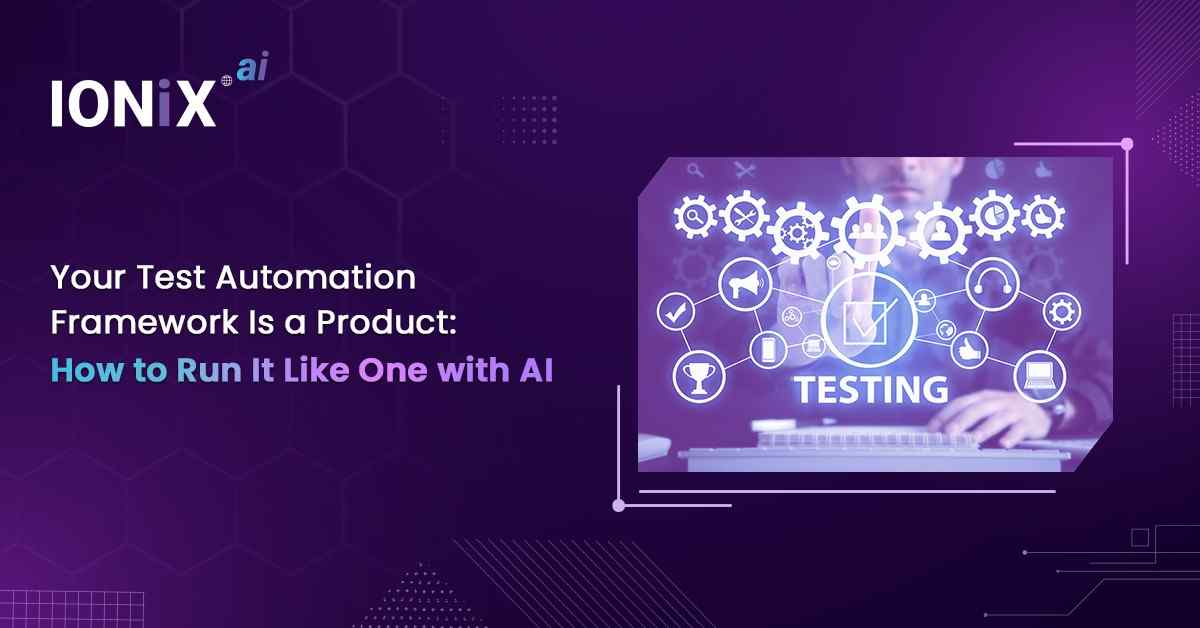
Most organizations still treat test automation as a side project. Scripts are written, frameworks evolve organically, and ownership shifts between teams as priorities change. Over time, the automation stack grows, but reliability, trust, and usability often decline. This is not a tooling problem. It is a product management problem.
Modern engineering organizations are beginning to recognize that a test automation framework as a product requires the same rigor applied to customer-facing platforms. It needs ownership, roadmaps, service guarantees, and continuous improvement. Without this mindset, even the most advanced tools fail to deliver lasting value. As IonixAI is on the shift to centralize how enterprise modern architecture works. This help organisazations apply product thinking, supported by Artificial Intelligence to the QA platform itself.
At IonixAI, this shift is central to how enterprises modernize quality engineering – by applying product thinking, supported by AI, to the QA platform itself. This AI-powered approach allows for a quicker time to market, which reduces escape defects and helps align with QA and DevOps pipelines. Enterprises earn intelligent orchestrations through self-healing tests, and adapt to code changes while analytics uncover hidden bottlenecks. Thus, for IT consulting firms handling Oracle EBS modernizations or cloud migrations, IonixAI delivers scalable quality engineering that evolves with the transformation and demanding work. This helps ensure robustness, reliability, and streamlines various deployments without compromising speed.
Traditional automation frameworks grow reactively. Tests are added to fix immediate gaps, tooling decisions are made tactically, and maintenance becomes nobody’s explicit responsibility.
The symptoms are familiar:
When automation is treated as infrastructure alone, it degrades. Treating the test automation framework as a product reframes it as something that must deliver value continuously to its users – developers, QA engineers, and release managers.
Every product starts with its users. In QA platforms, users are internal but no less demanding.
Typical user personas include:
A product operating model QA aligns the framework roadmap to these users’ needs rather than isolated test requirements.
Products have owners. Frameworks often do not. Running automation like a product means assigning:
This ownership model is foundational in platform engineering, where internal platforms are treated as first-class products rather than shared utilities.
Automation backlogs typically list test cases. Product roadmaps prioritize outcomes.
A QA platform roadmap focuses on:
This shift enables teams to define SLOs for quality, such as acceptable flakiness rates, execution reliability, and signal accuracy – metrics that matter far more than raw coverage counts.
Traditional frameworks struggle to meet SLOs because they are static. AI introduces adaptability.
With AI-driven systems, platforms can:
This intelligence allows the test automation framework as a product to improve itself continuously – something manual frameworks cannot achieve at scale.
IonixAI embeds this agentic intelligence directly into the QA platform, reducing maintenance overhead while increasing trust.
Infrastructure teams define SLOs for availability and latency. QA platforms need the same discipline.
Meaningful SLOs for quality include:
These metrics transform QA from a reactive function into a predictable service aligned with business risk.
Modern platform engineering has shown that internal platforms succeed when they:
Applying these principles to QA platforms means hiding brittle test logic behind intelligent systems, offering standardized workflows, and optimizing for trust and speed. This is where AI-driven QA platforms outperform traditional frameworks – by acting as self-improving internal products.
IonixAI is designed to help teams run QA like a product, not a project. Its agentic architecture continuously observes test behavior, adapts execution, and explains outcomes.
Key capabilities include:
These capabilities allow organizations to operationalize a product operating model QA without rebuilding their automation stack from scratch.
Running QA as a product requires a mindset shift. Teams move from owning individual tests to stewarding a shared platform.
This cultural change includes:
Organizations that embrace this shift see higher adoption, better signal quality, and faster releases.
Success is no longer defined by how many tests exist, but by how well the platform serves its users.
Effective indicators include:
These outcomes validate that the test automation framework as a product is delivering real, sustained value.
As systems grow more complex, QA platforms must become more autonomous. Manual upkeep cannot scale.
AI-driven platforms, built with product thinking and grounded in platform engineering, represent the future of quality assurance. They do not just validate software – they continuously improve the reliability of the delivery system itself.
If your automation framework feels brittle, slow, or untrusted, the issue is not effort – it is the operating model. Explore how IonixAI helps organizations run their test automation framework as a true internal product – powered by AI, guided by SLOs for quality, and aligned with modern platform engineering principles.
Ready to run your test automation like a true product? Reach out to us at IonixAI to align QA platforms with SLOs, AI intelligence, and product-grade operations.

© 2025 Crivva - Hosted by Airy Hosting Managed Website Hosting.