

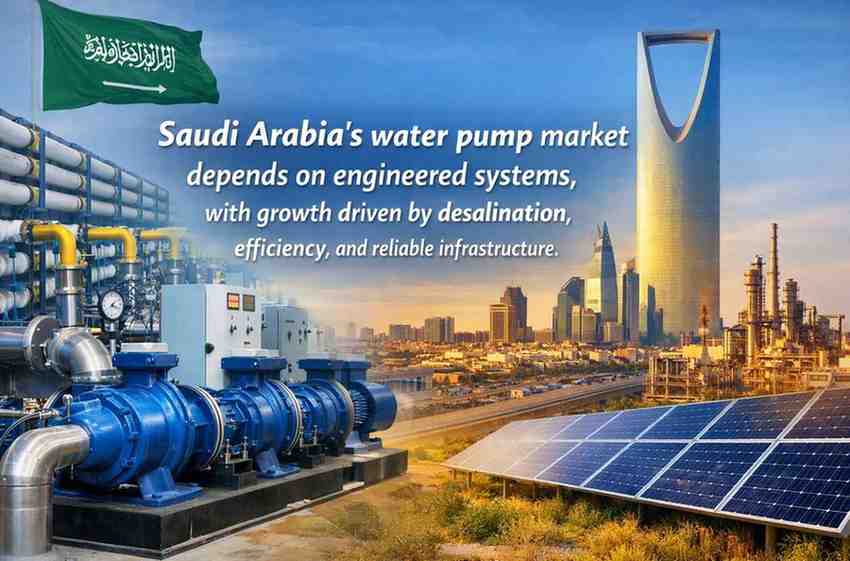
Water management is a central concern in Saudi Arabia, where natural water scarcity continues to shape infrastructure planning, industrial operations, and long-term policy decisions. Unlike regions with abundant freshwater resources, Saudi Arabia depends heavily on engineered systems to ensure consistent water availability. Within this framework, water pumps play a critical and often underappreciated role. They support the efficient movement, treatment, and utilization of water across residential, commercial, and industrial environments.
As per the study published by Vyansa Intelligence, the Saudi Arabia water pump market is valued at $755 million in 2025 and is projected to reach $925 million by 2032, growing at a CAGR of 2.94% between 2026 and 2032. This steady growth reflects a market that is closely tied to infrastructure development and long-term resource management strategies rather than short-term demand fluctuations. The market is defined by consistent usage patterns, supported by essential applications across multiple sectors.
Water pumps form the backbone of water distribution systems in Saudi Arabia. They are responsible for moving water across long distances and varying elevations, which is particularly important in a country where natural water sources are limited. Groundwater availability is constrained, and desalination has become the primary method for producing potable water.
In this context, efficient pumping systems are not optional. They are essential for maintaining supply continuity. From desalination plants to residential buildings, pumps ensure that water flows at the required pressure and reaches end users without interruption.
Their applications extend beyond basic supply. Water pumps are used in irrigation systems to support agriculture, in wastewater management for treatment and recycling, and in industrial operations for cooling and fluid handling. This wide range of applications highlights their importance across the entire water value chain.
Guidance from the Saudi Water Authority emphasizes the need for advanced water infrastructure to support sustainable resource management. Pumps are a key component of this infrastructure, enabling efficient use of limited water resources.
Saudi Arabia’s ongoing infrastructure development is a major driver of demand for water pumps. The country is investing heavily in urban expansion, smart city projects, and industrial zones as part of its long-term economic diversification strategy.
Large-scale developments require reliable water distribution systems. Residential complexes, commercial buildings, and public infrastructure all depend on integrated pumping solutions to ensure consistent water availability. These systems are designed to operate continuously, which creates steady demand for durable and efficient pump technologies.
Wastewater treatment infrastructure is another important area of growth. As the country focuses on improving sanitation and promoting water reuse, the need for advanced pumping systems continues to increase. Treated wastewater is being used for irrigation and industrial purposes, which reduces pressure on freshwater resources.
The scale and continuity of these projects create a stable demand environment. Growth is gradual but consistent, reflecting the long-term nature of infrastructure investments.
Industrial sectors play a significant role in shaping the Saudi Arabia water pump market. Industries such as oil and gas, petrochemicals, and power generation rely heavily on water for various operational processes.
In these sectors, pumps are used for cooling systems, fluid transfer, and waste management. The requirements are often complex, involving high-capacity and high-pressure systems designed to operate under demanding conditions.
Reliability is a critical factor. Any failure in pumping systems can disrupt operations, leading to financial losses and safety risks. As a result, industries prioritize durable and efficient pump solutions that can maintain performance over extended periods.
Regulatory standards and operational requirements also influence system design. Pumps must meet specific performance criteria to ensure safety and efficiency, which drives demand for high-quality products.
Saudi Arabia is one of the largest producers of desalinated water globally. This reliance on desalination creates significant demand for water pumps at multiple stages of the process.
Pumps are used for seawater intake, high-pressure processing, and distribution of treated water. Each stage requires specialized equipment capable of handling different operational conditions. The efficiency of these systems directly impacts overall water production and distribution.
Water treatment and reuse initiatives are also expanding. The government is investing in facilities that treat wastewater for reuse in agriculture and industry. This not only conserves freshwater resources but also creates additional demand for pumping systems.
Organizations such as the Saline Water Conversion Corporation play a central role in advancing desalination infrastructure. Their projects indirectly support the growth of the water pump market by increasing the need for advanced pumping solutions.
Technological innovation is gradually improving the performance and efficiency of water pumps in Saudi Arabia. Modern systems are designed to reduce energy consumption while maintaining high output levels, which is particularly important in large-scale applications.
Energy efficiency has become a key focus area. Pumping systems can consume significant amounts of power, especially in desalination and industrial processes. Advanced designs and control systems help optimize performance and reduce operational costs.
Automation is another important trend. Smart monitoring systems allow operators to track pump performance in real time and identify potential issues before they lead to failure. This improves reliability and reduces maintenance costs.
Integration with digital infrastructure is also increasing. Pump systems are being connected to centralized control platforms, enabling better coordination and system management. These developments are part of a broader shift toward smarter and more efficient infrastructure.
The Saudi Arabia water pump market includes a mix of local suppliers and international manufacturers. Companies are focusing on meeting the specific requirements of large-scale infrastructure and industrial projects.
Supply chain efficiency is essential for ensuring timely delivery and installation. Delays in equipment supply can impact project timelines and operational readiness, making logistics an important factor in market dynamics.
Maintenance and after-sales services are also critical. Water pumps require regular servicing to maintain performance and reliability. Companies that offer strong service support often have a competitive advantage.
Manufacturers are investing in distribution networks and service capabilities to support long-term customer relationships. This focus on service is becoming an important differentiator in the market.
Despite steady demand, the market faces several challenges. High initial costs can influence purchasing decisions, particularly in smaller projects with limited budgets.
Energy consumption remains a concern. While efficiency improvements are being made, large-scale pumping systems still require significant power. This can increase operational costs, especially in energy-intensive applications.
Environmental considerations are also becoming more important. Managing the impact of water extraction, desalination, and wastewater treatment requires careful planning and adherence to regulatory standards.
Harsh environmental conditions present additional challenges. Extreme temperatures and sand exposure can affect equipment performance and increase maintenance requirements.
Addressing these issues will be important for sustaining long-term market growth and ensuring system reliability.
The Saudi Arabia water pump market reflects the country’s broader focus on infrastructure development and efficient resource management. Growth is steady and aligned with long-term planning rather than rapid market shifts.
The projected CAGR of 2.94% indicates moderate expansion supported by consistent demand across multiple sectors. Water pumps will continue to play a critical role in ensuring the effective distribution, treatment, and reuse of water.
As highlighted in analysis by Vyansa Intelligence, the market’s development is closely tied to the need for sustainable water management solutions. Its importance extends beyond individual applications, supporting economic activity, industrial operations, and long-term environmental goals.

© 2025 Crivva - Hosted by Airy Hosting Managed Website Hosting.