


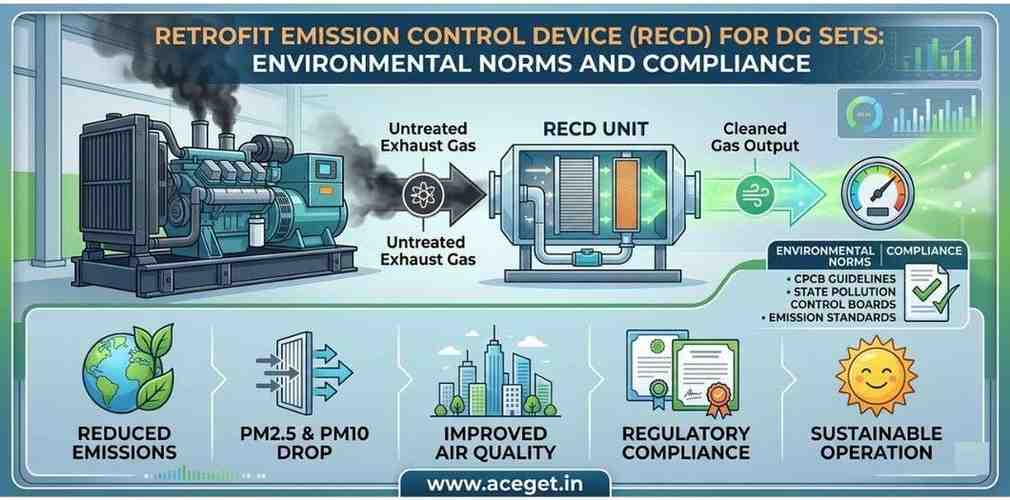
Diesel Generator (DG) sets have long been a reliable source of backup and continuous power across industries, commercial establishments, and residential complexes. However, their environmental impact particularly in terms of air pollution has become a growing concern. With increasing awareness of climate change and public health risks, governments and regulatory bodies have introduced stringent emission norms. In this context, the Retrofit Emission Control Device (RECD) has emerged as a practical and effective solution to ensure compliance without replacing existing DG infrastructure.
A Retrofit Emission Control Device (RECD) is an advanced pollution control system installed on the exhaust of existing diesel generator sets. Its primary function is to reduce harmful emissions such as particulate matter (PM), nitrogen oxides (NOx), carbon monoxide (CO), and hydrocarbons (HC).
Unlike modern generators that come equipped with built-in emission control technologies, older DG sets lack such systems. RECDs bridge this gap by retrofitting emission reduction mechanisms without requiring major modifications to the generator itself.
These devices typically use a combination of filtration and catalytic processes such as diesel oxidation catalysts (DOC) and particulate filters to convert toxic pollutants into less harmful substances before they are released into the atmosphere.
DG sets are significant contributors to urban air pollution, especially in densely populated and industrial regions. They emit high levels of particulate matter and toxic gases, which can lead to respiratory diseases, environmental degradation, and reduced air quality.
In cities already struggling with pollution from vehicles, construction, and industrial activity, DG sets add to the burden. Recent discussions in India highlight that controlling DG emissions is essential for improving air quality and protecting public health.
The need for emission control is not just environmental it is also regulatory. Non-compliance can lead to penalties, operational restrictions, and reputational risks for businesses.
India has introduced a robust regulatory framework to control emissions from diesel generators. The Central Pollution Control Board (CPCB) plays a key role in defining and enforcing these standards.
The CPCB has established emission norms for DG sets, including limits on PM, NOx, CO, and HC emissions. These norms have evolved over time, with stricter standards such as CPCB II and CPCB IV+ targeting both new and existing generators.
As per recent guidelines, DG sets manufactured between 1 July 2004 and 20 June 2023 are required to install RECD systems to meet emission standards.
This mandate applies particularly to high-capacity generators (typically above 125 kVA), which contribute significantly to pollution levels.
The Commission for Air Quality Management (CAQM) and the National Green Tribunal (NGT) have issued directives mandating emission control measures in regions like Delhi-NCR. These include the compulsory use of CPCB-approved RECDs for older DG sets.
Compliance is not limited to installing any RECD it must be sourced from CPCB-approved vendors. Authorities verify documentation, testing standards, and installation procedures during inspections.
RECD systems incorporate various emission control technologies depending on the DG set type and operational requirements:
These technologies work together to significantly reduce emissions often achieving reductions of up to 90% or more depending on system design and conditions.
The operation of a Retrofit Emission Control Device involves multiple stages:
This multi-stage process ensures that emissions are treated effectively before release into the environment.
The primary advantage of RECD installation is adherence to environmental norms set by CPCB, CAQM, and NGT. It helps organizations avoid penalties and operational disruptions.
RECDs can reduce harmful emissions by up to 90–96%, depending on technology and operating conditions.
Retrofitting is more economical than replacing existing DG sets with new compliant models, making it a practical option for businesses.
By lowering pollutant levels, RECDs contribute to cleaner air and better public health outcomes.
Proper emission control can improve engine efficiency and reduce wear, thereby increasing the lifespan of DG sets.
Despite its advantages, implementing RECD systems comes with certain challenges:
To ensure seamless compliance with emission norms, organizations should adopt a structured approach:
As environmental regulations continue to tighten, emission control technologies will evolve further. Innovations such as filter-less RECD systems, IoT-enabled monitoring, and advanced catalytic solutions are already emerging in the market.
In the long term, the shift toward cleaner energy sources may reduce dependence on diesel generators. However, until that transition is complete, RECDs will remain a critical tool for balancing energy needs with environmental responsibility.
Retrofit Emission Control Devices (RECDs) represent a vital step toward sustainable power generation in a world increasingly focused on environmental protection. By enabling older DG sets to meet modern emission standards, RECDs offer a practical, cost-effective, and regulatory-compliant solution.
With strict norms from CPCB, CAQM, and NGT, businesses can no longer afford to overlook emission compliance. Installing CPCB-approved RECD systems not only ensures legal adherence but also demonstrates a commitment to environmental stewardship.
As India continues its journey toward cleaner air and sustainable development, RECDs will play an essential role in transforming legacy infrastructure into eco-friendly assets bridging the gap between present energy demands and future environmental goals.

© 2025 Crivva - Hosted by Airy Hosting Managed Website Hosting.