

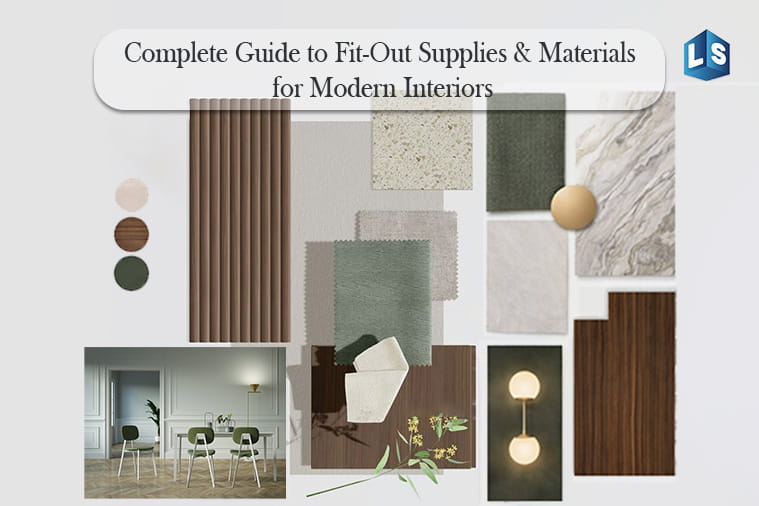
Every interior that holds its quality, serves its purpose, and continues to look considered years after completion was built on a foundation of informed material decisions. The fit-out phase is where those decisions become real — and for anyone whose work depends on getting them right, a clear understanding of fit-out supplies & materials is core professional competency, not optional background knowledge.
Fit-out refers to all the work carried out after a building’s structural shell is complete — installing the internal surfaces, joinery, furniture, and finishing components that make a space functional and finished. This is where design concepts meet physical materials, and where the decisions made by designers, contractors, and procurement professionals are translated into spaces that people inhabit every day.
Understanding fit-out materials — their properties, applications, and relative merits — is what allows professionals to specify confidently and source strategically.
If one material defines contemporary interior fit-out across more sectors than any other, it is high-pressure laminate. HPL surfaces appear on workstation tops, cabinet doors, wall panels, retail counters, and hospitality furniture — and their prevalence reflects a genuine alignment between designer needs and material capability.
HPL withstands the full range of interior surface stresses: heat, abrasion, impact, and repeated cleaning. It maintains surface integrity under sustained use in a way many alternatives cannot match at a comparable price point. The design range — spanning solid colors, woodgrain effects, stone textures, and finishes from matte to high-gloss — gives designers a genuinely expansive creative palette.
Natural timber carries associations of warmth and authenticity that influence how people experience interior spaces. The practical challenges of specifying real wood at scale — cost, maintenance demands, sensitivity to environmental conditions — make engineered alternatives essential.
Contemporary wood-effect laminates and panels reproduce grain depth, tonal variation, and surface texture with an accuracy that satisfies demanding design standards. They are used across residential furniture, corporate offices, hotel public areas, restaurant fit-outs, and retail environments — wherever timber aesthetics are desired but practical requirements argue for something more resilient.
Medium Density Fibreboard has been a cornerstone of interior fit-out for decades, and its position remains strong. For furniture fabrication and joinery work, MDF outperforms most alternatives where surface quality, dimensional consistency, and machining precision matter.
Its uniform composition makes it predictable to work with — it cuts cleanly, routes precisely, takes paint to a flawless finish, and accepts laminate without surface irregularities. For environments where humidity is a persistent factor, moisture-resistant fibreboard variants preserve these fabrication qualities while addressing the vulnerability to moisture-induced degradation that standard MDF would face.
Some fit-out applications push beyond what board products can reliably deliver structurally. Heavily loaded shelving, high-traffic partitions, and industrial-adjacent interiors all place demands that require genuine load-bearing capability.
Film-faced plywood meets these demands through engineered timber strength combined with a surface film that resists moisture and physical wear. Its versatility across both construction-phase and fit-out-phase work makes it a practical choice for contractors sourcing from a reliable building materials supplier who can ensure consistent availability across complex project programs.
Edge banding is where professional finish quality becomes visible. These finishing strips, applied to exposed panel and board edges, protect substrates from moisture, chipping, and wear while completing the visual finish of joinery with a level of detail that speaks directly to craftsmanship standards.
Its physical scale is modest. Its impact on perceived interior quality is not. Experienced designers and contractors treat edge banding specification as a detail that matters — because it is one of the first places where a shortcut in quality becomes apparent.
Precision cut-to-size supply has become an essential part of modern fit-out delivery. Materials arriving on-site ready for installation reduces on-site cutting, minimises waste, compresses timelines, and improves dimensional consistency throughout. For complex projects or fast-track programs, the operational efficiency gains are real, measurable, and cumulative.
The financial argument for quality fit-out materials is stronger than a simple upfront cost comparison suggests.
Materials engineered for performance maintain their visual and structural integrity under sustained use in ways cheaper alternatives cannot replicate. The condition of an interior at the five or ten-year mark is almost entirely a function of the quality of materials used to build it.
Every unplanned maintenance intervention or premature refurbishment resulting from material failure carries costs that were not budgeted for and could have been avoided. Quality materials reduce these events, generating lifecycle savings that routinely exceed the initial cost premium.
For design and construction professionals, there is also a reputational dimension. Spaces built from quality materials generate positive client experiences and referrals. Spaces that deteriorate prematurely generate the opposite.
Sustainability is an equally important consideration. Environmental responsibility in material specification has moved from optional to mainstream, embedded in client briefs and regulatory frameworks across most markets. The fit-out material industry has responded with products that carry genuine environmental credentials without compromising technical performance.
Residential projects rely on fit-out materials to create spaces that are aesthetically coherent and built to perform through daily family life. Kitchen and bathroom environments place particular demands on moisture resistance; living spaces prioritise finish consistency and aesthetic quality.
Commercial offices need materials that support productivity while communicating something authentic about the organisation occupying the space. Surface quality, durability, and the performance of workstation and partition systems all depend on material decisions made at specification stage.
Retail environments demand visual impact combined with operational resilience. Every surface contributes to the customer experience and must maintain that contribution through intensive daily footfall. Combining high-performance surface materials with well-specified flooring — such as porcelain floor tiles — creates interiors that earn their commercial value long after opening day.
Hospitality projects operate where luxury expectation meets relentless operational demand. Guests arrive with high aesthetic expectations, and surfaces throughout need to project quality convincingly while withstanding near-continuous use.
Healthcare and education environments impose specific requirements around hygiene, safety compliance, and intensive cleaning regimes — material-level considerations that demand genuine expertise in fit-out specification.
A specification document is a statement of intent. What converts that intent into a finished interior is the supply chain behind it. Inconsistent quality, limited product range, and unreliable lead times create project risk that translates into real financial and reputational consequences.
Suppliers who consistently add value share certain characteristics: comprehensive and consistent stock, rigorous quality standards, technical knowledge to support specification decisions, and the responsiveness to keep projects moving when circumstances change.
LS Trading and Contracting W.L.L. has built its reputation in the fit-out supply market by delivering on exactly these attributes — combining product breadth, quality consistency, and service reliability in a way that makes them a genuine operational partner for the professionals they work with.
The fit-out phase is where interior quality is ultimately determined — not in the design presentation or specification document, but in the materials themselves. Professionals who understand this treat fit-out material selection as the serious, consequential discipline it is. The interiors they deliver reflect that standard at every level, from the largest surface to the smallest detail.
Originally published on: https://www.lstcco.com/buy-fit-out-supplies-materials-for-interior-projects/

© 2025 Crivva - Hosted by Airy Hosting Managed Website Hosting.