


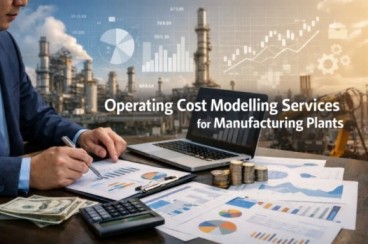
Operating cost modelling has become one of the most important parts of manufacturing project planning. Many factories focus heavily on land, machinery, and construction costs during the setup phase, but long-term profitability often depends more on how effectively the business controls raw material, labour, utility, maintenance, logistics, and compliance expenses after production begins.
For manufacturing plants, even small errors in operating cost assumptions can significantly affect profit margins, break-even periods, working capital requirements, and return on investment. This is why many companies now seek professional opex planning support service in India before launching a new factory or expanding an existing production facility.
Operating cost modelling is the process of estimating all recurring expenses required to run a manufacturing plant after commissioning. It helps businesses understand the true cost of production and evaluate whether the plant can remain commercially viable over the long term.
Manufacturing operating costs generally include:
Operating cost modelling is important because these expenses often represent a much larger long-term financial commitment than the initial capital investment itself. Manufacturing cost structures are typically built around direct materials, direct labour, manufacturing overhead, packaging, quality control, and logistics costs.
Consult Our Opex Planning Support Team: https://www.imarcengineering.com/services/capex-opex-planning-support
The first step in operating cost modelling is to define the expected production capacity of the plant and the mix of products that will be manufactured.
Businesses usually estimate:
This step is important because operating cost per unit changes significantly depending on whether the plant is operating at 50%, 70%, or 90% of installed capacity.
Factories operating below optimal utilization often experience higher production cost per unit because fixed operating expenses are spread across a smaller production volume.
Raw materials are usually the largest component of manufacturing operating costs.
Raw material modelling generally includes:
Manufacturing businesses should also consider wastage rates, rejected materials, yield losses, and supplier lead times while estimating raw material cost.
For industries such as food processing, pharmaceuticals, chemicals, plastics, and FMCG, raw materials often account for the largest share of production cost. Production cost models usually require detailed assumptions around material consumption, labour, equipment use, and yield losses.
Labour cost is another major component of plant operating expenses.
Labour planning generally includes:
Manufacturing plants should also include costs related to PF, ESI, bonuses, insurance, training, uniforms, safety equipment, and labour welfare.
Many businesses underestimate labour overhead, which can create significant gaps between planned and actual operating costs. Payroll overhead often includes insurance, pension contributions, paid leave, and other employee-related costs beyond basic wages.
Utilities are among the most volatile operating costs in manufacturing plants.
Utility cost modelling generally includes:
Manufacturing facilities with energy-intensive operations such as chemicals, pharmaceuticals, metals, textiles, food processing, and cold storage often spend a large portion of their OpEx on utilities.
Utility planning should consider future increases in electricity tariffs, fuel prices, water charges, and utility maintenance cost. Utility expenses typically include electricity, compressed air, steam, water treatment, and HVAC systems, which can have a major impact on total operating expenditure.
Maintenance is often underestimated in operating cost models, especially for plants with complex machinery and automation systems.
Maintenance cost planning usually includes:
Maintenance material costs are often estimated as a percentage of maintenance labour cost because they include oils, lubricants, tools, and small repair items. Plant overhead is also commonly calculated as a percentage of total labour and maintenance expenses.
Operating costs also include indirect expenses that are not directly linked to production.
These may include:
Factories in regulated sectors such as pharmaceuticals, food processing, and chemicals may also have recurring costs related to GMP, HACCP, FSSAI, ISO, environmental monitoring, and safety compliance.
Operating expenses are generally divided into production-related expenses and indirect administrative expenses. Efficient OpEx planning helps businesses improve profitability and long-term sustainability.
A good operating cost model should not rely on only one assumption.
Businesses should prepare multiple scenarios such as:
Sensitivity analysis helps businesses understand the impact of:
This is especially important because many industrial projects face cost overruns when estimates are based only on assumptions instead of detailed engineering and financial analysis. Manufacturers that use engineering-led OpEx planning generally achieve lower cost overruns, better financial performance, and higher funding approval rates.
Detailed operating cost models help businesses make better investment decisions before committing capital.
Professional opex planning support in India helps manufacturers:
The goal of OpEx planning is to ensure that operational costs remain aligned with revenue potential so the plant can remain profitable while supporting future growth.
IMARC Engineering
Phone: +91-120-433-0800
Email: [email protected]
India: C-130, Sector 2, Noida, Uttar Pradesh 201301
LinkedIn: https://www.linkedin.com/showcase/imarc-engineering/

© 2025 Crivva - Hosted by Airy Hosting Managed Website Hosting.