


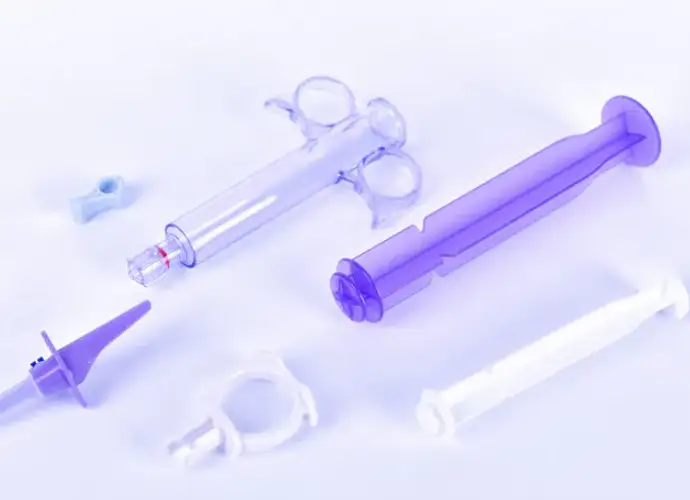
Medical injection molding plays a critical role in the production of modern healthcare devices. From disposable syringes and diagnostic housings to complex drug-delivery components, injection molded plastic parts are used across nearly every medical application.
Unlike general plastic manufacturing, medical injection molding operates under strict regulatory standards, demanding exceptional precision, material control, and process validation.
This article explores the key standards governing medical injection molding, the challenges manufacturers face, and how those challenges are addressed in real production environments.
Medical injection molding is a specialized manufacturing process used to produce plastic components for medical and healthcare applications. The process involves injecting molten medical-grade plastic into a precision-engineered mold to create parts with tight tolerances and consistent quality.
What differentiates medical injection molding from standard injection molding is not the machine itself, but the level of control, documentation, and compliance required throughout the entire production process. Every material, parameter, and process step must be validated and traceable.

ISO 13485 is the most important international standard for medical device manufacturing. It defines requirements for quality management systems specific to medical devices, including risk management, process control, and documentation.
Injection molding suppliers serving the medical industry must demonstrate:
Documented and repeatable processes
Full material traceability
Controlled production environments
Ongoing quality monitoring and corrective actions
Without ISO 13485 compliance, it is extremely difficult to supply regulated medical components.

In the United States, medical injection molding must comply with FDA Quality System Regulations. These rules govern design controls, production processes, and post-market monitoring for medical devices.
Injection molded medical parts must be produced under validated conditions, and any process changes require formal review and approval.
Many medical injection molded parts are produced in cleanroom environments, commonly ISO Class 7 or ISO Class 8. Cleanroom molding reduces the risk of contamination, which is especially important for components used in drug delivery, diagnostics, or implantable systems.
Material selection is one of the most critical decisions in medical injection molding. Materials must meet not only mechanical and thermal requirements, but also regulatory and biocompatibility standards.
Common medical-grade plastics include:
Polypropylene (PP) for disposable devices
Polycarbonate (PC) for transparent housings
PEEK for durable enclosures
Medical-grade nylon for structural components
Many medical applications require materials that comply with USP Class VI or ISO 10993 biocompatibility standards. Consistency between material batches is essential, as even small variations can affect performance or regulatory approval.

One of the biggest challenges in medical injection molding is maintaining compliance over time. Manufacturers must document:
Material certifications
Process parameters
Validation records
Inspection results
Any deviation, even minor, can trigger audits or production delays.
Medical components often require extremely tight tolerances, especially for parts involved in fluid control, sealing, or mechanical movement. Achieving this level of precision requires advanced mold design, stable molding processes, and continuous monitoring.
Contamination is a major risk in medical injection molding. Dust, oils, or material impurities can compromise device safety. Cleanroom production, strict handling procedures, and validated cleaning processes are essential to minimize this risk.
Medical-grade plastics can be sensitive to temperature, moisture, and shear. Inconsistent processing conditions can lead to defects such as warping, stress cracking, or dimensional variation. Maintaining process stability is critical for consistent quality.
Quality control in medical injection molding is significantly more rigorous than in general plastic manufacturing.
Key practices include:
Process validation (IQ, OQ, PQ)
In-process monitoring of critical parameters
Dimensional inspection using CMM or optical systems
Visual inspection for surface defects
Lot-level traceability
These controls ensure that every batch of medical injection molded parts meets both functional and regulatory requirements.
The complexity of medical injection molding means that supplier expertise matters as much as equipment. Experienced manufacturers invest in:
Advanced tooling and mold maintenance
Cleanroom infrastructure
Trained quality and regulatory teams
Continuous process improvement
Early collaboration between design engineers and injection molding specialists also reduces risk by addressing manufacturability and compliance concerns before production begins.
Medical injection molding is a highly controlled, standards-driven manufacturing process essential to modern healthcare. While the challenges—regulatory compliance, tight tolerances, contamination control, and material consistency—are significant, they are manageable with the right systems, expertise, and discipline.
For medical device companies, choosing an experienced injection molding partner is not just a manufacturing decision—it is a quality and risk management decision.
When standards are met and challenges are properly addressed, medical injection molding delivers safe, reliable, and scalable solutions for life-critical applications.

© 2025 Crivva - Hosted by Airy Hosting Managed Website Hosting.