


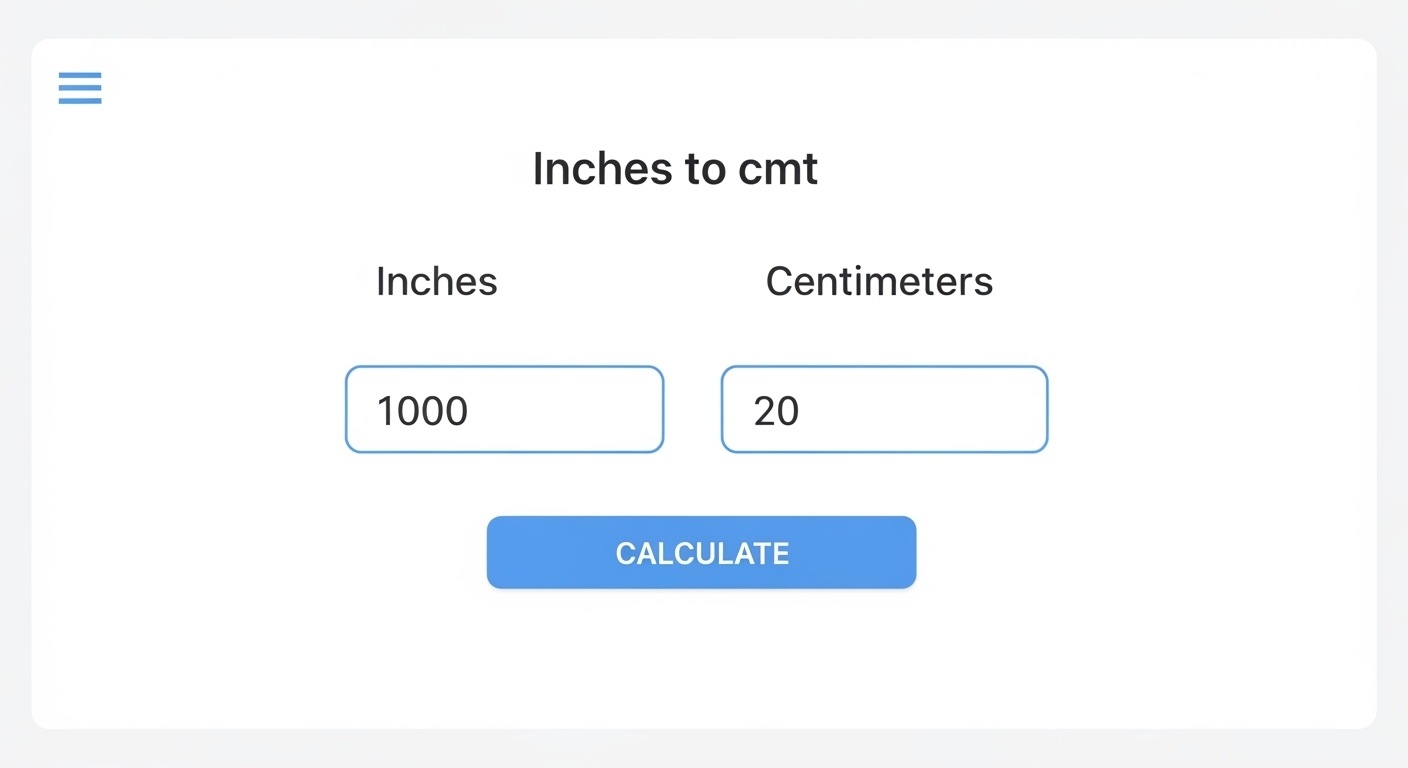
Converting inches to centimeters is one of the most common dimension conversions used in daily life, education, engineering, and international trade. Since different countries use different measurement systems, understanding how to convert inches into centimeters is essential for accuracy and communication. A reliable unit converter makes this process quick, easy, and error-free.
Whether you are measuring height, screen size, furniture, or product dimensions, knowing this conversion helps ensure precision.
Before learning the conversion, it is important to understand both units.
Inches are part of the imperial measurement system, commonly used in countries like the United States and United Kingdom. Inches are used for:
Height measurement
Screen sizes
Construction work
Clothing measurements
Centimeters, on the other hand, belong to the metric system, which is used in most countries worldwide. They are commonly used for:
Scientific measurements
Academic purposes
Product dimensions
Medical measurements
Because both systems are widely used, converting inches to centimeters is very important.
The standard formula for converting inches to centimeters is:
1 inch = 2.54 centimeters
To convert inches into centimeters:
Centimeters = Inches × 2.54
This formula provides accurate results for any value.
Here are some common examples:
1 inch = 2.54 cm
2 inches = 5.08 cm
5 inches = 12.7 cm
10 inches = 25.4 cm
12 inches = 30.48 cm
20 inches = 50.8 cm
30 inches = 76.2 cm
40 inches = 101.6 cm
50 inches = 127 cm
60 inches = 152.4 cm
These examples show how simple the formula is.
There are many situations where conversion is necessary.
Different countries use different measurement systems. Conversion ensures clarity.
Students need accurate conversions for mathematics and science.
Online shopping websites display sizes in both inches and centimeters.
Height and body measurements are often recorded in centimeters.
Precise measurements are critical for accurate work.
A unit converter helps professionals and students save time.
A unit converter is an online or digital tool that automatically converts measurements.
Instant results
Accurate calculations
Easy to use
Time-saving
No manual calculation
Simply enter the inches value and get the result immediately.
If you prefer manual conversion:
Step 1: Take the inches value
Step 2: Multiply by 2.54
Step 3: The result is in centimeters
Example:
15 inches × 2.54 = 38.1 cm
| Inches | Centimeters |
|---|---|
| 1 | 2.54 |
| 5 | 12.7 |
| 10 | 25.4 |
| 15 | 38.1 |
| 20 | 50.8 |
| 25 | 63.5 |
| 30 | 76.2 |
| 40 | 101.6 |
| 50 | 127 |
| 60 | 152.4 |
This table is useful for quick reference.
This conversion is used in many real-life situations.
Some countries use inches, while others use centimeters.
Example: 5 feet 10 inches = 177.8 cm
TV sizes are measured in inches, but some countries use centimeters.
Example: 55 inches = 139.7 cm
Furniture sizes often need conversion.
Different regions use different measurement units.
Accurate conversion is essential to avoid errors such as:
Product size mismatch
Construction mistakes
Engineering issues
Medical inaccuracies
Using a unit converter ensures accuracy.
Converting Inches to Centimeters is an essential skill because both units are widely used in different parts of the world. Inches belong to the imperial system, which is commonly used in the United States, while centimeters are part of the metric system, which is the global standard in most countries. This difference makes conversion necessary, especially when dealing with international products, measurements, or communication. The standard conversion formula is simple: 1 inch equals 2.54 centimeters. By multiplying the number of inches by 2.54, you can easily find the equivalent value in centimeters. This conversion is frequently used when measuring height, screen sizes, furniture dimensions, and clothing sizes. Understanding this difference explains why conversion is needed.
Uses inches, feet, and miles
Mainly used in the United States
Uses centimeters, meters, and kilometers
Used worldwide
The metric system is more widely accepted.
Centimeters offer several benefits:
More precise
Easier calculations
International standard
Used in science and medicine
This is why centimeters are preferred globally.
Both methods work, but converters are faster.
Advantages:
Helps understand the formula
Disadvantages:
Time-consuming
Risk of errors
Advantages:
Fast
Accurate
Easy
Disadvantages:
Requires a device
Converters are more convenient.
Many people use this conversion regularly, including:
Students
Engineers
Designers
Doctors
Online shoppers
Construction workers
It is useful in many industries.
Remember: 1 inch = 2.54 cm
Use an online converter
Keep a reference table
Practice common values
Using a unit converter makes the process even easier and faster, especially when accuracy is important. Instead of calculating manually, a converter provides instant and error-free results. This is particularly useful for students, engineers, designers, and online shoppers who work with measurements regularly. For example, television sizes are usually listed in inches, but some countries prefer centimeters, so converting helps buyers understand the actual size. Similarly, in education and scientific work, precise metric measurements are required. Understanding and using Inches to Centimeters conversion ensures clarity, prevents mistakes, and helps people work confidently across different measurement systems.
Unit converters support:
International business
Online shopping
Education
Engineering
They make measurements universal and simple.
Understanding how to convert inches to centimeters is essential in today’s global world. Since both imperial and metric systems are used worldwide, accurate conversion helps in education, shopping, engineering, and everyday life.
The formula is simple:
Centimeters = Inches × 2.54
However, using a reliable unit converter is the fastest and easiest method. It saves time, improves accuracy, and makes measurement conversion effortless.
Whether you are a student, professional, or everyday user, mastering this conversion helps you work more efficiently and avoid costly mistakes.

© 2025 Crivva - Hosted by Airy Hosting Managed Website Hosting.