


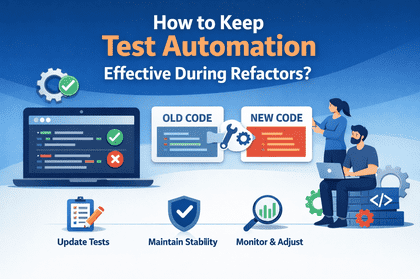
Refactoring is a normal and healthy part of software development. As systems evolve, teams refactor to improve readability, scalability, performance, or architectural clarity. But refactors also put test automation under maximum stress. Tests that once provided confidence suddenly start failing for unclear reasons, pipelines slow down, and engineers begin questioning whether the automation is helping or hurting.
When this happens, the problem is rarely the refactor itself. The real issue is that test automation was not designed to survive change. Keeping test automation effective during refactors requires intentional design choices that prioritize behavior, stability, and long-term maintainability over short-term coverage.
This article focuses purely on test automation—how it breaks during refactors, why that happens, and how to design automation that continues to add value even when large portions of the codebase change.
Refactors change structure, not intent. However, many automated tests are tightly coupled to structure rather than intent. When internal details shift, tests fail even though the system still behaves correctly from a user or consumer perspective.
Common causes of fragile test automation during refactors include:
Tests asserting internal classes, methods, or execution flow
UI tests that depend on fragile selectors or exact layouts
Tests tied to specific database schemas or internal data representations
Overuse of mocks that assume fixed internal interactions
When refactoring starts, these assumptions break immediately. The result is noisy failures that slow teams down and erode trust in automation.
The most important principle for refactor-resistant test automation is simple: validate behavior, not implementation.
Behavior is what the system guarantees externally. It includes:
API requests and responses
Business rules and invariants
State changes that matter to consumers
Events emitted or messages processed
If a refactor preserves these behaviors, test automation should continue to pass. If behavior changes unintentionally, tests should fail clearly. This makes failures meaningful and actionable instead of distracting.
Tests written at service boundaries tend to survive refactors far better than tests written deep inside the codebase.
Large refactors often reveal an unhealthy distribution of automated tests. Teams with a heavy concentration of UI-level automation usually experience the most pain because those tests are sensitive to structural changes.
A more refactor-friendly approach to test automation emphasizes:
Unit tests for pure logic and calculations
Integration and API tests for service boundaries
A limited number of end-to-end tests for critical user journeys
Before beginning a refactor, it is worth evaluating where most automation effort is spent. Shifting critical validation closer to APIs and services dramatically reduces breakage during structural change.
Effective test automation during refactors avoids hard dependencies on details that are likely to change. This requires discipline in how assertions are written.
Good practices include:
Asserting outcomes instead of intermediate steps
Avoiding strict ordering checks unless order is part of the contract
Validating schemas and contracts rather than full payloads
Allowing flexibility where exact values are not meaningful
This does not mean tests should be vague. It means they should be precise about what matters and flexible about what does not.
Refactors frequently involve changes to data models, persistence layers, or internal state management. Test automation that relies on static fixtures or exact database layouts becomes fragile under these conditions.
To keep automation stable:
Use test data builders instead of static data dumps
Isolate test data per test run where possible
Validate externally visible outcomes rather than internal state
Avoid assertions on entire database contents unless necessary
Well-designed test data strategies allow refactors to proceed without constantly rewriting tests.
Contracts define what consumers can rely on regardless of internal implementation. In API-first and distributed systems, contracts are often the most stable artifacts during refactors.
Contract-focused test automation:
Protects backward compatibility
Allows internal restructuring without breaking consumers
Makes breaking changes explicit and intentional
When contracts are treated as first-class citizens, refactors become safer because automation clearly defines what must not change.
Mocks can make test automation fast, but excessive mocking reduces confidence during refactors. When internal interactions change, mocked tests may continue to pass even though real integrations fail.
During refactors, prefer:
Lightweight stubs that model behavior
Real integrations for critical paths
Assertions on outcomes rather than call sequences
This ensures test automation reflects how the system behaves in reality, not how it is assumed to behave.
A common mistake is postponing test maintenance until after the refactor is complete. This almost always leads to a backlog of failing tests and unclear signals.
Instead:
Update test automation incrementally as code changes
Fix or remove brittle tests early
Treat failing tests as feedback on design quality
Continuously reassess whether a test still adds value
Test automation should evolve with the codebase, not lag behind it.
When many tests fail during a refactor, it often reveals deeper issues:
Unclear service boundaries
Leaky abstractions
Overexposed internal details
Rather than blindly updating tests, teams should ask whether the system’s external behavior is clearly defined. Systems that are easy to refactor are usually easier to test.
Some teams strengthen test automation during refactors by validating real system behavior instead of relying only on hand-written test cases. Comparing real request-response behavior before and after refactoring helps ensure that changes do not introduce subtle deviations.
Approaches that capture real traffic patterns and replay them against refactored systems provide strong confidence that automation reflects real usage. Tools like Keploy support this behavior-driven validation model, which is especially useful when internals change but external behavior should remain stable.
During refactors, success should not be measured by the number of passing tests. More meaningful indicators include:
Time to detect real behavior changes
Signal-to-noise ratio of test failures
Confidence to deploy after refactoring
Reduction in manual verification effort
These metrics reveal whether test automation is actually helping teams move faster and safer.
Refactoring is a sign of healthy engineering, and test automation should enable it—not fight it. By focusing on behavior, strengthening contracts, stabilizing test data, and evolving tests alongside code, teams can keep test automation effective even during large-scale change.
When test automation is designed to survive refactors, teams gain the freedom to improve architecture continuously. Instead of fearing change, they move forward with confidence, knowing their automation is validating what truly matters.

© 2025 Crivva - Hosted by Airy Hosting Managed Website Hosting.