

An intravenous (IV) cannula is one of the most commonly used disposable medical devices in modern healthcare. It provides direct access to a patient’s bloodstream for administering fluids, medications, blood products, and nutritional solutions. Despite its simple appearance, an IV cannula is a precision-engineered device that must meet strict safety, performance, and sterility requirements. As a result, IV cannula manufacturing demands a controlled, quality-driven approach aligned with global medical device regulations.
IV cannulas are used across a wide range of clinical settings, including hospitals, emergency care units, outpatient clinics, and home healthcare. They play a critical role in procedures such as fluid resuscitation, anesthesia delivery, chemotherapy, and long-term intravenous therapy.
Because IV cannulas come into direct contact with blood and tissue, even minor manufacturing defects can lead to complications such as infection, infiltration, thrombophlebitis, or device failure. This clinical significance places IV cannulas firmly within the category of high-volume but high-responsibility sterile disposable devices.
The IV cannula manufacturing process involves multiple controlled steps designed to ensure dimensional accuracy, material integrity, and sterility. While specific methods may vary by manufacturer, the core process typically includes component fabrication, assembly, testing, sterilization, and packaging.
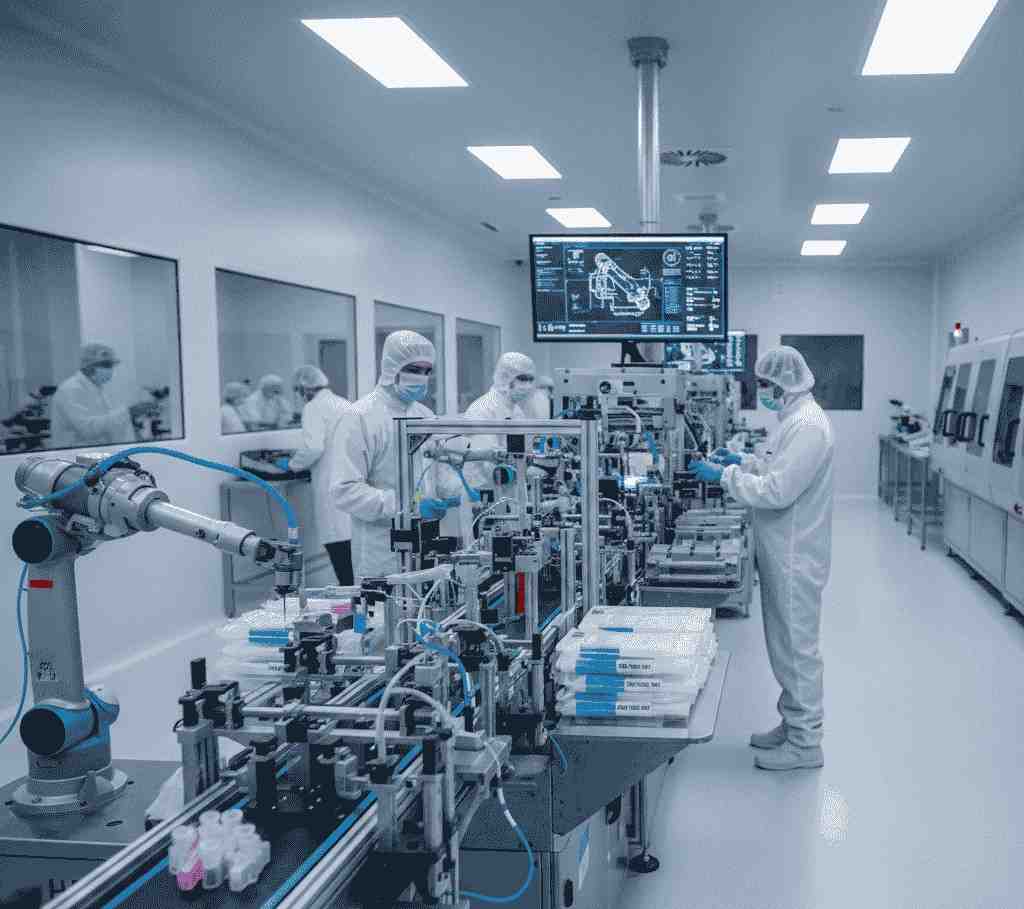
At an industrial level, IV cannula production relies heavily on automation to maintain consistency and reduce contamination risks. Injection molding machines are commonly used to manufacture plastic components, followed by precision assembly lines operating under cleanroom conditions.
Manufacturers offering turnkey solutions for medical disposables, such as Operon Strategist, often emphasize process validation and regulatory readiness as part of the manufacturing setup.
Material selection is a foundational element of IV cannula manufacturing. The cannula tube is typically made from medical-grade polymers such as PTFE, polyurethane, or FEP, chosen for their biocompatibility, flexibility, and kink resistance. The introducer needle is usually manufactured from stainless steel with a precisely ground bevel to minimize insertion trauma.
Other components, including hubs, caps, and wings, are molded from medical-grade plastics that meet regulatory standards for cytotoxicity, sensitization, and irritation. All raw materials must be traceable and supported by supplier qualification records to ensure compliance with medical device manufacturing standards.
Quality control is embedded throughout the manufacturing lifecycle of an IV cannula. Incoming raw materials undergo inspection and verification, while in-process checks monitor critical parameters such as dimensions, bonding strength, and needle sharpness.
Validation activities are essential to demonstrate that the IV cannula manufacturing process consistently produces devices that meet predefined specifications. This includes installation qualification (IQ), operational qualification (OQ), and performance qualification (PQ) for equipment and processes.
Routine testing may include flow rate testing, leakage testing, tensile strength evaluation, and visual inspection under magnification. These controls collectively reduce variability and enhance product reliability.
Sterilization is a non-negotiable requirement for IV cannulas, as they are classified as invasive sterile devices. Common sterilization methods include ethylene oxide (EtO) and gamma irradiation, each requiring validated cycles to ensure microbial inactivation without degrading material properties.
Packaging systems must maintain sterility throughout the product’s shelf life and distribution cycle. Primary packaging often includes medical-grade blister packs or pouches, while secondary packaging protects against physical damage and environmental exposure.
Proper labeling, batch identification, and traceability are integral to sterile packaging systems and support effective post-market surveillance.
IV cannulas are regulated as medical devices across global markets. In most jurisdictions, they fall under low to moderate risk classifications but still require regulatory approval or registration.
Manufacturers are expected to operate under a certified quality management system aligned with ISO 13485 manufacturing requirements. Compliance with standards such as ISO 10993 for biocompatibility and ISO 11135 or ISO 11137 for sterilization is also critical.
Understanding and implementing a compliant IV cannula manufacturing process helps manufacturers meet regulatory expectations while maintaining production efficiency.
Despite being a mature product category, IV cannula manufacturing presents several challenges. Maintaining consistent needle sharpness, preventing particulate contamination, and ensuring secure component bonding are common technical concerns.
Supply chain disruptions for medical-grade raw materials can also impact production schedules. To mitigate these risks, manufacturers often establish multiple qualified suppliers and implement robust incoming inspection protocols.
Process automation, preventive maintenance, and operator training further reduce variability and support long-term manufacturing stability.
A quality-focused manufacturing strategy is essential for ensuring patient safety and regulatory compliance. Rather than treating quality control as a final inspection step, leading manufacturers integrate quality principles into every stage of product development and production.
This approach supports consistent performance, reduces recalls, and enhances trust among healthcare providers and regulatory authorities. In high-volume products like IV cannulas, even small improvements in process control can have a significant impact on overall product quality.
In high-volume medical device production, effective process monitoring and traceability are essential to maintaining consistent product quality. IV cannula manufacturing involves multiple critical control points, each of which must be monitored to detect deviations before they affect finished devices. Parameters such as molding temperature, injection pressure, assembly force, and environmental conditions are routinely tracked using validated monitoring systems. Statistical process control tools are often applied to identify trends and support early corrective action.
Traceability plays a central role in post-market safety and regulatory compliance. Each batch of IV cannulas is typically assigned a unique lot number that links finished products to raw materials, production equipment, sterilization records, and quality inspection data. This level of traceability allows manufacturers to perform efficient investigations in the event of complaints or adverse events and supports targeted recalls if required. Regulatory authorities increasingly expect detailed traceability documentation as part of routine inspections and audits.
Continuous improvement is another important aspect of sustainable IV cannula production. Manufacturers regularly review nonconformance reports, customer feedback, and process performance data to identify opportunities for improvement. Design refinements, tooling optimization, and automation upgrades are commonly introduced to enhance product consistency and reduce manufacturing risk. These improvements are implemented through controlled change management procedures to ensure that modifications do not negatively impact safety or regulatory compliance.
By combining real-time process monitoring, robust traceability systems, and a structured improvement framework, manufacturers can strengthen operational control while meeting the growing expectations of healthcare providers and regulators. This disciplined approach supports long-term reliability and helps maintain trust in widely used disposable medical devices such as IV cannulas.
IV cannula manufacturing combines high-volume production with stringent safety and quality requirements. From material selection and process validation to sterilization and regulatory compliance, every stage plays a role in delivering safe and effective medical devices. By adopting standardized manufacturing practices, complying with global regulations, and maintaining a quality-driven mindset, manufacturers can ensure reliable IV cannula supply while meeting the evolving expectations of the healthcare industry.

© 2025 Crivva - Hosted by Airy Hosting Managed Website Hosting.