

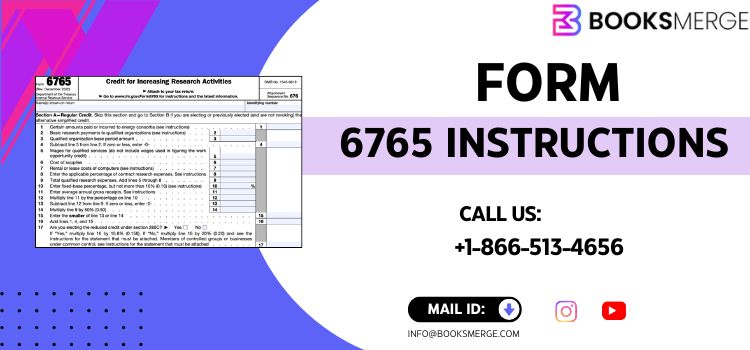
IRS Form 6765 instructions guide businesses on claiming R&D tax credits, detailing eligibility, qualified research expenses, calculation methods, and documentation requirements, helping companies legally reduce federal tax liability.
Innovation drives business growth, but it can get expensive fast. The IRS recognizes this with the Research and Development (R&D) tax credit, which businesses claim using Form 6765.
Many companies avoid this credit because the form looks complicated, but understanding IRS Form 6765 instructions makes the process manageable. Accurate filing can result in significant tax savings.
At BooksMerge, we help businesses maximize the credit while ensuring full IRS compliance. Call +1-866-513-4656 for expert guidance.
Form 6765 is used to claim the federal R&D tax credit. Businesses file it with their income tax return to reduce taxes.
The form helps companies:
Reduce federal income tax liability
Offset payroll tax for eligible startups
Carry unused credits forward to future years
This credit is designed to reward genuine research and development, including product improvement, process enhancements, and software development.
A common misconception is that only large tech companies qualify. In reality, any company performing research that meets the IRS four-part test may qualify.
To qualify:
Purpose: The activity improves function, quality, reliability, or performance
Technological: The work relies on engineering, science, or computer principles
Uncertainty: Outcomes are uncertain at the start
Experimentation: The business tests to resolve uncertainty
Industries often claiming R&D credits include software, manufacturing, biotech, engineering, and food processing. Both startups and established companies can benefit.
QREs, or Qualified Research Expenses, form the basis of the R&D credit. Not all spending counts, so proper categorization is crucial.
Employee wages for research and supervision
Supplies consumed in qualified research
Contract research (65% deductible)
Certain cloud computing and software development costs
Marketing or advertising expenses
Routine administrative overhead
Research conducted outside the U.S.
Accurate tracking and documentation of QREs is essential to claim the credit safely.
Form 6765 contains multiple sections to simplify filing:
Section A: Regular credit method
Section B: Alternative Simplified Credit (ASC)
Section C: Current year credit summary
Section D: Payroll tax offset for startups
Section E: Passive activity limitations
Most businesses prefer the ASC method because it reduces paperwork and audit risk.
Quick Note: An IRS form list acts like a tax roadmap, helping you quickly find the right forms, stay organized, and file accurately without costly mistakes.
List projects with technical challenges and experimental design. Include product improvements, process optimization, and software development initiatives.
Sum eligible wages, supplies, and contract research costs. Only expenses tied directly to research count.
Decide between regular and ASC methods. ASC is simpler for most companies.
Fill only sections relevant to your method, payroll offset eligibility, and passive activity limits.
Include the completed Form 6765 with your income tax filing. Ensure all calculations match supporting documents.
Credit = 20% of QREs above a base amount
Requires historical gross receipts and QRE data
More complex but can yield a higher credit if historical data supports it
Credit = 14% of QREs exceeding 50% of the prior three-year average
Simpler calculation, fewer records needed
Preferred by most businesses
Choosing the correct method affects both audit risk and the final credit amount.
IRS documentation is essential for compliance. Common records include:
Project descriptions and objectives
Employee roles and hours spent on research
Payroll records
Expense ledgers and receipts
Design notes, prototypes, or test results
These documents do not go with your return but must be maintained in case of IRS review.
Yes. Startups can offset up to $500,000 of R&D credits against payroll taxes.
Eligibility requirements:
Gross receipts under $5 million
No gross receipts before the previous five years
Conduct eligible research activities
This option is especially helpful for startups with little to no taxable income.
The 2025 instructions for Form 6765 highlight:
More detailed research activity descriptions
Alignment with Section 174 capitalization rules
Increased scrutiny for software R&D claims
Continued availability of payroll tax offset
Staying updated reduces audit risk and ensures maximum credit capture.
Frequent errors include:
Misclassifying routine work as research
Overstating wages or supply costs
Choosing the wrong calculation method
Failing to maintain supporting documentation
Ignoring Section 174 updates
Careful filing preserves credibility and prevents IRS issues.
BooksMerge combines accounting expertise and IRS compliance experience to help businesses:
Identify defensible QREs
Prepare accurate Form 6765 filings
Choose the best credit calculation method
Apply payroll tax offsets for startups
Call +1-866-513-4656 for professional support. Accurate filing maximizes credits and minimizes audit risk.
Understanding financial literacy improves tracking and claiming R&D credits correctly.
Form 6765 instructions exist to reward innovation, not intimidate businesses. By understanding eligibility, tracking QREs carefully, choosing the right method, and maintaining documentation, companies can maximize the credit legally.
Using BooksMerge expertise ensures compliance, reduces stress, and unlocks the full potential of your R&D efforts.
What is Form 6765 used for?
Form 6765 allows businesses to claim the federal R&D tax credit to reduce income or payroll taxes.
Who qualifies for R&D tax credit?
Businesses performing research meeting the IRS four-part test may qualify, regardless of size or profitability.
What are QREs?
Qualified Research Expenses include wages, supplies, and contract research directly related to R&D projects.
How to calculate ASC vs regular method?
ASC uses a three-year average of QREs with a 14% credit; regular method uses a base amount and 20% credit.
What documents are required?
Maintain project descriptions, payroll, expense ledgers, and technical documentation for IRS review.
Can startups use payroll offset?
Yes. Eligible startups may offset up to $500,000 of credits against payroll taxes.
What changed in 2025?
2025 instructions emphasize documentation, Section 174 compliance, and increased scrutiny on software R&D claims.

© 2025 Crivva - Hosted by Airy Hosting Managed Website Hosting.