

Specialized manufacturers support large projects by acting as integrated partners who manage the entire lifecycle from design engineering and material specification to scaled production, logistics, and installation coordination. They provide the expertise and industrial capacity required to deliver consistent, high-quality, and brand-aligned pieces on schedule and within budget. This level of partnership, focused on creating custom commercial furniture, ensures a project’s design vision is realized without compromising on durability or function, a collaboration essential for architects and designers where off-the-shelf solutions are inadequate.
This article details the comprehensive support system that specialized manufacturers provide for large-scale commercial endeavors. It is intended for project managers, interior designers, architects, and business owners involved in hospitality, corporate, or public space development. By the end, you will have a clear understanding of the manufacturer’s role as a strategic partner, the specific processes they manage, and how they solve the unique challenges of furnishing large, high-traffic environments.
For large commercial projects, a manufacturer is far more than a simple supplier. They are a critical strategic partner whose involvement begins long before production and extends well beyond delivery. Standard furniture suppliers lack the capability to handle the unique demands of a large-scale project, which often involves hundreds or thousands of pieces that must meet specific aesthetic, functional, and durability standards.
They possess deep knowledge of materials science, structural engineering, and manufacturing processes. This allows them to consult on the best materials and construction methods to ensure longevity in high-use environments, such as hotels, restaurants, and corporate offices.
Their facilities are equipped for mass production, ensuring that every piece of furniture, from the first to the thousandth, maintains perfect consistency in quality, color, and finish. This level of uniformity is impossible to achieve with smaller shops or multiple suppliers.
They integrate directly into the project’s timeline, coordinating with general contractors, designers, and logistics teams to ensure that furniture is produced and delivered precisely when needed, avoiding costly delays and storage issues.
The support provided by a commercial furniture manufacturer is a multi-stage process that aligns with the overall project timeline. Each stage involves close collaboration with the project’s stakeholders to translate a creative vision into a tangible, durable reality.
The process often begins with a designer’s or architect’s concept. The manufacturer’s in-house design and engineering teams work to refine these concepts into viable products. This involves creating detailed shop drawings that specify every dimension, material, and construction detail. They identify potential structural issues, suggest modifications to improve durability, or engineer solutions to meet a specific functional need, such as integrated power sources or unique storage capabilities. This crucial step ensures that the final product is not only beautiful but also manufacturable and built to last.
Selecting the right materials is critical for commercial applications. A manufacturer provides invaluable guidance on which woods, metals, fabrics, and finishes will withstand the rigors of a commercial environment. For example, they can specify contract-grade fabrics with high rub counts for seating in a busy hotel lobby or recommend finishes that are resistant to scratches and stains for restaurant tables. For custom outdoor commercial furniture, this expertise extends to materials that resist UV degradation, moisture, and extreme temperatures. Their established supply chains also give them access to a wide range of high-quality materials at competitive price points.
Before committing to full-scale production, a manufacturer will typically produce a physical prototype or “mock-up” for approval. This allows the designer and client to see and touch the final product, assess its comfort and functionality, and approve the exact finishes. The prototype serves as the gold standard for the entire production run. Once approved, rigorous quality control processes are implemented at every stage of manufacturing to ensure each piece matches the prototype perfectly. This eliminates surprises and guarantees a consistent, high-quality result across the entire project.
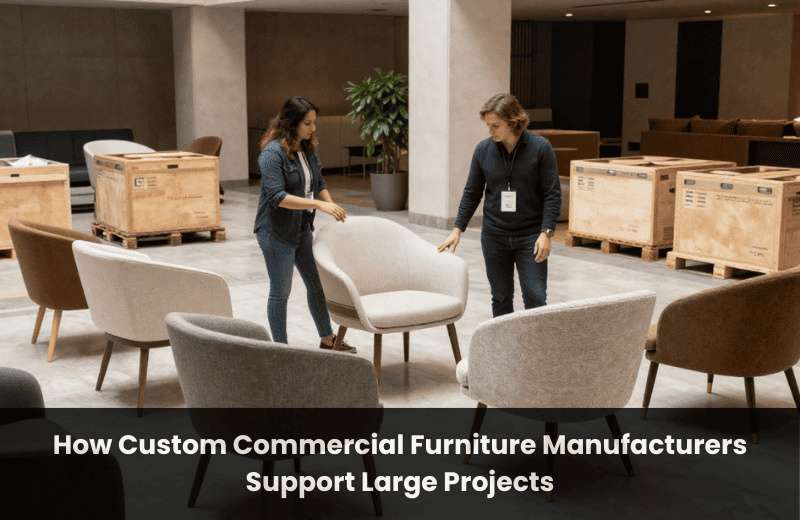
This is where a true manufacturing partner demonstrates their core value. They manage the complex process of producing large quantities of commercial custom furniture on a strict schedule. Their production lines are optimized for efficiency and consistency. Simultaneously, their logistics team plans the intricate details of delivery. Furniture is often staged and delivered to the job site in a phased sequence that aligns with the construction schedule, ensuring that pieces for the third floor arrive only when the third floor is ready. This “just-in-time” approach minimizes on-site storage needs and prevents furniture from being damaged in a chaotic construction environment.
Different commercial environments have vastly different needs. Experienced manufacturers often have specialized knowledge in key sectors, particularly hospitality, where the demands on furniture are exceptionally high.
In the hospitality industry, furniture is a direct extension of the brand and a key component of the guest experience. Custom hospitality furniture manufacturers understand that pieces must be both visually stunning and incredibly robust. For custom hotel furniture, this means creating casegoods that can withstand constant use by travelers, seating that is both comfortable and easy to clean, and public area furniture that makes a strong design statement. These manufacturers work closely with hotel brands and designers to ensure every piece aligns with the brand’s identity while meeting stringent performance and safety codes, such as fire resistance standards.
Creating durable custom outdoor commercial furniture presents a unique set of challenges. Materials must be carefully selected to resist fading from sun exposure, corrosion from rain or salt air, and damage from temperature fluctuations. Manufacturers specializing in this area have expertise in marine-grade polymers, powder-coated aluminum, treated hardwoods like teak, and performance fabrics designed specifically for outdoor use. They engineer pieces with proper drainage and construction techniques that prevent water damage and ensure a long, low-maintenance service life.
Engaging with a manufacturer is a structured process designed to ensure clarity, quality, and efficiency from start to finish. Understanding these steps helps project managers and designers partner more effectively to achieve their goals.
The project begins with a detailed discussion to understand the designer’s vision, the functional requirements of the space, the budget, and the project timeline. The manufacturer reviews concept drawings, floor plans, and inspiration images to develop a clear scope of work.
The manufacturer’s engineering team translates the initial concepts into detailed technical drawings. These drawings specify materials, dimensions, construction methods, and hardware. This is a collaborative phase where feedback is exchanged to refine the designs for both aesthetics and manufacturability.
Samples of all proposed materials and finishes—such as wood stains, metal powders, and fabric swatches—are submitted for approval. This ensures the final product will match the overall design palette of the project perfectly.
A full-scale prototype of key pieces is manufactured. Stakeholders review the prototype for quality, comfort, and adherence to the design intent. Any final adjustments are noted and implemented before mass production begins.
Once the prototype is approved, the project moves into full production. The manufacturer schedules the production run to align with the project’s master schedule, ensuring all pieces will be ready by the required delivery date.
The manufacturer’s logistics team coordinates the entire delivery process. They work with the general contractor and installation team to schedule deliveries, ensuring a smooth and efficient installation. This end-to-end management prevents logistical bottlenecks and ensures the final phase of the project is executed flawlessly.
By providing this comprehensive, integrated support, a manufacturer of high-quality furniture becomes an indispensable asset to any large project. Their ability to manage the complex journey from an abstract idea to a fully furnished space ensures that the final environment is not only true to its design vision but is also built to endure, delivering long-term value and performance.

© 2025 Crivva - Hosted by Airy Hosting Managed Website Hosting.