


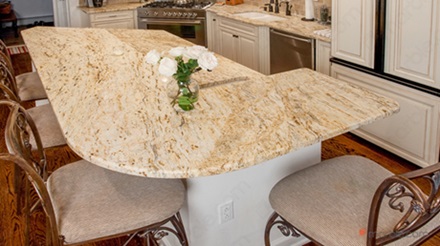
Colonial Gold Granite has a calm confidence to it. It does not shout for attention, yet once installed, it quietly defines the space. Architects and bulk buyers often describe it as balanced, warm, and dependable. The real charm of this stone lies in its soft golden movement, a flowing pattern that feels natural rather than forced. But that movement is not accidental. It is shaped by geology, quarry conditions, processing methods, and the decisions made by suppliers long before the slab reaches a project site.
This article breaks down what actually shapes the look and movement of Colonial Gold Granite. Not surface level facts, but the deeper factors buyers and designers should understand before committing to this stone in large volumes.
Colonial Gold Granite is formed deep within the earth under extreme heat and pressure. Its base structure is made up of feldspar quartz and mica, minerals that slowly crystallize over time. The golden tones come mainly from feldspar, while grey and black accents appear due to mica content and trace minerals.
What creates the soft movement is the way these minerals cooled and settled. Unlike highly dramatic granites with sharp contrasts, Colonial Gold Granite cooled at a steadier pace. This allows minerals to blend more smoothly, resulting in flowing waves rather than broken patterns.
Buyers who understand this geological background know why complete uniformity is impossible. The beauty of Colonial Gold Granite comes from controlled variation, not repetition.
Not all Colonial Gold Granite is exactly the same. Quarry location plays a major role in shaping its appearance. Even within the same region, slight changes in mineral concentration can shift the base color from light gold to warmer honey tones.
Buyers inspecting slabs often notice
An experienced export quality granite slab supplier separates material based on tone groups. This helps buyers maintain visual harmony across large installations. Mixing slabs from different quarry pockets without sorting leads to inconsistent results that no polishing can fix later.
The movement in Colonial Gold Granite is not random. It follows the natural flow of mineral deposits within the stone. This is why slabs cut from the same block often show related patterns.
Soft golden movement appears as
Designers prefer this granite for large surfaces because the movement does not overwhelm the space. It supports the design instead of competing with it.
A reliable marble & granite supplier and exporter understands how to cut slabs to preserve this flow. Poor cutting direction can break the natural movement and make the slab look busy or unbalanced.
Before any slab is produced, block selection determines the final look. Large blocks are examined for consistency, structural integrity, and pattern continuity.
Professional buyers ask suppliers
Colonial Gold Granite blocks with stable mineral flow produce slabs with smoother movement. Blocks with too many internal shifts may result in uneven patterns. Experienced suppliers avoid mixing such material into premium orders.
This is where an export quality granite slab supplier adds value. They do not just sell stone. They manage risk for buyers by controlling input material quality.
How a block is cut has a huge effect on movement. Vertical cuts emphasize flow, while inconsistent cutting angles can distort patterns.
For flooring and wall cladding, buyers often prefer slabs with horizontal movement. For countertops, a softer directional flow looks more refined. Suppliers who understand end use applications cut accordingly.
When Colonial Gold Granite is cut without considering orientation, the golden movement can appear broken. This mistake cannot be corrected during polishing or installation.
Polishing does more than add shine. It reveals the true character of the stone. Colonial Gold Granite responds best to controlled polishing that enhances depth without making the surface too reflective.
Over polishing can
Under polishing leaves the surface dull and unfinished. The goal is balance. A skilled marble & granite supplier and exporter knows when to stop. The result is a slab where golden tones glow naturally under light.
Buyers often inspect slabs under different lighting to see how movement appears throughout the day. A well polished slab maintains its softness in both natural and artificial light.
Some Colonial Gold Granite slabs receive resin treatment to fill micro fissures. When done properly, this process strengthens the stone without altering its appearance.
Poor resin application can darken certain areas or create uneven sheen. Buyers are quick to spot this during inspection. They prefer transparency from suppliers about whether resin has been used.
An export quality granite slab supplier discloses this information upfront. Trust matters more than hiding treatments that buyers will notice anyway.
Thickness may seem like a technical detail, but it affects how light interacts with the stone. Uneven thickness can cause certain areas to appear darker or lighter.
Buyers inspect
Uniform thickness allows light to reflect evenly, enhancing the soft golden movement. Inconsistent slabs create visual disruptions that become obvious once installed.
Movement can also be affected after production. Improper handling during transport can cause micro cracks or edge damage that interrupts visual flow.
Buyers prefer suppliers who use
A marble & granite supplier and exporter who invests in packaging protects not only the stone but also their reputation. Damaged slabs disrupt pattern continuity and reduce usable material.
Designers often select Colonial Gold Granite because its movement supports scale. In large lobbies kitchens or commercial floors, dramatic stones can feel overwhelming. Colonial Gold Granite provides warmth without chaos.
Its soft golden movement
This stone does not follow trends. It stays relevant because it feels natural and grounded.
Before approving bulk orders buyers examine
They do not rely on single sample slabs. They want to see bundles, slab rows, and block continuity. This is where a dependable export quality granite slab supplier proves their capability.
Projects often require repeat orders months later. Buyers want assurance that future shipments of Colonial Gold Granite will match previous ones as closely as nature allows.
Suppliers who maintain quarry relationships and block records offer better continuity. This is a major reason buyers stick with the same marble & granite supplier and exporter over time.
Colonial Gold Granite is shaped by nature and refined by human decisions. Its soft golden movement comes from slow geological formation, careful quarrying, thoughtful cutting, and skilled finishing.
Buyers who understand these factors make better sourcing decisions. They know what to inspect, what questions to ask, and what variations to accept.
This stone rewards patience and attention. When selected properly, Colonial Gold Granite delivers warmth, consistency, and long lasting visual comfort. That is why it remains a trusted choice for serious projects, year after year.

© 2025 Crivva - Hosted by Airy Hosting Managed Website Hosting.