


A lot of brands do not struggle because they lack content ideas.
They struggle because they cannot stay consistent long enough for the content to compound.
That is where clipping campaigns become useful.
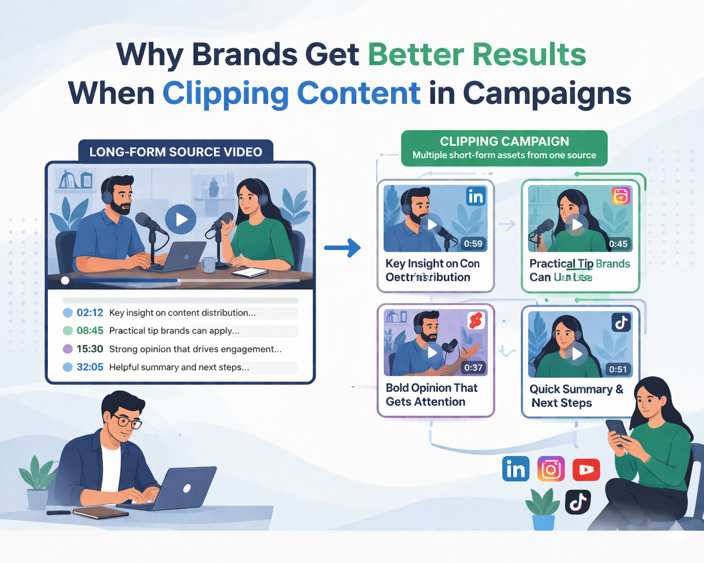
A clipping campaign helps a brand turn one long-form asset into multiple short-form pieces that can be published over time. Instead of relying on one webinar, one founder interview, one podcast episode, or one educational video to create one short burst of attention, the brand gets several smaller opportunities to stay visible.
That is a much better system for consistency.
A lot of content strategies fail quietly.
Not because the ideas are bad.
Not because the brand has nothing useful to say.
Not because the team lacks effort.
They fail because the publishing rhythm breaks too often.
One strong post goes live. Then there is silence. Then another post appears a week later. Then the team gets busy, priorities shift, and the content schedule starts falling apart again.
This happens to startups, agencies, service businesses, creators, consultants, and even bigger brands that should know better.
The reason is simple. Consistency is difficult when every piece of content has to be created from scratch.
That kind of system puts too much pressure on the team. It demands fresh ideas, fresh recording time, fresh editing time, and fresh promotion every single time the calendar needs filling.
That is hard to sustain.
It is even harder when content is not the only thing the business has to manage.
This is the part a lot of teams miss.
Many brands already have enough source material to support a much stronger short-form presence. They record webinars, sales demos, live sessions, podcasts, founder interviews, team discussions, educational videos, or internal presentations. The issue is not that they have nothing to work with.
The issue is that too little of it gets reused properly.
One long-form asset often contains several moments worth publishing separately.
There may be:
But instead of extracting those moments, many teams publish the full version once and move on.
That is where the waste happens.
Clipping campaigns create structure around repurposing.
Instead of treating one long-form asset as one finished product, the team treats it as the source for several smaller pieces of content.
That changes the entire workflow.
Now the question is no longer:
“What do we need to create next?”
It becomes:
“What else can this source asset give us?”
That shift is important because it makes the content system less fragile.
A clipping campaign usually includes:
This gives the team more usable assets without demanding more recording every week.
And that is exactly why clipping campaigns help with consistency.
Random short-form posting can make a brand look active for a moment, but it rarely creates lasting momentum.
A clip goes live because someone had time to cut it. Another appears days later with no real connection to the first. Sometimes the topic changes, the tone changes, and the publishing rhythm changes too.
The result is predictable.
The brand stays visible in fragments, not in a pattern.
That matters because people rarely remember a brand after seeing one isolated post. They remember brands after seeing useful content from them multiple times. Repeated exposure builds familiarity. Familiarity makes the brand easier to recognize and easier to trust.
Random posting does not usually create that.
A clipping campaign does.
Because a campaign creates a sequence instead of a one-off post. It gives the audience multiple entry points into the same brand, the same message, and the same source content.
That is much more effective than scattering short clips with no larger plan behind them.
Long-form content takes effort to create.
Someone has to plan it.
Someone has to record it.
Someone has to edit it.
Someone has to publish it.
If all that work leads to one upload and one short attention window, the return is weaker than it should be.
A better system gets more value from the same source.
That is what clipping campaigns do.
They help a team turn one long-form asset into several short-form opportunities that can be published across days or even weeks. Instead of the content fading immediately after the main upload, it keeps creating visibility.
That is not just smart from a marketing perspective.
It is smart from an operational perspective too.
Because content creation is expensive, even when no money changes hands directly. It still costs time, focus, and effort. If a business is already investing in long-form content, it makes sense to squeeze more value from that work.
Large teams can sometimes absorb inefficient workflows.
Growing brands usually cannot.
A smaller company does not always have a dedicated editor, strategist, writer, designer, and social manager all working together. Often the same few people are handling everything. In that kind of setup, the content system has to be efficient or it starts breaking fast.
That is why clipping campaigns are especially useful for:
These groups often have plenty of useful source material, but not enough time to create fresh content every day.
A clipping system gives them leverage.
One founder interview can become multiple short clips.
One webinar can support a week of posting.
One podcast episode can create several entry points for discovery.
That kind of leverage helps smaller teams stay visible without burning out.
Most brands think consistency is a discipline problem.
Sometimes it is.
But often it is a systems problem.
If the workflow demands constant reinvention, consistency will always be fragile. People get busy. Deadlines stack up. Client work takes priority. The content calendar starts slipping.
When the system is stronger, consistency becomes easier.
A clipping campaign helps because it creates a pipeline.
Once the long-form asset exists, the team already has material to work from. They are not starting empty every time they need the next post. That reduces pressure and improves continuity.
Instead of:
The system becomes:
That is a much more realistic model for long-term content growth.
Long-form content is valuable because it builds depth.
Short-form content is valuable because it builds entry points.
Most people are not going to discover a brand by sitting down for a 45-minute webinar first. They are much more likely to find the brand through a smaller moment. A useful insight. A short tip. A strong quote. A simple explanation that solves a problem quickly.
That is how discovery works for a lot of brands now.
And the more useful moments a brand can create from one strong source, the better its chances of being found.
This is one reason more teams are using structured clipping campaigns instead of relying on random short-form posting. They want the source content to keep producing visibility instead of disappearing after a single upload.
That is a smarter use of content.
Content only compounds when it stays in motion long enough.
A one-off post might create a little attention. A sequence of related posts has a better chance of building recognition. The audience sees one useful moment, then another, then another. That creates a stronger mental link to the brand.
Clipping campaigns support that process.
They make it easier to keep the same source material working across multiple touchpoints. Instead of one burst of attention followed by silence, the brand gets ongoing visibility from content it has already created.
That is a better foundation for growth.
Because the goal is not just to publish.
The goal is to keep showing up in a way the audience can remember.
Clipping campaigns help brands stay consistent because they make content systems easier to maintain.
They turn one long-form asset into multiple short-form opportunities. They reduce the pressure to constantly create new material. They improve efficiency. And they help teams stay visible without relying on random posting.
That is what makes them valuable.
Not just more clips.
A better system for staying present online.
When a brand can turn one webinar, one podcast episode, or one founder interview into a stream of useful short-form assets, consistency becomes much more realistic. And when consistency becomes realistic, the content has a better chance to compound.
For most brands, that is the real win.

© 2025 Crivva - Hosted by Airy Hosting Managed Website Hosting.