

Access to the European medical device market depends heavily on achieving and maintaining CE marking under Regulation (EU) 2017/745, commonly known as the EU Medical Device Regulation (EU MDR). CE marking is not simply a product approval; it is a comprehensive demonstration that a medical device meets stringent requirements related to safety, performance, quality management, and post-market surveillance. For manufacturers planning new production facilities, compliance cannot be treated as an afterthought. It must be embedded from the earliest stages of manufacturing plant planning.
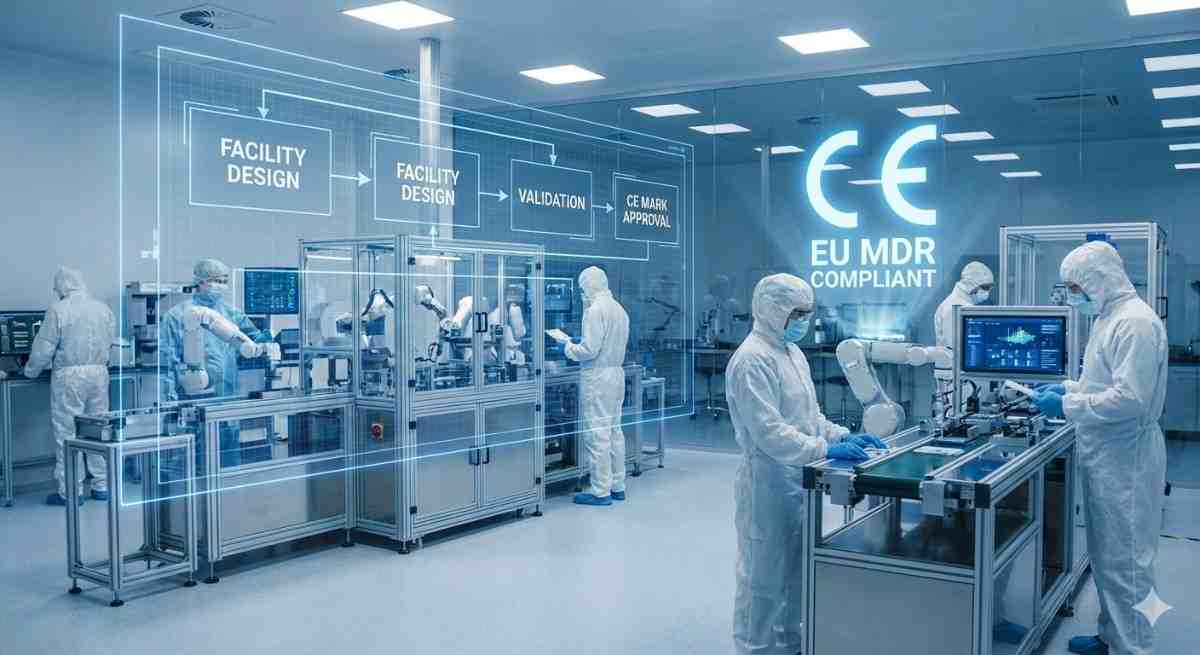
Medical device turnkey plant projects have emerged as a preferred approach for manufacturers and investors seeking faster setup, regulatory alignment, and operational readiness. These projects integrate facility design, equipment selection, validation, and documentation into a single coordinated framework. When EU MDR compliance is incorporated at the plant design stage, it significantly reduces regulatory risks, minimizes rework, and supports smoother CE marking pathways. Aligning manufacturing infrastructure with regulatory expectations from the outset is now considered a critical success factor for European market entry.
CE marking signifies that a medical device complies with all applicable requirements of EU MDR and is legally allowed to be placed on the European market. Under the previous Medical Device Directive (MDD), conformity assessment pathways were comparatively simpler. EU MDR introduced a far more rigorous framework, focusing strongly on clinical evidence, traceability, lifecycle risk management, and post-market oversight.
EU MDR applies to manufacturers, authorized representatives, importers, and distributors. Manufacturers bear the primary responsibility for demonstrating conformity, supported by a robust Quality Management System and comprehensive technical documentation. Notified Bodies play a central role in reviewing conformity for higher-risk devices, auditing manufacturing facilities, and verifying compliance with MDR requirements. Manufacturing sites are now examined in greater depth, with increased emphasis on process validation, contamination control, and data integrity.
EU MDR has a direct and significant impact on how medical device manufacturing facilities are designed, validated, and operated. One of the most important requirements is the implementation of a Quality Management System aligned with ISO 13485. This system must cover all processes affecting product quality, from supplier controls to production, testing, and post-market activities.
Risk management, based on ISO 14971, must be integrated into both product design and manufacturing processes. Facilities must support consistent risk controls, validated production methods, and traceable records. Clinical evaluation and post-market surveillance requirements under MDR also influence manufacturing, as production data feeds into vigilance reporting and continuous safety monitoring. Additionally, technical documentation requirements under Annex II and Annex III require manufacturing processes to be fully defined, validated, and controlled.
A medical device turnkey plant project refers to an end-to-end approach where a single entity or coordinated team delivers a fully operational, regulatory-ready manufacturing facility. This includes facility layout planning, cleanroom design, utility systems, equipment procurement, installation, qualification, validation, and preparation for regulatory audits.
The turnkey model is particularly advantageous for medical device manufacturers because it reduces fragmentation between engineering, quality, and regulatory functions. Instead of retrofitting compliance measures after construction, regulatory requirements are considered during initial planning. This approach improves efficiency, ensures regulatory readiness, and shortens timelines for CE marking and market entry.
Integrating EU MDR compliance into turnkey plant design begins with understanding how facility layout affects product safety and process control. Manufacturing flows must minimize cross-contamination risks, support segregation of processes, and allow effective material and personnel movement. Cleanroom classifications must align with device risk profiles and sterilization requirements.
Equipment qualification plays a central role in MDR-compliant facilities. All critical equipment must undergo Installation Qualification, Operational Qualification, and Performance Qualification to demonstrate consistent and controlled operation. Process validation ensures that manufacturing steps produce devices meeting predefined specifications. Documentation generated during these activities becomes a vital part of the technical file and supports Notified Body audits.
Environmental monitoring, contamination control, and utility validation further strengthen compliance. These elements demonstrate that the manufacturing environment consistently supports device safety and performance, which is a core expectation under EU MDR.
Technical documentation under EU MDR is more detailed and structured than under previous regulations. Annex II and Annex III require manufacturers to document device design, manufacturing processes, risk management, clinical evaluation, labeling, and post-market surveillance plans. Manufacturing facilities must be capable of generating and maintaining accurate, complete, and traceable records to support this documentation.
Device master records, standard operating procedures, batch records, and validation reports form the backbone of regulatory readiness. Labeling and Unique Device Identification requirements demand traceability from raw materials to finished products. Robust document control systems ensure data integrity, version control, and audit readiness, which are critical during Notified Body inspections.
ISO 13485 serves as the foundation for EU MDR compliance and is closely scrutinized during CE marking audits. Implementing ISO 13485 during plant setup ensures that quality processes are embedded into daily operations rather than added later. This includes supplier qualification, training programs, change control, nonconformance management, and corrective and preventive actions.
During turnkey projects, ISO 13485 requirements guide facility design decisions, equipment selection, and workflow planning. Internal audits and management reviews conducted during plant commissioning help identify gaps early and prepare the organization for external regulatory assessments. A well-implemented ISO 13485 system not only supports CE marking but also enhances long-term operational efficiency.
New manufacturing plants often face challenges when regulatory requirements are not integrated early enough. One common issue is delayed involvement of regulatory expertise, leading to facility designs that do not fully meet MDR expectations. Retrofitting cleanrooms, modifying layouts, or revalidating processes can result in significant delays and increased costs.
Limited availability of Notified Bodies adds further complexity. Inadequate preparation can prolong audit timelines or result in nonconformities that delay CE certification. Gaps in clinical evaluation planning or post-market surveillance integration can also hinder compliance, even if manufacturing processes are technically sound. Validation deficiencies remain another frequent challenge, particularly when documentation does not fully align with MDR requirements.
Early regulatory integration offers substantial advantages for manufacturers pursuing CE marking. Facilities designed with MDR in mind are more likely to pass Notified Body audits with fewer observations. This leads to faster certification timelines and reduced regulatory uncertainty.
Proactive compliance reduces rework, lowers long-term operational risks, and supports scalability as product portfolios expand. MDR-aligned facilities are also better positioned to adapt to future regulatory updates, making them a strategic investment rather than a short-term solution. From an investor perspective, regulatory-ready plants enhance asset value and market credibility.
Expert regulatory support plays a critical role in aligning turnkey manufacturing projects with EU MDR requirements. Strategic regulatory planning helps define compliance roadmaps, identify applicable conformity assessment routes, and coordinate interactions with Notified Bodies. MDR gap assessments provide clarity on facility readiness and documentation completeness.
Support across documentation development, validation planning, and audit preparation ensures consistent alignment between manufacturing operations and regulatory expectations. Organizations such as Operon Strategist contribute regulatory insight that helps manufacturers integrate compliance seamlessly into turnkey plant execution, supporting efficient and sustainable EU market access.
CE marking under EU MDR requires a comprehensive, lifecycle-based approach that extends well beyond product design. Manufacturing facilities play a decisive role in demonstrating compliance, making regulatory integration at the plant setup stage essential. Medical device turnkey plant projects provide an effective framework for embedding MDR requirements into facility design, validation, and quality systems from the beginning.
By aligning plant infrastructure with EU MDR expectations, manufacturers can achieve faster certification, reduce compliance risks, and build future-ready operations. In an increasingly regulated European market, compliance-driven turnkey manufacturing facilities are not only enablers of CE marking but also strategic assets that support long-term growth, quality, and global competitiveness.
Read More at- CE Mark and EU-MDR Compliance for Medical Device

© 2025 Crivva - Hosted by Airy Hosting Managed Website Hosting.