

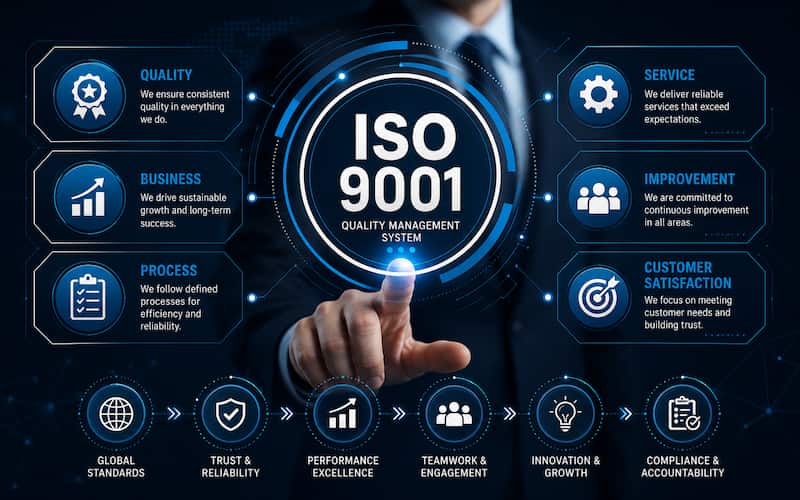
In today’s highly competitive industrial landscape, manufacturing companies must consistently deliver quality products while maintaining efficiency, reducing costs, and meeting customer expectations. This is where ISO 9001 Certification plays a crucial role. Recognized globally, ISO 9001 provides a structured framework for establishing an effective Quality Management System (QMS) that helps organizations improve performance and achieve long-term success.
When it comes to ISO 9001 for manufacturing businesses, business owners, production managers, and decision-makers need to be able to understand the advantages of this internationally recognized standard to decide whether or not it will suit their organization. From improving product quality to enhancing customer satisfaction, ISO 9001 offers numerous advantages that contribute to sustainable business growth.
The International Organization for Standardization (ISO) has created an internationally accepted standard for quality management systems (QMS) known as ISO 9001. It is concerned with developing standard processes, mitigating risks, optimizing operational efficiency and continually improving the performance of the organization.
Quality is more than just a product for manufacturers. It encompasses all aspects of production such as procurement, design, production planning, quality control, packaging and delivery. All these processes are effectively coordinated when a well-designed QMS is implemented.
Manufacturing environments face various challenges such as:
Without a structured management system, these issues can significantly impact profitability and reputation. Implementing a recognized quality framework helps manufacturers establish clear procedures and maintain consistency across operations.
One of the most significant advantages of adopting ISO 9001 is improved product quality. The standard requires organizations to establish documented procedures, quality controls, and monitoring systems throughout the production process.
As a result, manufacturers can:
Consistent quality strengthens customer confidence and enhances brand reputation.
Customer satisfaction is a core principle of ISO 9001. The standard encourages organizations to understand customer requirements and continuously evaluate their ability to meet those expectations.
Benefits include:
Satisfied customers are more likely to provide repeat business and positive referrals.
Many manufacturing companies struggle with inefficiencies caused by unclear procedures and inconsistent workflows. ISO 9001 promotes process-based management, helping organizations identify areas for improvement.
This can lead to:
When processes become more efficient, businesses can increase productivity while controlling costs.
Waste reduction is a major concern in manufacturing. Excessive material waste, production errors, and unnecessary rework can significantly affect profitability.
By implementing structured quality controls, organizations can:
Over time, these improvements contribute to substantial cost savings.
Modern manufacturing operations face numerous risks, including supply chain issues, equipment failures, compliance challenges, and market fluctuations.
ISO 9001 introduces risk-based thinking, which encourages organizations to:
Proactive risk management helps prevent disruptions and supports long-term stability.
Employees play a vital role in maintaining quality standards. ISO 9001 promotes clear responsibilities, training programs, and communication channels throughout the organization.
Benefits for employees include:
When employees understand expectations and contribute to improvement efforts, overall organizational performance improves.
Manufacturers depend heavily on suppliers for raw materials, components, and services. Poor supplier performance can directly affect product quality and delivery timelines.
A structured quality management approach helps organizations:
Stronger supplier relationships create a more reliable and efficient supply chain.
Certification demonstrates a company’s commitment to quality and continuous improvement. Many customers, distributors, and business partners view certified organizations as more reliable and trustworthy.
This enhanced credibility can:
In competitive industries, demonstrating commitment to quality can become a valuable business advantage.
Manufacturing companies often operate under strict regulatory and industry-specific requirements. Maintaining compliance can be challenging without structured systems and documentation.
ISO 9001 helps organizations:
A well-documented management system simplifies compliance management and audit preparation.
Many government agencies, multinational corporations, and large buyers prefer working with certified suppliers. In some industries, certification is even a mandatory requirement for bidding on contracts.
Manufacturers with an effective quality management system often gain access to:
This creates a solid foundation for sustainable business expansion.
Although implementation requirements vary by organization, the certification process generally follows several key stages.
The organization reviews existing processes to identify areas that need improvement to meet ISO requirements.
Policies, procedures, and quality objectives are established or updated to align with the standard.
Staff members receive training to understand quality requirements and their roles within the management system.
The organization applies the documented procedures and begins operating under the new system.
An internal review is conducted to identify nonconformities and improvement opportunities.
An accredited certification body performs an independent assessment to verify compliance.
After certification, the organization continually monitors and improves its processes to maintain effectiveness.
Selecting the right certification provider can significantly impact the success of implementation.
When evaluating certification bodies or consultants, consider:
Choose a provider with industry-specific experience and knowledge of manufacturing operations.
Ensure the certification body is properly accredited and recognized internationally.
Look for organizations that clearly explain timelines, requirements, and certification procedures.
A reliable partner should provide guidance throughout implementation and surveillance audits.
Research customer feedback and industry reputation before making a decision.
The right partner can simplify the certification journey and help maximize long-term benefits.
ISO 9001 is suitable for organizations of all sizes, including small and medium-sized manufacturers.
Modern ISO 9001 focuses on effective process management rather than unnecessary paperwork.
Quality management is an ongoing process that requires continuous monitoring and improvement.
Certification helps reduce errors and improve consistency, but it does not eliminate every possible issue.
The benefits of ISO 9001 for manufacturing companies extend far beyond achieving certification. By implementing a structured quality management system, manufacturers can improve product quality, increase customer satisfaction, reduce operational costs, strengthen risk management, and create opportunities for long-term growth.
Organizations that invest in ISO 9001 Certification often experience greater efficiency, stronger market credibility, and improved competitiveness in both local and international markets. For manufacturing businesses seeking sustainable success, adopting a recognized quality management framework can be a strategic decision that delivers lasting value.

© 2025 Crivva - Hosted by Airy Hosting Managed Website Hosting.