

In the field of civil engineering and infrastructure development, understanding the subsurface conditions is one of the most critical aspects before initiating any project. The success, safety, and longevity of structures such as buildings, bridges, dams, and tunnels largely depend on the properties of soil and rock beneath the surface. Without proper investigation, projects may face risks like settlement, instability, or even structural failure.
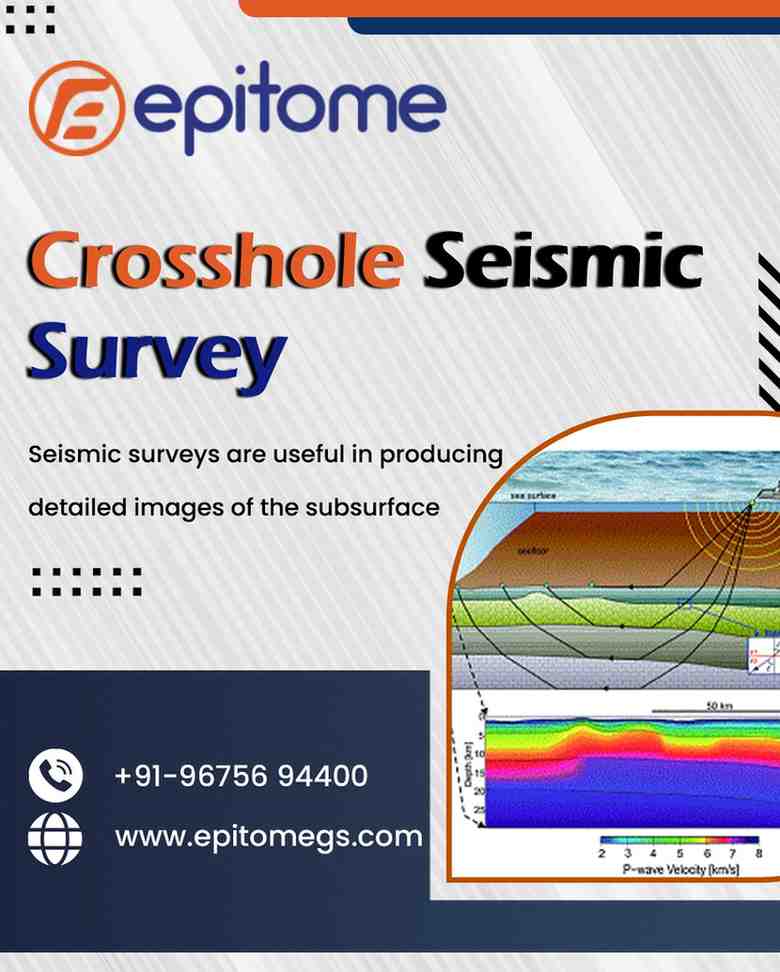
To overcome these uncertainties, engineers rely on advanced geophysical techniques, among which the Crosshole Seismic Survey stands out as one of the most accurate and reliable methods. This technique provides direct measurement of seismic wave velocities, enabling engineers to determine the dynamic properties of subsurface materials with high precision.
Epitome Geotechnical Services offers expert Crosshole Seismic Survey solutions using advanced equipment and industry best practices. The company ensures accurate data collection and interpretation, helping clients make informed engineering decisions and achieve successful project outcomes.
Crosshole Seismic Survey is an in-situ geophysical testing method used to measure the velocity of seismic waves traveling through soil and rock layers between two or more boreholes. Unlike surface-based methods, this technique provides direct and highly accurate results because the measurements are taken within the ground itself.
The survey focuses on two primary types of seismic waves:
By analyzing these wave velocities, engineers can assess the mechanical behavior of soil and rock, which is essential for designing safe and efficient structures.
The working principle of Crosshole Seismic Survey is based on the transmission of seismic waves between boreholes. The method measures the time taken by waves to travel a known distance, allowing precise calculation of wave velocities.
The process involves:
This direct measurement approach eliminates many uncertainties associated with indirect methods, making it highly reliable.
Crosshole Seismic Survey offers several benefits that make it a preferred choice for geotechnical investigations:
The versatility of Crosshole Seismic Survey makes it useful in various engineering fields:
It helps engineers evaluate soil stiffness and bearing capacity, ensuring safe and stable foundation systems.
Provides essential data for seismic hazard analysis, ground response studies, and earthquake-resistant design.
Used to assess the strength and stability of subsurface materials, preventing failures.
Supports the design of deep foundations and piers by providing accurate subsurface data.
Helps identify geological conditions and potential risks along tunnel alignments.
Essential for metro projects, highways, and large-scale construction in urban areas.
Used in power plants, refineries, and heavy industrial construction where ground stability is crucial.
In modern geotechnical engineering, the importance of dynamic soil properties has increased significantly. Traditional methods often focus on static properties, but dynamic behavior is equally important for structures subjected to vibrations, seismic forces, and cyclic loading.
Crosshole Seismic Survey provides critical insights into:
These parameters enable engineers to design structures that can withstand dynamic forces and ensure long-term stability.
While there are several seismic survey techniques available, Crosshole Seismic Survey offers unique advantages:
However, it requires borehole drilling, which increases cost and effort. Despite this, its accuracy makes it indispensable for critical projects.
Epitome Geotechnical Services is a leading provider of geophysical and geotechnical investigation services. The company is known for delivering high-quality Crosshole Seismic Survey solutions tailored to project requirements.
With a strong commitment to quality and precision, Epitome ensures that clients receive reliable data for better decision-making.
Despite its advantages, Crosshole Seismic Survey has certain limitations:
These challenges can be effectively managed with proper planning and experienced professionals.
Modern technology has significantly improved the efficiency and accuracy of Crosshole Seismic Survey. Some advancements include:
These innovations allow engineers to visualize subsurface conditions more clearly and make faster, more accurate decisions.
With increasing infrastructure development worldwide, the demand for accurate geotechnical investigation methods is growing rapidly. Crosshole Seismic Survey is expected to play a major role in:
Its ability to provide precise and reliable data ensures its continued importance in future engineering projects.
Crosshole Seismic Survey is one of the most advanced and reliable methods for subsurface investigation. Its ability to provide accurate, in-situ measurements of seismic wave velocity makes it an essential tool for modern geotechnical engineering.
From foundation design to earthquake analysis, the data obtained from this method helps engineers design safe, stable, and efficient structures. Although it involves higher initial costs and effort, the accuracy and reliability it offers make it a worthwhile investment.
Epitome Geotechnical Services stands as a trusted partner in delivering high-quality Crosshole Seismic Survey solutions. With expertise, advanced technology, and a commitment to excellence, the company ensures successful project outcomes and long-term structural safety.
🌐 www.epitomegs.com
#CrossholeSeismicSurvey #GeotechnicalServices #SoilInvestigation #SeismicSurvey #EpitomeGeotechnical #SubsurfaceInvestigation #FoundationEngineering #ConstructionSafety #EngineeringSolutions #InfrastructureDevelopment #GeophysicalSurvey #CivilEngineering #SoilAnalysis #SeismicTesting #GroundInvestigation

© 2025 Crivva - Hosted by Airy Hosting Managed Website Hosting.