

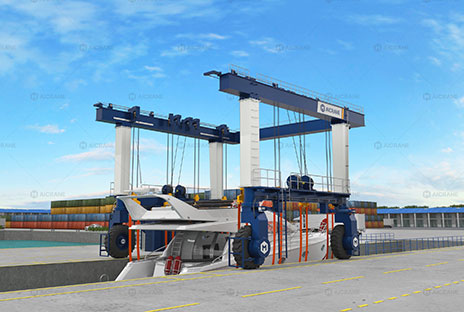
Mobile boat hoists, also known as marine travel lifts, play a critical role in modern marinas, shipyards, yacht clubs, and boat maintenance facilities. As vessels continue to increase in size and marina layouts become more compact, maneuverability has become one of the most important performance factors when selecting a boat hoist. While lifting capacity and safety remain essential, the ability of a hoist to move efficiently within restricted spaces directly impacts operational productivity, storage density, and overall handling efficiency.
Among the most valuable maneuverability technologies in modern mobile boat hoists are 90-degree steering and carousel steering systems. These steering modes significantly improve movement flexibility, allowing operators to transport vessels safely through narrow lanes, crowded storage yards, and complex marina layouts. Understanding how these steering systems work and why they matter can help marina operators choose the right equipment for long-term operational success.
Traditional boat handling methods often require large turning radii and extensive open space for movement. In busy marinas and shipyards where land costs are high, maximizing usable storage space is essential. Poor maneuverability can create operational bottlenecks, increase vessel handling time, and limit the number of boats that can be stored on-site.
Modern mobile boat hoists are expected to perform multiple tasks efficiently, including:
Advanced steering systems allow operators to complete these tasks with greater precision and reduced risk of collisions or positioning errors.
The steering system of a mobile boat hoist or travel lift controls the directional movement of the machine’s wheels. Depending on the design, the hoist may use hydraulic steering, electronic synchronization systems, or intelligent wheel control technologies to coordinate movement.
Modern heavy-duty boat hoists typically feature multiple steering modes that operators can switch between based on operational requirements. These may include:
Among these options, 90-degree steering and carousel steering are especially important for facilities with limited maneuvering space.
90-degree steering refers to the ability of all wheels on a mobile boat hoist to rotate perpendicular to the machine’s longitudinal direction. Instead of moving forward or backward conventionally, the hoist can travel sideways.
This lateral movement capability dramatically improves operational flexibility.
In a 90-degree steering configuration, hydraulic or electronically controlled wheel assemblies rotate simultaneously until they align at a right angle relative to the hoist frame. Once aligned, the machine can move laterally while maintaining stable load distribution.
The steering process usually involves:
Modern control systems ensure that wheel angles remain synchronized throughout the operation to prevent tire wear and structural stress.
Many marinas and shipyards have limited aisle widths between stored boats. Conventional steering often requires repeated forward and backward repositioning. With 90-degree steering, the hoist can move directly sideways into tight storage positions.
This allows operators to utilize available yard space more efficiently.
Sideways movement enables tighter boat placement, increasing the number of vessels that can be stored within a given area. For marinas where land availability is limited, this can significantly improve profitability.
Traditional maneuvering methods may require multiple corrections to align a vessel properly. 90-degree steering minimizes unnecessary adjustments, reducing handling time and improving workflow efficiency.
Precise lateral movement reduces the risk of accidental contact with nearby vessels, docks, or structures. This is particularly important when handling expensive yachts or fragile fiberglass boats.
Boat repair workshops often have restricted entrances and confined indoor spaces. Sideways movement allows easier positioning of vessels inside maintenance facilities.
Carousel steering, sometimes called rotational steering or center-pivot steering, allows the mobile boat hoist to rotate around its own center axis. Instead of requiring a large turning radius, the machine can pivot within a compact area.
This steering mode is especially useful for highly congested operating environments.
In carousel steering mode, each wheel turns at a calculated angle relative to the machine’s center point. The wheels then move in coordinated motion, enabling the hoist to rotate smoothly around its center.
The steering control system continuously manages:
Advanced hydraulic and electronic control technologies are essential for maintaining stability during rotational movement, particularly when transporting heavy vessels.
The biggest advantage of carousel steering is the ability to rotate within minimal space. This allows operators to reposition vessels in crowded storage yards without requiring large maneuvering areas.
Shipyards and marinas often evolve over time, resulting in irregular layouts. Carousel steering helps operators navigate around obstacles, buildings, and densely packed boats.
Reducing maneuvering complexity shortens handling cycles and improves overall operational throughput. Facilities can process more launches, retrievals, and storage movements within the same timeframe.
Conventional sharp turning can create significant tire friction and wear. Properly synchronized carousel steering minimizes tire scrubbing by allowing wheels to follow coordinated rotational paths.
Modern electronic steering systems simplify complex movements, allowing operators to control large machines with improved accuracy and confidence.
Many advanced mobile boat hoists integrate both steering modes into a single intelligent control system. This combination provides maximum operational versatility.
Operators can select the most suitable steering mode depending on the environment:
The ability to switch seamlessly between modes improves efficiency across different handling scenarios.
High-end yacht storage facilities often need to maximize every square meter of space. Advanced steering systems enable denser storage arrangements without sacrificing accessibility.
Boat manufacturers frequently transport hulls between production stages. Tight indoor factory layouts benefit greatly from precision maneuverability.
Maintenance workshops require accurate vessel positioning for inspection, painting, hull repairs, and engine servicing. Advanced steering improves alignment accuracy and reduces handling risks.
Large commercial shipyards handling workboats, patrol vessels, and service boats often operate in crowded industrial environments. Maneuverability becomes critical for maintaining efficient logistics.
As marinas continue expanding capacity, efficient yard utilization becomes increasingly important. Mobile boat hoists with advanced steering systems help operators maximize available infrastructure.
Modern maneuverability systems rely heavily on intelligent hydraulic and electronic technologies.
Hydraulic cylinders provide the force required to rotate wheel assemblies smoothly under heavy loads. High-quality hydraulic systems ensure precise and responsive steering performance.
Electronic control units monitor wheel positions in real time to maintain synchronization. This prevents uneven wheel angles that could cause structural strain or unsafe movement.
VFD systems regulate wheel motor speeds for smoother acceleration, deceleration, and directional transitions.
Modern operator cabins often feature touchscreen interfaces and programmable steering modes, simplifying machine operation.
When selecting a mobile boat hoist, operators should evaluate several factors related to maneuverability.
Facilities with narrow aisles or limited turning space benefit most from advanced steering capabilities.
Larger yachts require more precise handling due to their length and weight distribution.
Uneven pavement, slopes, and outdoor conditions may influence steering system requirements.
High-volume marinas handling multiple vessels daily can achieve significant productivity gains from enhanced maneuverability.
Investing in advanced steering systems can support future operational growth and changing facility layouts.
The marine equipment industry continues moving toward greater automation and intelligent control systems. Future steering technologies may include:
These innovations will further improve safety, reduce operator fatigue, and maximize handling precision.
As marina space becomes increasingly valuable and vessel sizes continue growing, advanced maneuverability will remain a major competitive advantage.
90-degree steering and carousel steering have transformed the operational capabilities of modern mobile boat hoists. These advanced steering technologies enable safer vessel handling, tighter storage arrangements, improved operational efficiency, and greater flexibility in confined marina environments.
For marinas, yacht clubs, shipyards, and boat manufacturers seeking to maximize productivity while minimizing space limitations, investing in mobile boat hoists with advanced maneuverability systems offers substantial long-term benefits.
As the marine industry continues evolving, intelligent steering technologies will play an increasingly important role in helping operators handle vessels more efficiently, safely, and precisely in even the most challenging working conditions.

© 2025 Crivva - Hosted by Airy Hosting Managed Website Hosting.