

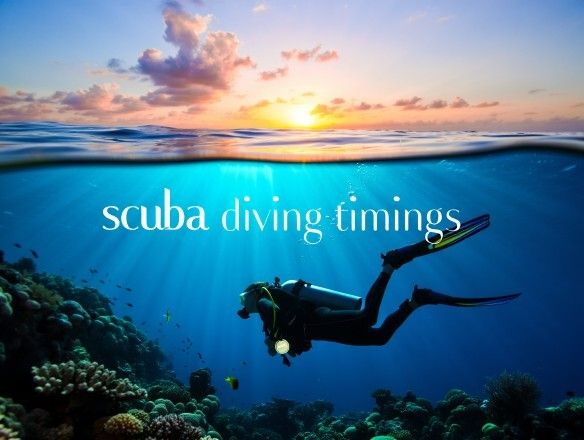
Have you ever wondered why some divers return from the ocean with stories of crystal-clear water and vibrant coral, while others describe a murky, “soup-like” experience? The secret often lies in their scuba diving timings. Whether you are planning your first discovery dive or are a seasoned pro, the time of day you hit the water significantly impacts what you see and how safe you feel.
In this guide, we’ll dive into the best daily windows, seasonal shifts, and the environmental factors that dictate the perfect underwater schedule.
From the angle of the morning sun to the invisible pull of the lunar cycle, every second counts. In this guide, we will break down the essential scuba diving timings you need to master—covering the best hours of the day, peak global seasons, and the non-negotiable safety intervals that keep you out of the decompression chamber.
For most recreational divers, the hours between 8 AM and 11 AM are considered the gold standard. During these early morning hours, the ocean is typically at its calmest. Overnight winds have died down, allowing sediment to settle on the sea floor, which results in the best possible visibility.
Another reason to prioritize these scuba diving timings is the angle of the sun. As the sun rises, it penetrates the water at a steep angle, illuminating the reef and making the colours of the coral and fish pop for your photos. Furthermore, many marine species are most active at dawn as they emerge to feed, giving you a front-row seat to the ocean’s morning rush hour.
If you aren’t an early bird, afternoon dives (usually starting around 2:00 PM) offer their own charm. The sun is at its highest point, providing maximum light penetration for macro photographers. However, be prepared for potentially stronger currents and slightly reduced visibility as the day progresses.
The “best” time can shift depending on what you want to experience. Here is how the day breaks down:
Beyond just the clock, professional dive centers plan their scuba diving timings based on these three natural phenomena:
Tides move massive amounts of water. Most experts recommend diving during slack tide—the brief period between high and low tide when the water stops moving. This minimizes strong currents that can exhaust a diver and ensures the clearest water is pulled in from the open ocean.
High winds create “surface chop,” which can lead to seasickness on the boat and murky water below. Checking the forecast for light winds (under 10 knots) and low swells (under 2–3 feet) is essential for choosing your scuba diving timings.
If you are doing multiple dives in one day, your scuba diving timings must account for a “surface interval.” This is the mandatory 1-hour (or longer) wait on the boat between dives to let your body safely off-gas nitrogen.
Scuba diving is a sport governed by physics. To dive safely, you must adhere to strict physiological scuba diving timings to manage the nitrogen levels in your body.
Regardless of depth, a 3-minute safety stop at 5 meters (15 feet) is non-negotiable. This allows your body to slowly off-gas nitrogen that has dissolved into your tissues under pressure, drastically reducing the risk of Decompression Sickness (DCS).
When performing multiple dives in one day, the “Surface Interval” is your best friend. Most dive computers require at least 60 minutes between dives to reset your “no-decompression limits.” Pushing these scuba diving timings can lead to nitrogen buildup and fatigue.
One of the most overlooked aspects of scuba diving timings is the tide. For shore dives or sites located in channels, the “Slack Tide”—the brief window when the tide is turning and the water is still—is critical.
Always consult with a local dive center like DIVEIndia or Dressel Divers to understand how local topography affects tidal scuba diving timings, as a safe site at 9:00 AM could become a dangerous washing machine by noon.
Globally, “scuba season” often runs from October to April, but it varies by location:
Q: Can I dive at night?
Yes! Night dives typically begin just after sunset (around 6:00 PM to 6:30 PM in the tropics). These scuba diving timings allow you to see nocturnal creatures like octopuses and hunting moray eels that hide during the day.
Q: How long does a standard dive last?
A typical recreational dive lasts between 45 and 60 minutes, depending on your depth and air consumption.
Q: What is “Bottom Time”?
This refers to the actual time spent at depth, excluding your ascent and safety stop. Managing your bottom time is the core of all safe scuba diving timings.
By respecting the ocean’s schedule and your own body’s limits, you can ensure every underwater adventure is as safe as it is spectacular.
Setting the right scuba diving timings is the difference between a “good” dive and a “life-changing” one. By aiming for early morning slots and keeping an eye on the tides, you maximize your chances of seeing the ocean at its most majestic.

© 2025 Crivva - Hosted by Airy Hosting Managed Website Hosting.