Here is a statistic that puts the entire paid advertising landscape into perspective: Google Ads delivers a 200% average ROI across industries, meaning businesses earn $2 for every $1 spent. And yet, according to the same research, the top 10% of advertisers generate over 4x higher ROI than the average. The platform is the same. The audience pool is the same. The gap between average results and exceptional results comes down entirely to strategy and execution.
This is the defining reality of paid advertising in 2026: access to the tools has never been easier, and the difference between businesses using them competently and those using them expertly has never been wider. Global search ad spending is projected to reach $218.3 billion in 2026, according to PPC Chief, a market that size reflects not just enthusiasm for paid media but measurable evidence that, in the right hands, it works extraordinarily well.
The question worth asking is not whether paid advertising works. It does. The question is whether your campaigns are being run with the expertise and strategic discipline that a specialist paid advertising agency applies, or whether they are running on autopilot while budget quietly burns.
The barrier to running a Google Ads campaign is low. A business can have ads live within hours of creating an account. And that accessibility (genuinely one of the platform’s strengths) is also the reason so many campaigns underperform from day one.
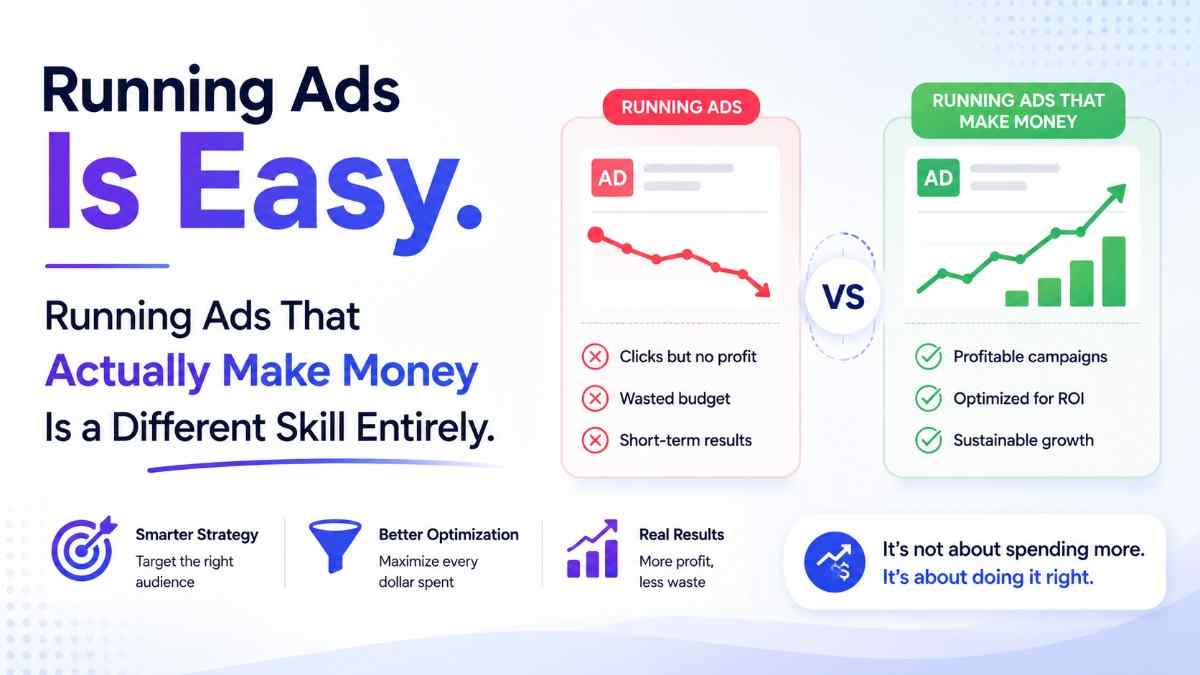
The most common failure mode is not overspending. It is underthinking. Campaigns built around broad keyword lists, without negative keyword strategies to filter irrelevant traffic, without proper conversion tracking to measure what actually works, and without landing pages aligned to the specific intent of each ad, these are campaigns that generate clicks and burn budget without meaningfully contributing to revenue. They are active, visible, measurable in the wrong metrics, and commercially ineffective.
Cost per click increased for 87% of industries in 2025, with an average increase of 10%, according to PPC Chief. In an environment of rising costs, the margin for waste is narrower than it has ever been. A campaign that was merely inefficient two years ago is now actively damaging. Every irrelevant click, every unconverted landing page visit, and every campaign running without a properly structured negative keyword list is a direct cost to the business, and those costs compound daily.
The businesses pulling furthest ahead in paid advertising are not those with the largest budgets. They are those with the most disciplined, data-driven approach to how every pound or dollar of that budget is deployed. That discipline is what a specialist paid advertising agency brings to campaigns that internal teams, stretched across multiple responsibilities, rarely have the focus to apply consistently.
The single biggest lever in paid advertising performance is not budget size, not creative quality, and not even targeting precision. It is ongoing Google Ads optimization, the continuous cycle of analysis, refinement, and improvement that separates campaigns that compound in value from those that plateau or decline.
Regular campaign optimization can improve ROI by over 50%, according to research from Marketing LTB. That figure reflects the cumulative impact of the marginal improvements that optimization delivers over time: tightening match types to improve relevance, refining bid strategies as conversion data accumulates, testing ad copy variations to identify the messaging that resonates most strongly, improving quality scores to reduce cost per click, and eliminating low-performing search terms before they drain significant budget.
The mechanics of paid campaign management in 2026 are more sophisticated than at any previous point. Smart Bidding (Google’s AI-driven bid management) uses signals including device, time of day, location, audience segment, and search context to optimize bids in real time at a granularity no human manager can match manually. 85% of advertisers now use automated bidding strategies, and businesses using Google Ads automation report 20% better ad performance on average. But automation is not a replacement for strategic oversight; it is a force multiplier for it. Smart Bidding optimizes toward the objective it is given. If that objective is poorly defined, or if the conversion tracking feeding it is inaccurate, the automation compounds the error rather than correcting it.
This is where the expertise of a specialist paid advertising agency becomes commercially critical. The strategic decisions (which campaign structures to use, how to segment audiences, which conversion actions to optimize toward, how to balance brand and non-brand spend, when to expand and when to consolidate) are the decisions that determine what the automation has to work with. Get the strategy right, and automation accelerates the result. Get it wrong, and automation accelerates the waste.
Of all the targeting capabilities available in the Google ecosystem, remarketing remains one of the most powerful and most frequently underutilized. The logic is straightforward: someone who has already visited your website, watched your video ad, or interacted with your brand has demonstrated a level of intent that cold audiences cannot match. Serving them targeted, relevant advertising is not an interruption; it is a continuation of a conversation they already started.
The performance data for Google Ads remarketing reflects this intent advantage clearly. Remarketing audiences convert at rates two to four times higher than equivalent cold traffic, and remarketing campaigns consistently deliver 30 to 50% lower cost per acquisition than prospecting campaigns targeting new audiences. For businesses investing in top-of-funnel awareness campaigns (whether on Google Search, YouTube, or the Display Network), remarketing is the mechanism that captures the return on that investment rather than letting warm prospects drift away unconverted.
The most effective remarketing strategies in 2026 go well beyond the basic “show an ad to website visitors” approach. Audience segmentation by engagement depth, separating visitors who spent two minutes on a pricing page from those who bounced after ten seconds, allows campaigns to deliver meaningfully different messages to meaningfully different prospects. Sequential remarketing, which serves progressively more specific and decision-oriented creative as a prospect moves closer to a purchase decision, treats the advertising journey as a conversation rather than a repeated interruption. And cross-channel remarketing (coordinating messages across Google Search, Display, YouTube, and Gmail) ensures brand presence at every surface where a warm prospect might be active.
For businesses serving a specific geographic area (whether a city, a region, or a defined service radius), local PPC represents one of the most commercially efficient paid advertising opportunities available. 70% of mobile searchers call a business directly from Google Ads, reflecting the immediate, high-intent nature of local search behavior. Someone searching for a service provider in their area on their phone is not browsing; they are buying. The question is whether your business appears at the right moment with the right message.
The most common mistake businesses make with local search advertising is treating it as a scaled-down version of a national campaign, the same keyword strategy, the same ad copy, and the same bid approach, simply with a geographic filter applied. That approach misses the specific dynamics that make local search different. Local searchers use different language, have different intent signals, and respond to different value propositions than broader audiences. A campaign built around generic category keywords will lose to a competitor whose campaigns are structured around the specific terms, locations, and queries that local buyers actually use.
The right campaigns in 2026 are built around a few non-negotiables: location-specific ad copy that speaks to the local audience directly, call extensions and location extensions that reduce friction for mobile users, bid adjustments by proximity to drive efficiency in the most commercially valuable geographic segments, and Google Business Profile integration that connects paid campaigns to local search presence. For businesses with multiple locations, granular campaign structures (with distinct ad groups and landing pages for each location) consistently outperform consolidated campaigns that serve generic messaging across a broad area.
The case for working with a specialist paid advertising agency is not simply about access to expertise, though that matters. It is about consistent, focused attention in a channel where inattention is expensive.
Internal marketing teams managing paid campaigns alongside content, social, email, and events rarely have the bandwidth to optimize Google Ads at the cadence and depth the platform rewards. The weekly search term reviews, the bid strategy adjustments, the creative testing cycles, the audience list refinements, and the landing page experiments each of these is a marginal improvement that compounds over time. Executed consistently by a focused specialist, they produce the difference between average and top-decile performance. Executed intermittently by a generalist, they produce campaigns that are live but not improving.
A strong paid advertising agency delivers expert strategy, industry insights, and continuous optimization that are hard to manage internally. Since Google Ads is the highest ROI channel for many businesses, success depends on experienced campaign management and consistent performance tracking.
The paid advertising landscape in 2026 is highly competitive, and success depends on strategy, optimization, smart remarketing, and precise targeting, not just budget. While anyone can run ads, achieving consistent, scalable returns requires expert management and continuous optimization. With CPC costs rising across most industries, precision and expertise are now essential for maximizing ad performance and revenue growth.

© 2025 Crivva - Hosted by Airy Hosting Managed Website Hosting.