


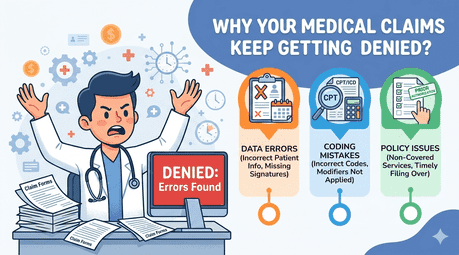
Every denied claim is a story that did not have to end that way. A patient received care. A provider delivered it. The paperwork simply failed somewhere between the exam room and the payer’s system and suddenly, reimbursement that a practice rightfully earned vanishes into a dispute queue. For healthcare organizations relying on steady cash flow, that gap is not just frustrating. It is existential.
The good news? The majority of claim denials are entirely preventable. With the right medical billing services framework and a proactive approach to claim denial management services, practices of every size can dramatically increase their clean claim rate — and keep it high.
A clean claim is one that contains all required information, has no errors or omissions, and meets the payer’s specific submission requirements. It moves directly from submission to adjudication without triggering a request for additional information, a correction, or a denial. Clean claims are paid faster, require less staff time, and keep your accounts receivable cycle lean.
Contrast that with a “dirty” claim — one that has missing patient demographics, incorrect procedure codes, mismatched diagnosis codes, or an expired authorization number. Each of these issues adds days — sometimes weeks — to your revenue timeline. Multiply that across hundreds of claims per month and you begin to understand why clean claim rates are one of the most closely watched metrics in revenue cycle management.
Most healthcare organizations know denials cost money. Far fewer truly measure how much. Beyond the obvious lost reimbursement, consider the downstream effects: staff hours spent reworking and resubmitting claims, administrative overhead for appeals, late payment penalties, and the opportunity cost of resources diverted away from patient care. Studies consistently show that reworking a single denied claim can cost between $25 and $118 in administrative labor alone.
Effective claim denial management services address this at the root — not by managing denials after they occur, but by preventing them in the first place through systematic front-end controls, real-time eligibility verification, and continuous coding audits.
Here is the insight that separates high-performing revenue cycle teams from those stuck in a cycle of denial and rework: the secret to clean claims is not a better appeals process. It is a better submission process. When your medical billing services are structured around prevention — catching errors before the claim ever leaves your system — denial rates drop sharply and collection rates climb.
This means implementing real-time claim scrubbing tools that check for payer-specific edits before submission. It means structured front-desk workflows that verify insurance, confirm authorizations, and collect accurate patient data at registration. It means ongoing education for clinical coders on documentation requirements, and regular reporting that identifies denial patterns by payer, provider, and procedure code.
The front end of your revenue cycle — everything that happens before a claim is submitted — is where most denials are born. A patient who arrives with outdated insurance information, a procedure that was never authorized, or a registration form with a misspelled name: each of these creates a defect that will surface later as a denial. Fixing these problems at the source is far cheaper than chasing them downstream.
A denial-proof front-end workflow starts at scheduling. When a patient books an appointment, your team should verify insurance eligibility in real time, flag any required authorizations, and confirm that the provider is in-network for that specific plan. At check-in, a second eligibility check confirms that nothing has changed since the appointment was booked. This two-step verification catches the lapses and plan changes that a single point-of-entry check misses entirely.
Verify eligibility in real time, identify required authorizations, confirm network status for the patient’s specific plan.
Run a second eligibility check, collect updated insurance cards, confirm referrals and authorizations are in place.
Audit clinical documentation, validate CPT and ICD-10 combinations, apply correct modifiers before claim generation.
Run automated claim scrubbing, review payer-specific edits, and confirm filing within each payer’s deadline window.
Even with best-in-class prevention, some denials will occur. Payers change requirements, systems glitch, and edge cases arise. This is where dedicated claim denial management services deliver their greatest value. A structured denial management program includes root-cause categorization of every denial, a prioritized rework queue based on dollar value and appeal deadlines, a formal appeals workflow with payer-specific documentation templates, and trend analysis that feeds back into prevention.
Practices that outsource this function to specialized medical billing services providers consistently outperform those managing it in-house — largely because dedicated billing teams have payer-specific expertise, current knowledge of regulatory changes, and technology infrastructure that most individual practices cannot justify maintaining independently.
You cannot improve what you do not measure. Track your first-pass claim acceptance rate monthly. Monitor denial rate by payer and by denial reason code. Measure your average days in accounts receivable. Track the percentage of denials successfully appealed and reversed. These metrics, reviewed consistently, reveal where your revenue cycle is losing ground — and where targeted improvements will have the highest return.
A first-pass rate below 90% is a warning sign. Days in AR exceeding 40 suggests a systemic bottleneck. A denial reversal rate below 50% points to a documentation or appeals workflow problem. Each of these numbers tells a story — and the right medical billing services partner helps you read that story and act on it before small gaps become large revenue losses.
Clean claims are not an accident. They are the result of intentional process design, skilled billing professionals, and the right technology working in concert. Whether you manage billing internally or partner with an external provider, the commitment to submitting clean claims from the first touch — backed by robust claim denial management services for the exceptions — is the single most powerful lever available to improve your practice’s financial health.
The move from “Denied” to “Paid” does not require a miracle. It requires a system, the discipline to maintain it, and the right team to run it.

© 2025 Crivva - Hosted by Airy Hosting Managed Website Hosting.