

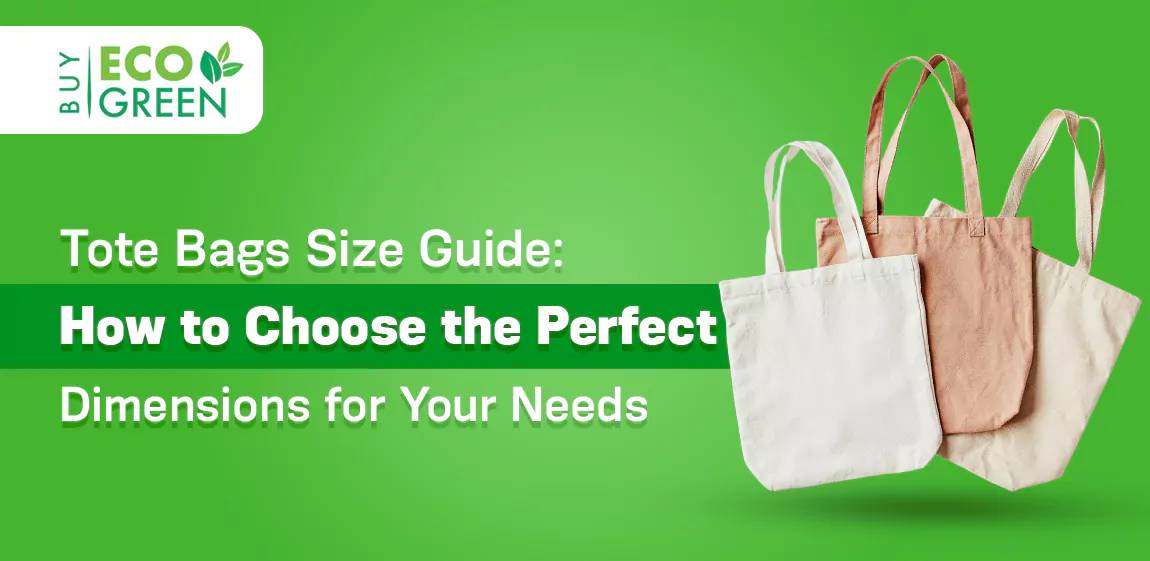
Walk through any Australian school, council office, community event, or business conference and you’ll spot them everywhere. Tote bags have become a staple of sustainable procurement, and for good reason. They replace single-use plastic, they last through years of regular use, and they carry a visible signal about the values of the organisation that handed them out or put them to work.
But choosing the wrong size creates real problems. A tote that’s too small can’t carry what it’s supposed to. One that’s too large becomes unwieldy, sags without support, and often gets left behind rather than carried. For organisations ordering tote bags in volume, whether for school resources, community programs, staff use, event giveaways, or bulk resale, getting the dimensions right from the start avoids waste, returns, and reorders.
This guide covers every measurement that matters when selecting a tote bag, explains how different sizes map to different institutional uses, and helps procurement teams, school administrators, sustainability officers, and event coordinators make a confident, well-informed decision before placing a bulk order.
Most organisations ordering tote bags in bulk focus primarily on material and price. Size is often treated as a secondary consideration, sometimes an afterthought. That’s where ordering errors happen.
The dimensions of a tote bag determine:
For institutions where tote bags serve a functional role rather than just a promotional one, such as schools distributing resource packs, councils supplying welcome kits, or childcare centres handing out supply bags to families, the wrong size isn’t just inconvenient. It undermines the purpose of the bag entirely.
At Buyecogreen, we supply eco-friendly tote bags to Australian schools, councils, businesses, not-for-profit organisations, and community groups. Understanding the sizing framework below will help you identify the right bag for your specific organisational context before you commit to a bulk order.
Before getting into sizes, it’s important to understand what’s actually being measured. Tote bag specifications typically include four dimensions, and all four affect how the bag performs in practice.
Width is measured across the widest point of the bag from one side seam to the other. This is usually the first dimension listed in a product specification and gives you the most immediate sense of how much the bag can hold side to side.
Height is measured from the bottom of the bag to the top edge, not including the handles. This tells you how tall the interior space is, which matters when you’re packing items with vertical height such as water bottles, rolled documents, notebooks, or boxed goods.
The gusset is the depth of the bag from front to back when the bag is open and in use. This is the measurement most frequently overlooked when ordering, and it has the greatest impact on actual carrying capacity. A bag with no gusset is essentially flat and suited only to lightweight, thin items. A bag with a 10 to 15cm gusset can stand upright and hold substantial volume.
Handle drop is the distance from the top edge of the bag to the highest point of the handle when the handles are held together. This measurement determines how the bag sits when carried. A short handle drop of 15 to 20cm sits close to the hand and is suited to hand carrying. A drop of 25 to 30cm allows the bag to be worn over the shoulder comfortably. A drop above 30cm creates a longer hang suitable for over-the-shoulder carrying with additional layering, such as a jacket or backpack underneath.
For organisations ordering tote bags that staff or community members will carry regularly, handle drop is not a detail to overlook. A bag with a handle drop that doesn’t allow for shoulder carrying will be used far less frequently, which defeats the environmental purpose of providing a reusable bag in the first place.
Small tote bags are compact, lightweight, and suited to low-volume carrying tasks. They are not designed for heavy loads or bulky items, but they serve a clear purpose in the right context.
In an institutional setting, small totes are well suited to:
The compact size of a small tote also makes it practical for storing flat when not in use, which matters in schools and offices where storage space is limited. When ordered in bulk for events or distribution programs, small totes stack and pack efficiently, reducing freight volume.
The printable surface area on a small tote is more limited than larger formats, so if your organisation wants to include a logo, name, or message, keep the design simple and consider whether the space available will display it clearly.
The medium tote bag is the most widely ordered size across Australian institutional, business, and community settings. It offers genuine carrying capacity without becoming impractical or heavy when empty, and it provides a strong printable panel if branding or messaging is part of the brief.
Medium totes accommodate:
For school canteens and childcare centres, a medium tote can serve as a reusable alternative to single-use bags for daily supply distribution. For councils running environmental awareness campaigns or community clean-up events, medium totes are practical enough to be kept and reused by recipients long after the event itself, which maximises the environmental and promotional value of the bag.
The medium format also offers the best balance between surface area for branding, material use, and carrying practicality. It’s the most commonly recommended size for organisations ordering tote bags for the first time without a specific use case in mind.
Large tote bags are built for volume. They hold more, carry heavier loads, and require more structural support in both the base and the handles to maintain their shape and integrity under use.
In a B2B and institutional context, large totes are appropriate for:
A large tote with a gusset of 12cm or more can carry a significant load, but that capacity is only useful if the bag is structurally sound enough to support it. When ordering large totes in bulk, material weight and handle construction are particularly important factors. Lighter-weight fabric at a larger dimension will not hold its shape or support heavier loads reliably, which leads to bags that stretch, sag, or fail at the handle attachment points.
If your organisation is ordering large totes for daily use rather than occasional distribution, prioritise material thickness and reinforced stitching at the stress points over a lower unit cost.
Extra-large tote bags are not standard stock in most Australian institutional procurement settings, but they serve specific purposes where volume and capacity are the priority.
Common applications include:
Extra-large totes generally require heavier fabric to maintain structural integrity at their dimensions. Lightweight canvas or calico at this size will not hold its shape when loaded. If your organisation needs totes in this size range, material weight and gusset construction are the primary considerations, not the print area or aesthetic finish.
Learn more: https://www.buyecogreen.com.au/tote-bag-size-guide-dimensions/

© 2025 Crivva - Hosted by Airy Hosting Managed Website Hosting.