

A homeowner in a coastal wind zone asks a fair question before signing off on a solar install: what actually keeps this array on the roof when sustained winds hit 130 mph and gusts go higher? It’s a reasonable thing to lose sleep over, especially after watching storm footage of shingles peeling off roofs that seemed fine the day before.
The answer isn’t a single product or a marketing claim. It’s a chain of engineering decisions, starting with how wind loads are calculated and ending with how a lag bolt is torqued into a rafter. Hurricane-resistant solar mounting systems are built around that entire chain, not just one strong-looking bracket. This article walks through how that chain holds together, where it tends to break, and what code requirements exist to catch the gaps before a storm does.
Most residential roofs are designed to shed wind, not fight it head-on. A bare roof surface lets wind pass over it with relatively predictable pressure. Add a solar array, and the panels create an edge where wind can catch underneath and generate uplift, similar to how air moving under an airplane wing generates lift.
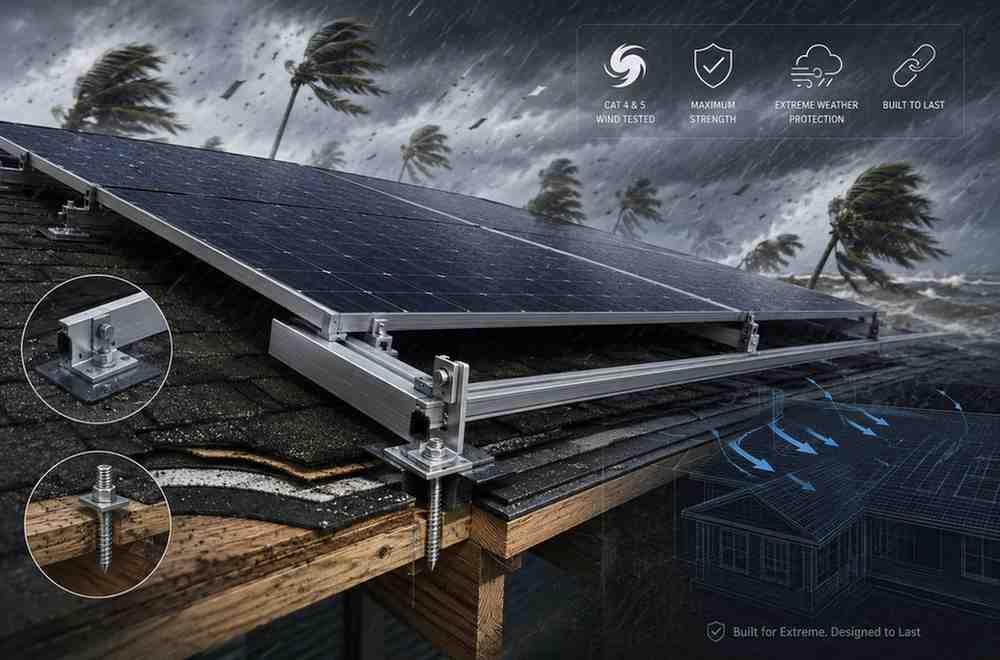
During a Category 4 or 5 storm, that uplift force can exceed 40 to 60 pounds per square foot at the array’s edges and corners, depending on the site’s exposure category and the roof’s height. That’s not a typo-level concern. A single panel weighing 40 to 50 pounds can experience uplift forces several times its own weight, which is exactly why mounting hardware, not panel weight, carries the structural burden in a storm.
This is where solar mount durability during hurricane conditions becomes a design question rather than a product spec sheet. Engineers use ASCE 7 (the American Society of Civil Engineers’ standard for minimum design loads) to calculate site-specific wind pressures based on wind speed zone, building height, roof geometry, and exposure category. A mount that performs fine in Ohio may be structurally undersized for a coastal site in Florida, even if it’s the exact same part number.
Every mounting system, rail-based or railless, is built around a load path: a sequence of connected parts that carries wind force from the panel surface down into the structural roof framing.
A typical path looks like this:
If any single link in that chain is undersized, the whole system is only as strong as its weakest point. A mount rated for 180 mph winds is meaningless if the lag bolt beneath it only penetrates 1 inch into a rafter that requires 2.5 inches of embedment for adequate pull-out resistance. This is a common field mistake: installers hit “something solid” and assume they’ve found the rafter, when they’ve actually caught the edge of it at an angle.
Rail-based systems spread wind load across multiple attachment points along a continuous rail, which helps distribute uplift force more evenly across the roof structure. This makes rail systems forgiving of minor rafter-spacing irregularities, since the rail itself acts as a load-sharing member between attachment points.
Railless systems attach panels directly to mounting points without rails. When correctly designed, they perform similarly in wind tests, but attachment spacing is critical since there’s no rail to share load if one point fails. Manufacturers provide maximum spacing tables based on wind zone and roof pitch, which should be followed exactly.
Neither approach is superior for hurricane zones. What’s important is if the installation follows the manufacturer’s letter or ICC-ES ESR report for the site conditions, not generic instructions for moderate wind zones.
A few standards consistently show up in hurricane-zone solar permitting:
Local building departments in hurricane-prone regions frequently require a site-specific engineering letter that ties the generic ESR data to the actual roof framing, rafter spacing, and wind exposure of the property being permitted. This step gets skipped more often than it should, usually because it adds time to the permitting process, but it’s the document that actually confirms the mount will perform as tested under that roof’s real conditions.
Wind gets the attention, but corrosion is what quietly weakens a mounting system between storms. Coastal air carries salt, and salt accelerates galvanic corrosion between dissimilar metals, particularly at the point where aluminum rails meet steel fasteners.
Stainless steel hardware (typically 305 or 316 grade in coastal applications) resists this degradation far better than standard zinc-plated steel. A mount that tested perfectly on day one can lose a meaningful percentage of its pull-out strength after a few years of coastal exposure if the wrong fastener grade was used. This matters directly for storm survivability: a corroded lag bolt has less holding power exactly when a hurricane tests it hardest.
Post-storm inspections typically reveal the same few issues:
None of these are unusual failure modes. They are shortcuts taken during installation that only become problems when wind load tests them.
Surviving a Category 4 or 5 hurricane isn’t about one heroic bracket holding everything together. It’s the cumulative result of correct wind load calculations, a complete and unbroken structural load path, code-compliant attachment spacing, and hardware that resists corrosion long enough to still perform years after installation. Hurricane resistant solar mounting is less a product category and more a documented, site-specific engineering process, one where the ESR, the engineering letter, and the actual fastener embedment in the field all have to agree with each other. When they do, the array’s ability to withstand extreme wind isn’t a guess. It’s a calculated, verifiable outcome.
Properly designed systems with correct attachment spacing, embedment depth, and code-compliant hardware can resist Category 5 wind loads. Their survival depends on site-specific engineering considering actual wind exposure, not just on the panel or mount brand.
Many certified mounting systems are engineered for wind speeds over 180 mph when installed per ICC-ES reports and manufacturer specs, depending on system and site conditions.
Standard roof hurricane straps reinforce roof-to-wall connections but don’t directly strengthen solar attachment points. Solar arrays depend on their own mounting hardware and load paths, not roof strapping systems.
Properly installed, code-compliant systems stay in place during hurricanes and usually don’t need removal. Removal is only necessary if installation didn’t meet current wind-zone standards or shows prior damage.

© 2025 Crivva - Hosted by Airy Hosting Managed Website Hosting.