

Okay so your skin feels tight after a shower. Not every time, but enough that you’ve noticed. Or maybe it’s the itching that starts about ten minutes after you towel off, right along the shins or the sides of your torso. You’ve probably tried a different lotion, maybe a gentler body wash, something labeled “sensitive” or “soothing” on the bottle.
And it kind of helps. But the problem keeps coming back.
Here’s what a lot of people don’t figure out until way later the soap itself might be the problem. Not the lotion you’re not using enough of.
Walk into any big-box store and read the fine print on those bars. A lot of them say “beauty bar” or “cleansing bar” because legally they can’t call themselves soap. They’re detergent. Synthetic lathering agents designed to strip oil fast, rinse clean, and shelf-stable for two years in a warehouse.
That’s fine for getting grease off a pan. Not ideal for daily skin contact.
The squeaky-clean feeling after using one of those bars? That’s your skin’s acid mantle the thin protective layer — getting wiped out. Your skin then goes into a kind of panic mode trying to produce more oil to compensate. Which is why some people end up both dry and oily, somehow, at the same time. It’s maddening.
Real handmade goat milk soap doesn’t do that.
Fat. That’s the short answer.
Goat milk has a naturally high fat content, and that fat doesn’t just sit on top of your skin it absorbs. The molecular structure of goat milk fat is smaller than cow milk, which means it actually gets in there. When soap is made with real goat milk, those fatty acids stay in the bar through the saponification process and do real work on your skin.
There’s also lactic acid in goat milk. It’s a gentle AHA alpha hydroxy acid the same type of thing people pay a lot of money for in serums. In soap form it’s less concentrated, so it won’t peel your face off. What it does is slow, subtle exfoliation. Smoothing texture over weeks without you even clocking it’s happening.
And the pH. Goat milk sits around 6.7 to 6.9. Human skin is about 5.5. That’s close enough that it doesn’t throw your barrier into chaos the way a highly alkaline bar does.
Fragrance is sneaky. A lot of people with reactive skin have spent years blaming everything except fragrance diet, stress, hard water, laundry detergent. Meanwhile they’re rubbing synthetic parfum all over their body twice a day and wondering why nothing improves.
Unscented goat milk soap removes that variable completely. No essential oils, no masking fragrance, nothing your skin has to fight through. Just the base. If your skin calms down after switching, you know it was probably the fragrance all along. If it doesn’t, at least you’ve ruled that out and can look somewhere else.
I know unscented sounds boring. It kind of is. But boring and effective is a pretty good combination when your skin is already aggravated.
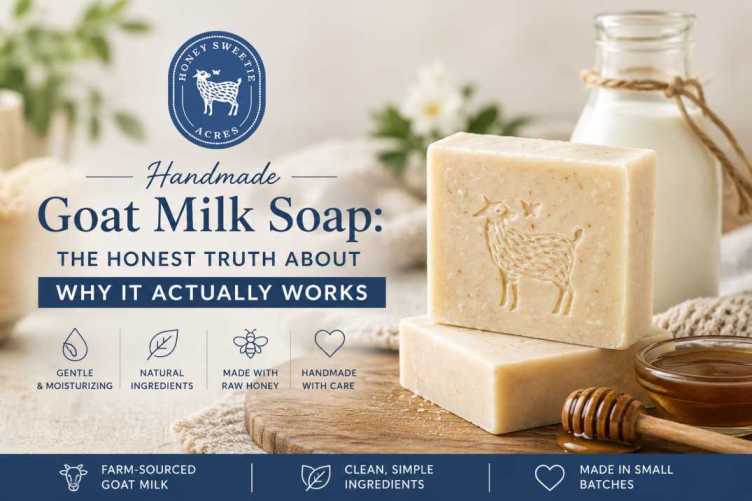
Some of the better handmade bars also include raw honey, and there’s a real reason for it. Honey is humectant it pulls moisture toward the skin instead of away from it. It also has natural enzyme activity that’s mildly antibacterial, which matters if you’re prone to breakouts or folliculitis or just that general low-grade congestion that never fully clears.
Honey & goat milk handmade soap specifically tends to feel different on the skin during the rinse. Less stripping. The water kind of sheets off instead of pulling at your skin. It’s a small thing but once you notice it you start paying more attention to how your skin actually feels mid-wash, not just after.
For combination skin dry cheeks, oily T-zone, the whole annoying mess honey and goat milk together tends to work without overcorrecting in either direction.
There’s a real difference between a small producer making soap in batches of 50 bars and a factory running thousands of units a day. It’s not just the story on the label.
Cold-process soap the method most small-batch soapmakers use takes 4 to 6 weeks to cure properly. A lot of commercial operations skip or rush that process. The result is a bar that’s softer, wears down faster, and hasn’t fully finished saponification, meaning there’s still some lye activity happening that can irritate skin.
A properly cured bar feels harder, denser, and lathers differently. It also lasts longer in the shower instead of turning into that sad mushy sliver after a week.
That’s one reason people end up going back to places like Honey Sweetie Acres it’s small-batch, farm-source goat milk, and you can tell in how the bar actually holds up over time. Not because the branding says so, but because you can feel it.
If you’re buying goat milk soap and want to know if it’s real:
The best goat milk soap doesn’t need to announce itself. It just works quietly and your skin shows it over time.
One bar isn’t going to undo years of barrier damage. People try it for a week and say it didn’t work. That’s not how skin behaves.
The realistic timeline is 3 to 4 weeks of consistent daily use before you can make a fair judgment. What usually happens and this is pretty consistent across people who make the switch is that the bad stuff stops happening first. No more tightness. No post-shower itch. Flare-ups get less frequent. The dramatic improvement people expect usually comes later, after the skin barrier has had enough time to actually stabilize.
Most people don’t even realize how reactive their skin was until it stops reacting.
It’s not a miracle product. Goat milk soap is just a well-made bar that doesn’t fight your skin while it cleans it. For a lot of people, that ends up being exactly what they needed and couldn’t find at the drugstore. Worth trying. Your skin’s been patient enough.

© 2025 Crivva - Hosted by Airy Hosting Managed Website Hosting.