

Market Overview:
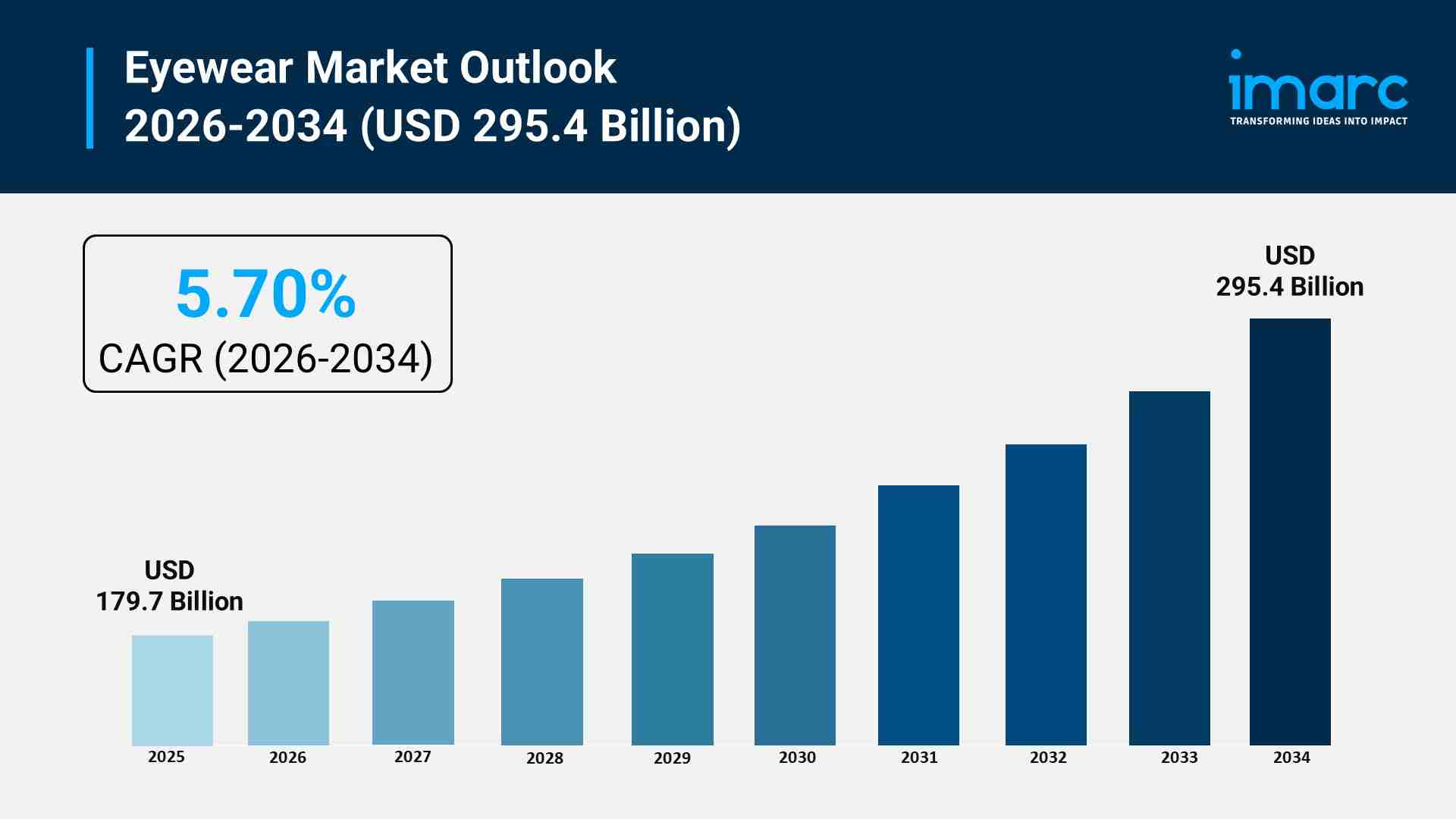
The eyewear market is experiencing rapid growth, driven by escalating prevalence of vision disorders, strategic government and institutional initiatives, and integration of advanced lens technology. According to IMARC Group’s latest research publication, “Eyewear Market: Global Industry Trends, Share, Size, Growth, Opportunity and Forecast 2026-2034”, the global eyewear industry size reached USD 179.7 Billion in 2025. Looking forward, IMARC Group expects the market to reach USD 295.4 Billion by 2034, exhibiting a growth rate (CAGR) of 5.70% during 2026-2034.
This detailed analysis primarily encompasses industry size, business trends, market share, key growth factors, and regional forecasts. The report offers a comprehensive overview and integrates research findings, market assessments, and data from different sources. It also includes pivotal market dynamics like drivers and challenges, while also highlighting growth opportunities, financial insights, technological improvements, emerging trends, and innovations. Besides this, the report provides regional market evaluation, along with a competitive landscape analysis.
Download a sample PDF of this report: https://www.imarcgroup.com/eyewear-market/requestsample
Our report includes:
Rising rates of myopia and other refractive errors serve as a primary catalyst for the expansion of the global eyewear sector. In several Asian nations, including China and South Korea, myopia prevalence has reached levels exceeding 80% among young adults, necessitating a consistent demand for corrective lenses. This surge is largely attributed to lifestyle shifts, such as increased screen time and a transition toward remote work and digital learning environments. Furthermore, at least 2.2 billion people worldwide currently experience some form of near or distant vision impairment, creating a massive addressable market for prescription spectacles. The aging global population also contributes to this demand, as older demographics increasingly require specialized products like bifocals and progressive lenses to address presbyopia. Consequently, the medical necessity of vision correction remains a fundamental and stable pillar supporting the continuous growth of manufacturers and retail optical chains.
Public health programs and policy reforms are significantly bolstering the accessibility and consumption of eyewear across diverse regions. In India, the government allocated INR 1,850 crore under the National Programme for Control of Blindness to expand school vision screening initiatives, which directly increases the adoption of spectacles among children. Similarly, China’s National Health Commission updated its myopia control guidelines to recommend clinical monitoring and the use of orthokeratology lenses for school-age populations, where nearly 68% of urban children are myopic. Beyond health, economic policies like India’s Union Budget 2026 are fostering retail growth by developing City Economic Regions in Tier 2 and Tier 3 cities, enhancing urban infrastructure and increasing disposable incomes. These systematic efforts, combined with the removal of export value caps on courier consignments, empower companies to scale their international operations and reach underserved populations more efficiently than in previous years.
Technological innovation in lens manufacturing is transforming eyewear from simple medical tools into high-performance lifestyle assets. The widespread adoption of blue-light blocking lenses is a direct response to digital eye strain, with these products now integrated into standard workplace wellness recommendations. Advanced photochromic technologies, which allow lenses to shift opacity based on lighting conditions, have improved the functionality of prescription sunglasses, making them more appealing to a broader consumer base. In the United States, research indicates that while many adults express concerns about vision health, only 28% undergo annual exams, prompting companies to implement AI-enabled eye testing to streamline the diagnostic process. These technical upgrades, alongside the use of materials that respond to skin temperature or incorporate smart sensors for health monitoring, are encouraging consumers to upgrade their existing eyewear more frequently, thereby stimulating higher sales volumes across both premium and mid-range segments.
The fusion of traditional frames with sophisticated digital capabilities is a dominant trend, as smart glasses transition from niche gadgets to essential health and productivity tools. Modern iterations are equipped with sensors capable of monitoring heart rate, physical activity, and even brain activity, positioning eyewear as a primary wearable device for real-time wellness tracking. Artificial Intelligence integration further enhances this experience by enabling voice command features that allow users to manage navigation, music, and real-time language translation entirely hands-free. These innovations are particularly popular among tech-savvy professionals and younger demographics who prioritize multitasking and connectivity. Leading optical retailers are already rolling out specialized lines featuring these smart capabilities to meet the growing consumer appetite for multifunctional accessories. As AI-powered testing also becomes more prevalent in physical stores, the entire purchasing journey is becoming increasingly digitized and data-driven for the end user.
A clear shift in aesthetic preferences is currently favoring precision-crafted shapes that blend vintage inspirations with contemporary, aerodynamic lines. Sleek oval silhouettes, reminiscent of fluid 1990s designs, have returned as a major fashion statement, valued for their ability to soften facial features while maintaining a modern edge. In addition to these curves, geometric frames featuring soft hexagons and sharp, sculpted edges are gaining traction among consumers seeking unique character without overwhelming their facial proportions. Rimless eyewear is also making a notable comeback in two distinct forms: ultra-thin, nearly invisible designs and those featuring thick, contrasting side shells for added structural depth. These trends are heavily influenced by social media and celebrity endorsements, which drive seasonal updates and encourage fashion-conscious individuals to view eyewear as a core component of their personal identity rather than just a functional necessity.
Economic shifts are steering consumer behavior toward a blend of price sensitivity and sustainability, leading to a rise in demand for mid-range and eco-friendly products. In the current market, the mid-price segment accounts for a substantial portion of the market share, reflecting a broader trend where shoppers seek quality craftsmanship without the premium luxury price tag. This value-conscious approach is evidenced by an uptick in single-pair purchases over multiples and a preference for independent eye care practices that offer personalized service. Simultaneously, there is an increasing sensitivity toward responsible consumption, prompting brands to adopt ethical sourcing, recycled components, and biodegradable packaging. Large-scale distributors are responding by expanding their footprints in smaller urban centers and rural areas, where affordable yet stylish options are in high demand. This dual focus on financial pragmatism and environmental impact is reshaping how manufacturers design and market their latest collections.
Leading Companies Operating in the Global Eyewear Industry:
Eyewear Market Report Segmentation:
By Product:
Spectacles dominate the eyewear market, driven by the prevalence of refractive errors and increasing demand from the aging population, along with advancements in eyewear materials and styles.
By Gender:
Unisex eyewear holds the largest market share, reflecting trends towards gender-neutral fashion and convenience, appealing to consumers with versatile designs and minimalist aesthetics.
By Distribution Channel:
Optical stores lead the market segment due to their specialized services, extensive product ranges, and the availability of professional eye care, enhancing consumer trust and satisfaction.
Regional Insights:
Europe accounts for the largest eyewear market share, supported by high consumer spending, a strong presence of leading brands, and a growing geriatric population needing vision correction.
Note: If you require specific details, data, or insights that are not currently included in the scope of this report, we are happy to accommodate your request. As part of our customization service, we will gather and provide the additional information you need, tailored to your specific requirements. Please let us know your exact needs, and we will ensure the report is updated accordingly to meet your expectations.
About Us:
IMARC Group is a global management consulting firm that helps the world’s most ambitious changemakers to create a lasting impact. The company provide a comprehensive suite of market entry and expansion services. IMARC offerings include thorough market assessment, feasibility studies, company incorporation assistance, factory setup support, regulatory approvals and licensing navigation, branding, marketing and sales strategies, competitive landscape and benchmarking analyses, pricing and cost research, and procurement research.
Contact Us:
IMARC Group
134 N 4th St. Brooklyn, NY 11249, USA
Email: [email protected]
Tel No:(D) +91 120 433 0800
United States: +1-201971-6302

© 2025 Crivva - Hosted by Airy Hosting Managed Website Hosting.