

Bounce rate is one of the most critical yet undervalued metrics for optimizing the performance of website in SEO campaign. Sometimes it can be confusing especially when optimizing your website.
It is important to understand the factors that contribute to a high or low bounce rare to improve the performance of your website. Bounce rate in SEO can provide valuable insights for improving content and experience of user while it is not a ranking factor in the algorithm of Google.
Let’s know about the bounce rate is still relevant or not.
Bounce rate is essential metric to analyzing the website performance and the engagement of user.
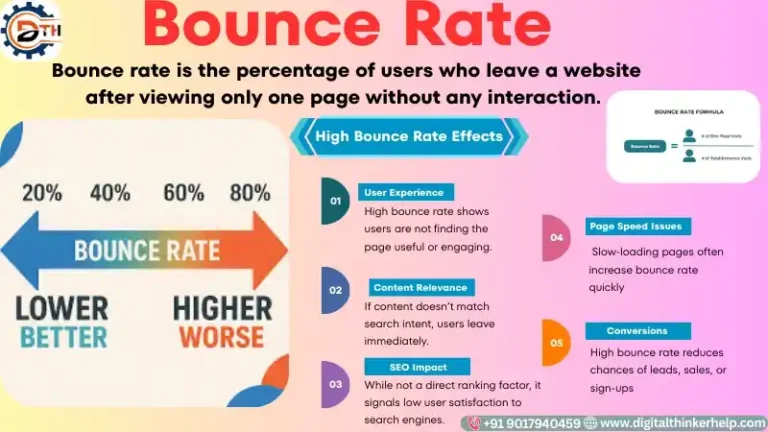
It refers to the percentage of visitors who leave the page of a website after viewing only a single page.
They don’t stay longer or don’t interact with other pages or elements on the site.
It happens possibly leads it to lower ranking in search engine results pages (SERPs). It shows to search engines that users are not finding what they are seeking for on a webpage.
With dividing the number of unengaged session by total number of session. After then, get multiplying by 100 to calculate the bounce rate.
Bounce Rate = (Unengaged sessions / Total sessions) × 100
For your understanding, if your site gets 1,000 sessions; and 320 of them are unengaged. So, your bounce rate will be 32%.
Bounce rate is also the inverse of engagement rate. So, if your site earns 30% bounce rate, then its engagement rate will be 70%.
Good bounce rate is not constant; it can be vary your website’s objective and industry to industry. As per PRO digital marketer, generally 20–40% is excellent, 40–55% is average, and 55–70% may need to improvement.
If users quickly find what they want still it can indicate success that doesn’t mean a high bounce rate is always bad. The main thing is compare against your own goals, traffic sources and past performance rather than relying on a single benchmark.
There are slight differences between bounce rate and exit rate are both used as proxies for website engagement. When users enter a website and left without visit any other page on the website and bounce rate measures the number of users. The users who left a website from a specific page and exit rate measures the number of users.
Let’s take an example when 100 people visit on the homepage and 50 of them leave without visit any other pages then the bounce rate will be 50% of the homepage. Although the homepage may get the 400 visits at the same time and only 100 of them leave the site from the homepage. So the exit rate will be 25% in that case.
There are many reasons that your site might have a high bounce rate, including:
Slow load times: As every user wants to complete tasks or actions quickly. When your page takes time more than three seconds then users will leave your page without any interactions. You have to be sure your pages load in less than 2.5 seconds.
Poor web design: When the website design is cluttered or overloaded that can turn visitors away. If there is used of inconsistent typefaces, many color palettes and clashing colors can create the negative user experience and force the users to leave your site.
Bad navigation: It is difficult for visitors to navigate your website when there are hidden or complex menus. Do not give too many options to visitors. The Aim should be to create a lean and simple menu and avoid lengthy and inconsistent navigation with excessive submenus.
Irrelevant content: If your content is low-quality, irrelevant or complex then visitors may bounce. To keep visitors engaged you should review your content pages to ensure they offer value and are legible.
Traffic quality: The quality of your website traffic heavily influences bounce rates. Visitors coming from irrelevant ads or untargeted campaigns are more likely to leave quickly. To reduce bounce rates, ensure your visitors align with your website’s goals. Regularly analyze your traffic sources and adjust your targeting to reach the right audience.
If you’re looking for expert guidance, the Best Digital Marketing company in Yamunanagar can help optimize your campaigns and attract high-quality traffic.
Now, it is time to cover the solutions why the people bounce from a page. We have already covered a different number of reasons of bounce rate.
So, there are different capacities to enhance the experience of user.
When users visit on your page and you want them to navigate down the funnel and for this you need to engage them continuously.
It is good that there are many ways to create engaging elements.
It will be done only with a simple click after add breadcrumbs to allow users to know that where they are on the site hierarchy. Also give them a simple way to zoom out and access broader pages on your site.
Adding “People Also Bought” or “People Also Viewed” section to their pages can be benefit for Ecommerce sites. It attracts the users not only to click but also offer additional value.
The strategy with solid internal linking can make sure that your related pages are grouped into their appropriate topic cluster. It also encourage the users down the path to further pages on your site.
As we see here for a blog this can be in the form off further resources or additional readings.
Content is at the heart of SEO probably you are aware of that by now. Our marketing make a list of 8 tricks to create engaging content that includes the things like supplemental video, a key points section and many more.
As previously discussed to match the correct user intent is a important as the content itself and the way you present your content the same efforts. A blog post is ideal for information although category and product pages are necessary to properly address a transactional intent. But, still a blog post is ideal for informational intent queries.
The attention span of users is short so don’t make users search hard to find the information they are seeking. They will bounce back in case they don’t get the answer of their query.
You have to prove the user that you have the information they need by showing the important elements on the top. So, that the user will stay and explore more.
Your page always needs to load fast for online people as they won’t wait for long. You should use page speed testing tool to check the page speed performance and optimize to fix anything that slows down your website.
Keep it remind that if there is a seconds-long delay results can cause of bounce rate.
You should avoid the elements that cause of mess and confusion. These elements are included pop-up windows, advertisements and as we mentioned before about auto-play videos.
You can add these kinds of contents but be careful for your actual content of page. If these additional elements get the spotlight then that means your page is failed to do its own job.
People use mobile devices to access the content anytime and anywhere. So it is important it should be mobile-friendly. If it is not then you may lose a large number of the visitors who won’t come to your site.
When you design for mobile the content must be readable but it feels the crowded. Also it should be easy to view and use your site.
Hence the page is much better on mobile.
You must be ensuring that you target your relevant audience in at place. To avoid a bounce keep your audience engaged on your site.
If you obtain a 404 error then you have to need creating a useful page. Keep checking your web pages to catch any broken links that would send users straight back to the SERPs.
For an example you can guide users to your homepage or add a CTA. In this manner you can rectify the situation by providing some sort of value and influence the users not to bounce even if there is a technical error.
Users want to use the high-quality, dynamic web pages with engaging texts, images, videos and other visual elements.
Google Analytics provide the details of web analytics of bounce rate data.
Hotjar helps to Shows visual insights with heatmaps and session recordings
Mixpanel keep tracks completely the user interaction with event-based analytics.
Optimizely Lets you experiment with pages to improve performance and reduce bounce rates.
Bounce rate is complicated and a useful metric that shows how well a website meets visitors’ needs and expectations. It’s not a direct ranking factor but it affects user experience without any doubt and that can influence SEO.

© 2025 Crivva - Hosted by Airy Hosting Managed Website Hosting.