

Winning a five-year road maintenance contract in Indonesia is only the first step. The real success depends on how well you manage production costs, equipment utilization, and long-term profitability. Among all investment decisions, selecting the right asphalt batching plant capacity has the strongest impact on ROI.
If the capacity is too small, you will struggle during peak paving seasons. If it is too large, your equipment will sit idle and reduce returns. Therefore, the goal is not just to produce asphalt, but to produce it efficiently over five years with stable demand and controlled cost.
In this article, we will break down how different capacities perform in real Indonesian maintenance projects and how contractors can maximize ROI in practical terms.
Road maintenance contracts in Indonesia are usually long-term but highly variable in workload. You may have heavy production during dry seasons and lower output during rainy months. This fluctuation makes capacity planning more important than ever.
Most contractors work on a mix of provincial roads, city streets, industrial access roads, and emergency repairs. Because of this diversity, asphalt demand is rarely constant. Instead, it moves in cycles, which directly affects plant utilization rates.
This is why choosing a balanced production capacity often leads to better ROI than simply choosing the largest plant available.
Smaller asphalt plants are often used for local projects or district-level maintenance work. They offer lower investment costs and easier logistics, especially in remote areas.
However, they also come with limitations. When multiple projects run at the same time, production capacity becomes a bottleneck. This can lead to delays and increased labor costs.
For contractors with limited annual asphalt demand, these plants can still provide stable returns, especially when project schedules are predictable.
But for long-term contracts with increasing workload, many companies quickly find themselves needing more capacity.
For reference, you can check harga aspal mixing plant to understand how investment levels change across different configurations.
Among all options, the 80–120 TPH range is often considered the most balanced choice for Indonesian contractors handling five-year maintenance contracts.
This range supports continuous production without excessive idle cost. It also provides enough flexibility for multiple concurrent projects without overloading the system.
More importantly, this capacity range matches the real demand pattern of many provincial and national maintenance contracts.
As a result, utilization rates remain stable, which directly improves ROI over time.
In many cases, contractors using this range achieve better financial performance than those investing in larger but underutilized equipment.
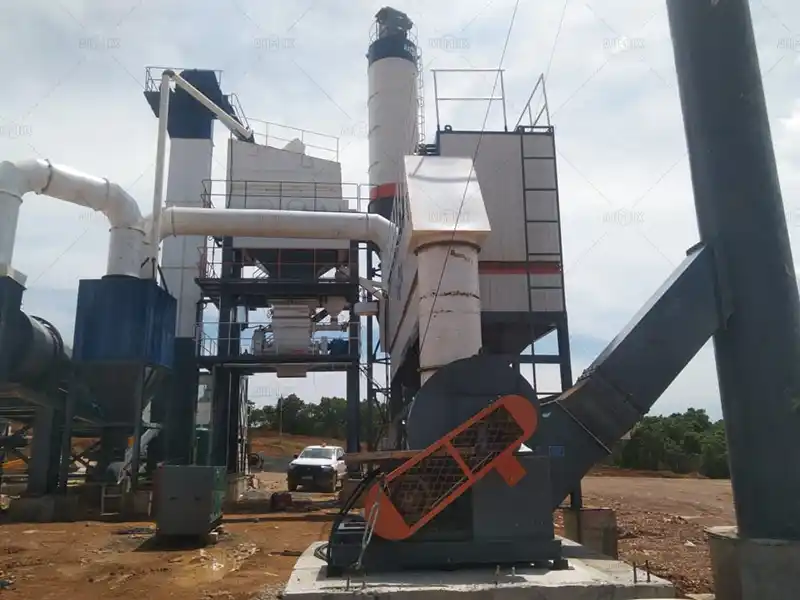
If you are comparing production options, the amp hotmix system is often used in this capacity range for stable continuous output in road maintenance projects.
Large asphalt batching plants are designed for high-output infrastructure projects such as expressways, airports, and large EPC contracts.
They deliver impressive production performance, but only when demand is consistently high. Otherwise, operating costs increase faster than revenue.
In a five-year maintenance contract scenario, many contractors find it difficult to maintain full utilization throughout the year.
This leads to longer payback periods and reduced ROI efficiency unless the contractor has multiple large-scale projects running simultaneously.
Therefore, high-capacity plants are best suited for companies with strong government or national infrastructure pipelines.
Indonesia’s geography plays a major role in equipment planning. Projects are often spread across islands, cities, and remote areas. Because of this, mobility becomes an important ROI factor.
A mobile plant can reduce relocation cost and setup time, especially when projects are geographically separated. This improves overall utilization and helps maintain production continuity.
For contractors who frequently move between project sites, a mobile asphalt batching plant can significantly improve operational flexibility and reduce downtime.
However, mobility should still be balanced with capacity needs. A highly mobile but under-capacity plant may still limit project efficiency.
While capacity is important, ROI depends on several other operational factors as well.
Fuel consumption directly affects production cost. A well-optimized plant can significantly reduce cost per ton of asphalt.
The higher the utilization rate, the faster the investment is recovered. Idle time is one of the biggest hidden costs in asphalt production.
Regular maintenance prevents unexpected downtime. This ensures consistent production during peak project periods.
Efficient aggregate and bitumen supply chains help avoid production interruptions and improve scheduling accuracy.
Instead of focusing only on equipment size, contractors should evaluate real project demand over time. A five-year contract is not static. It changes with government budgets, seasonal conditions, and project expansion opportunities.
Therefore, the best approach is to calculate average annual asphalt demand and compare it with peak seasonal requirements.
If your peak demand is too high for a small plant, you risk delays. If your average demand is too low for a large plant, you risk low utilization.
The ideal capacity is the one that keeps production steady while minimizing idle time across the full contract duration.
In Indonesia’s road maintenance market, ROI is not determined by the biggest asphalt plant, but by the most balanced one. A well-matched capacity ensures stable production, controlled operating costs, and high equipment utilization throughout the contract period.
For most contractors, the 80–120 TPH range offers the strongest balance between investment and long-term return. It adapts well to real project conditions while maintaining efficiency across multiple seasons and project types.
If you are planning a five-year road maintenance contract, choosing the right asphalt batching plant is not just a technical decision. It is a strategic business move that will directly affect your profitability for years.
To explore different configurations and compare solutions based on your project requirements, you can review detailed equipment options and technical guidance to build a more accurate investment plan.

© 2025 Crivva - Hosted by Airy Hosting Managed Website Hosting.