Introduction
Customer expectations in online shopping have evolved. Instead of just browsing, people want to interact with products—choosing, adjusting, and personalizing them before buying. Businesses that provide these interactive experiences are gaining an advantage over those still relying on static product pages.
A smart product configurator plays a key role in this shift. It allows customers to customize products in real time and instantly see the results of their choices. This reduces uncertainty, lowers cart abandonment, and creates a more engaging and trustworthy shopping experience.
This article explores how smart configurator technology works, what makes the best solutions effective, how different industries use it, and why investing in it is becoming essential for long-term business success.
What Makes a Configurator “Smart”?
The word “smart” gets used loosely in technology marketing, but in the context of a product configurator, it refers to something specific. A smart configurator is not simply a tool that lets customers pick colors from a swatch palette. It is a system that understands your product rules, responds intelligently to customer inputs, prevents invalid selections, guides decision-making, and connects seamlessly to the broader commerce and manufacturing ecosystem behind the scenes.
A basic configurator shows a product and allows limited changes. A smart configurator knows that if a customer selects a particular frame size, only certain upholstery options are compatible. It knows that a specific material combination will affect lead time. It knows that a chosen accessory requires a particular base configuration. All of that logic runs silently in the background, so the customer sees only smooth, intuitive choices while the system ensures that every configuration that reaches production is technically valid.
This intelligence is what transforms a configurator from a visual gimmick into a genuine business tool that adds value at every stage of the product journey.
The Customer Experience Advantage
A smart configurator significantly improves the customer buying experience. In a typical online store, customers only see static images and specifications, forcing them to imagine how a product will look with different options. This uncertainty often leads to hesitation or abandoned purchases.
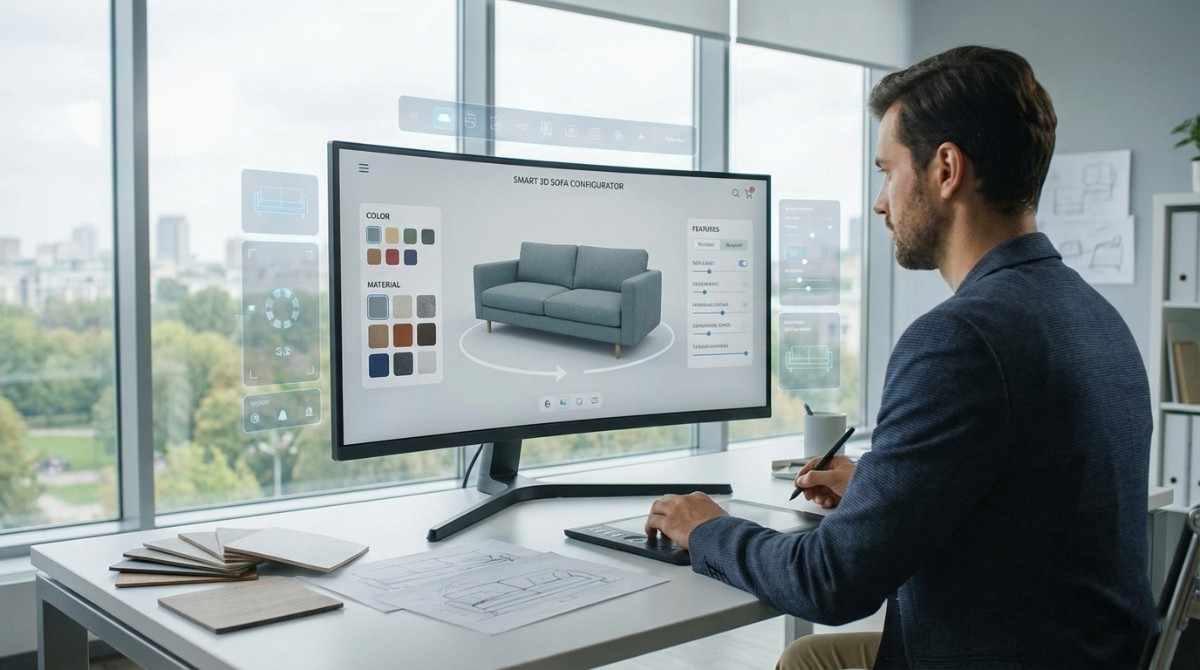
With a smart configurator, customers can interact with the product in real time—rotating it, changing colors, adding features, and even previewing it in their own space using their phone camera. This visual, interactive experience answers questions instantly and builds confidence.
As a result, customers spend more time on product pages, conversion rates increase, and product returns decrease because buyers clearly understand what they are purchasing.
Core Capabilities That Define a Smart Configurator
Building a configurator that delivers genuine intelligence requires a specific set of technical and functional capabilities working together.
Real-Time Visual Rendering
The visual engine is the most visible component of any configurator. A smart solution uses optimized 3D rendering, typically powered by WebGL, to ensure that every configuration change appears immediately and accurately with correct lighting, material textures, shadows, and reflections. The experience must be smooth on every device, from a high-end desktop monitor to a mid-range mobile phone.
Rules-Based Product Logic
Behind the visual layer sits the product logic engine, the part that makes a configurator truly smart. This system encodes all of the compatibility rules, constraints, dependencies, and pricing relationships that govern your product catalog. It ensures customers can only build configurations that can actually be manufactured, quoted, and delivered, while remaining invisible to the user in terms of interface friction.
Guided Selling and Decision Support
Smart configurators do not wait passively for customers to navigate options on their own. They actively guide the journey, surfacing popular configurations, highlighting upgrade opportunities, suggesting complementary options, and flagging when a combination might not be the best fit for the customer’s stated needs. This guided approach reduces decision fatigue and increases the average value of completed orders.
Augmented Reality Placement
The ability to use a smartphone camera to place a configured product in a real-world environment is one of the most powerful conversion tools available in commerce today. When a customer can see a configured sofa sitting in their actual living room, or a customized shelving unit filling their office wall, the last remaining doubt about whether the product will work in their space is removed entirely.
Dynamic Pricing and Instant Quoting
Every configuration change a customer makes should be reflected immediately in the price display. Smart configurators calculate pricing dynamically based on the chosen specifications, quantities, materials, and options,s giving customers full transparency and eliminating the need for manual quote requests in B2B contexts. For complex products, this can compress a sales cycle that previously took days into a process that takes minutes.
Applications Across Key Industries
Smart configurator technology has found meaningful applications across a wide range of product categories and business models.
Furniture and Home Interiors
Furniture is one of the most challenging categories in online retail. Size, material, color, and finish all interact in ways that are genuinely difficult to communicate through static photography. A smart furniture configurator lets customers build their exact pie,ce choosing dimensions, fabric, leg finish, cushion firmness, and more, ore and see the result rendered accurately in real time. Combined with AR placement, it effectively replicates the showroom experience from home.
Automotive and Vehicles
Vehicle configurators have long been a standard feature of automotive brand websites, but modern smart configurators have taken the experience far beyond color and trim selection. Customers can now configure complex interiors, select technology packages, view accurate reflections on different paint finishes under different lighting conditions, and receive instant pricing updates all within a browser.
Jewelry and Precious Accessories
For luxury and fine jewelry, the configurator experience carries particular weight. Customers selecting custom rings, necklaces, or watches are making high-value, emotionally significant purchases. A smart jewelry configurator allows them to choose metal, gemstone type, cut, setting style, and engraving, seeing every detail rendered with the precision and quality that the price point demands.
Industrial and B2B Manufacturing
In B2B contexts, smart configurators serve a different but equally important function. Rather than driving emotional purchase decisions, they streamline complex specification processes,s allowing procurement teams to configure technical products, validate specifications against engineering rules, receive instant quotes, and submit orders that arrive in production with zero ambiguity. The reduction in sales friction and order errors translates directly to cost savings and faster deal cycles.
Apparel and Custom Footwear
Fashion and footwear brands are using smart configurators to offer genuine mass customization at scale, le letting customers design their own products from a structured set of options and see the result on a 3D model that accurately represents the finished garment or shoe. This made-to-order model reduces inventory risk while delivering a premium customer experience.
The Measurable Business Impact
A well-implemented smart configurator improves several key business metrics. Conversion rates increase because customers who customize products are more confident in their purchase. Return rates decrease since buyers receive exactly what they configured, reducing mismatches between expectations and reality. Average order value also rises as customers easily discover upgrades and add-ons.
For B2B companies, configurators can dramatically shorten the sales cycle by replacing manual quotes, emails, and sample reviews with instant self-service customization.
In addition, businesses offering interactive configurator experiences gain stronger brand recognition, more social sharing, and higher customer loyalty compared to standard product pages.
What to Look for in a Configurator Development Partner
Selecting the right partner to build and implement a smart configurator is as important as the decision to invest in the technology itself.
The ideal partner brings together deep technical expertise in real-time 3D rendering, browser-based performance optimization, and commerce system integration, alongside a genuine understanding of how customers make decisions and how product businesses operate. They should have a portfolio of completed configurator projects across different industries and product types, demonstrating that they can handle the full range of complexity that a real product catalog presents.
Equally important is the ability to support the solution after launch, by updating product logic as your catalog evolves, optimizing performance as usage grows, and integrating new capabilities as the technology continues to develop.
Conclusion
The smart product configurator is a major advancement in online commerce, replacing passive product viewing with interactive customization. It solves the key limitation of digital shopping by allowing customers to actively personalize products before purchasing.
For brands and manufacturers, this leads to clear benefits: higher conversions, fewer returns, faster sales cycles, and a stronger customer experience.
Interactive customization is no longer a future trend—it is already transforming online shopping. Businesses that adopt this technology now will be the ones customers trust and return to in the future.