

Building with large language models has become far more powerful over the past couple of years, but it has also become far more complicated. In the early days, most teams picked one provider, learned its API, and shipped. That is no longer how modern AI applications are built. Today a single product might use one model for fast, inexpensive classification, another for long context reasoning, and a third for creative generation or multilingual support. Teams increasingly mix OpenAI, Anthropic, Google, and Mistral inside the same product because no single provider is best at everything. The result is flexibility, but also a growing tangle of accounts, SDKs, authentication schemes, and rate limits that every engineering team has to manage on its own.
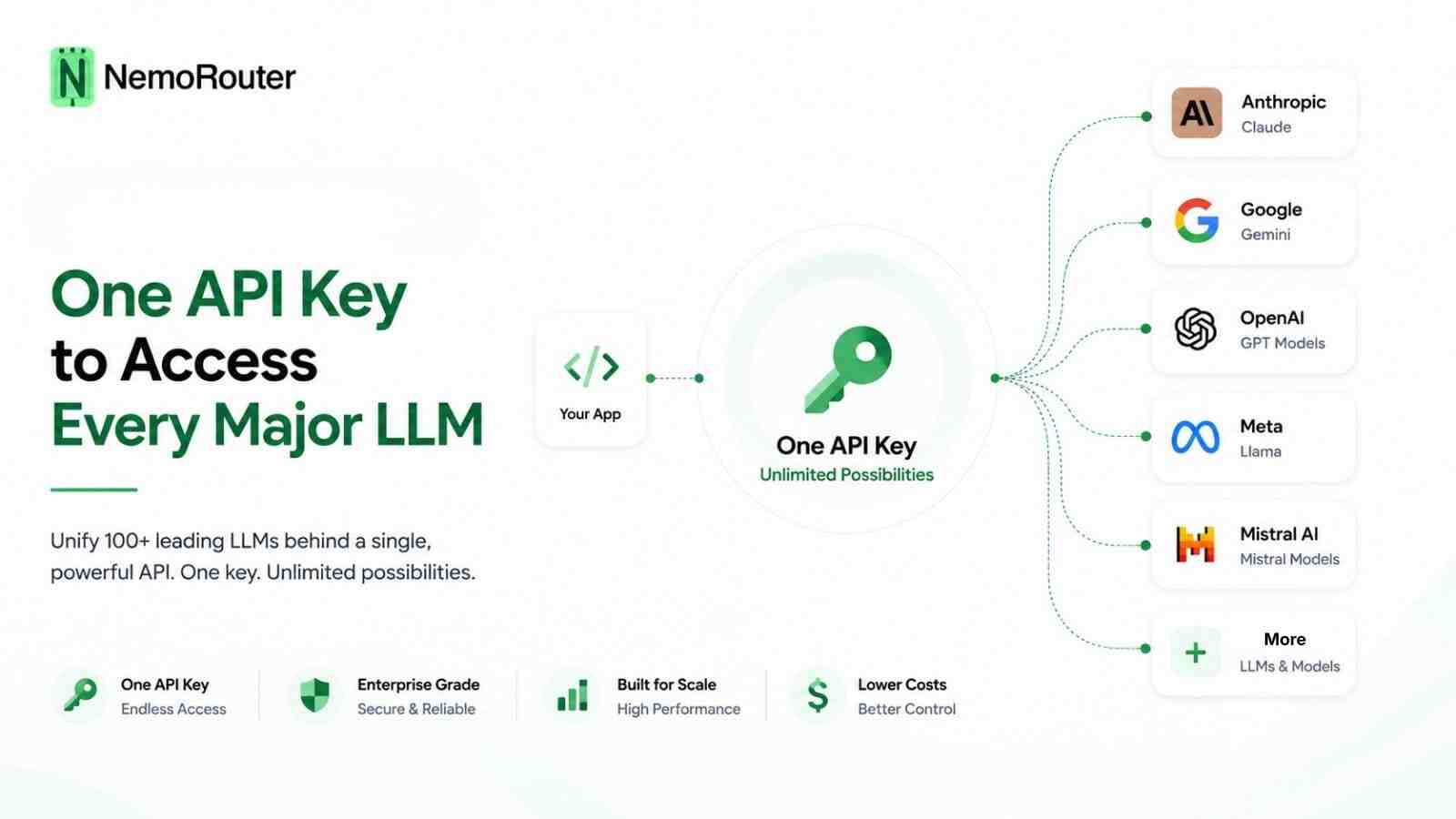
That complexity is exactly the problem NemoRouter was built to solve. NemoRouter is a unified API gateway for language models. It gives you a single API key that reaches every major provider, so instead of wiring up and maintaining a separate integration for each vendor, you integrate once and route your requests through one consistent interface. Behind that single endpoint, NemoRouter talks to OpenAI, Anthropic, Google, Mistral, and more, translating your request into whatever each provider expects and returning results in a predictable shape. For a developer, this means you can switch models or add a new provider without rewriting your application code.
One of the most immediate benefits is the reduction in boilerplate. Anyone who has integrated several model providers knows how much repetitive work is involved. Each vendor has its own SDK, its own authentication flow, its own way of streaming tokens, and its own quirks around error handling and retries. Multiply that across four or five providers and a meaningful share of your codebase becomes plumbing that has nothing to do with your actual product. NemoRouter absorbs that plumbing. You learn one interface, and the gateway handles the provider specific details so your team can spend time on features instead of maintenance.
Cost control is another area where a unified gateway pays off. When calls to many different providers are scattered across a codebase, it is genuinely hard to answer a simple question like how much are we spending on inference this month and where is it going. NemoRouter centralizes that visibility. Because every request flows through one place, you get a consolidated view of usage and spend across all providers. On top of that, NemoRouter supports budget enforcement, so you can set limits and stop surprise bills before they happen rather than discovering them after the fact. For teams moving from experimentation into production, that kind of predictability is often the difference between a project that scales and one that gets shut down.
Reliability and safety round out the picture. NemoRouter includes guardrails that let you apply consistent policies to what goes into and comes out of your models, which matters a great deal once real users are involved. It also offers smart routing, so requests can be directed to the most appropriate model based on your priorities, whether that is lowest cost, lowest latency, or highest quality for a given task. If one provider has an outage or starts returning errors, routing logic can fall back to an alternative instead of taking your whole feature down. In practice this turns a fragile setup that depends on a single vendor into something far more resilient.
It is worth emphasizing how much the landscape has shifted. A few years ago, choosing a model provider was close to a permanent architectural decision, because the cost of switching was high. Now the pace of releases is so fast that the best model for a task can change within months. Teams that hard wire themselves to one vendor pay a steep price when something better comes along, because migrating means touching authentication, request formatting, streaming, and error handling all over again. A gateway like NemoRouter turns that painful migration into a configuration change. You can test a new model against your real traffic, compare quality and cost, and move over gradually, all without a risky rewrite.
We also built NemoRouter with the reality of team collaboration in mind. In most organizations, more than one team ends up calling language models, and without a central layer you quickly get duplicated keys, inconsistent logging, and no shared understanding of what is being spent or why. By routing everything through one gateway, you get a single source of truth for keys, usage, budgets, and policies. That makes governance dramatically simpler, and it means a new engineer can become productive without hunting down credentials for five different services.
None of this requires giving up control. NemoRouter is designed to sit cleanly in front of the providers you already use, so you keep the flexibility to choose exactly which models power each part of your product. The difference is that you make those choices through one consistent layer rather than through a patchwork of separate integrations. You get the breadth of the entire ecosystem with the simplicity of a single key.
Developer experience was a first class concern from the very beginning. A gateway is only useful if it gets out of your way, so NemoRouter is built to feel like a natural extension of the tools engineers already reach for. Requests and responses stay familiar, streaming behaves the way you expect, and the interface stays stable even as we add support for new providers behind the scenes. That stability is deliberate, because the whole point of a gateway is to shield your application from churn in the underlying ecosystem. When a new model launches or a provider changes its API, that disruption is our problem to absorb, not yours to chase.
There is also a strategic advantage that is easy to overlook. When switching or combining models becomes cheap, you can make decisions based on evidence rather than guesswork. You can run the same prompt across several providers, measure real differences in quality, latency, and cost on your own traffic, and let those numbers guide your architecture. Instead of committing to a vendor and hoping it stays competitive, you keep your options open and continuously route work to whatever performs best for each task. Over the life of a product, that ability to adapt quickly and cheaply can matter far more than any single model choice you make today, and it is precisely the kind of leverage a unified gateway is meant to give you.
If you are building anything that touches large language models, the trend is clear. You will almost certainly want to use more than one model over time, and the cost of managing that yourself only grows as your product does. A unified gateway lets you embrace that multi model future without drowning in integration work. If any of this resonates with the challenges your team is facing, it is worth seeing how much simpler the process can be. You can explore the platform and start building at https://nemorouter.ai/

© 2025 Crivva - Hosted by Airy Hosting Managed Website Hosting.