


You’ve built the product. Maybe it’s a course, a set of Lightroom presets, a Notion template, or an ebook you’ve been sitting on for months. Now you’re stuck on a smaller decision that somehow feels bigger than it should: where do you actually sell it?
Two names keep coming up. Shopify and Gumroad. Both let you sell digital downloads. Neither one is obviously wrong. But they’re built for different kinds of sellers, and picking the wrong one means either overpaying for features you don’t need or hitting a ceiling faster than you expected.
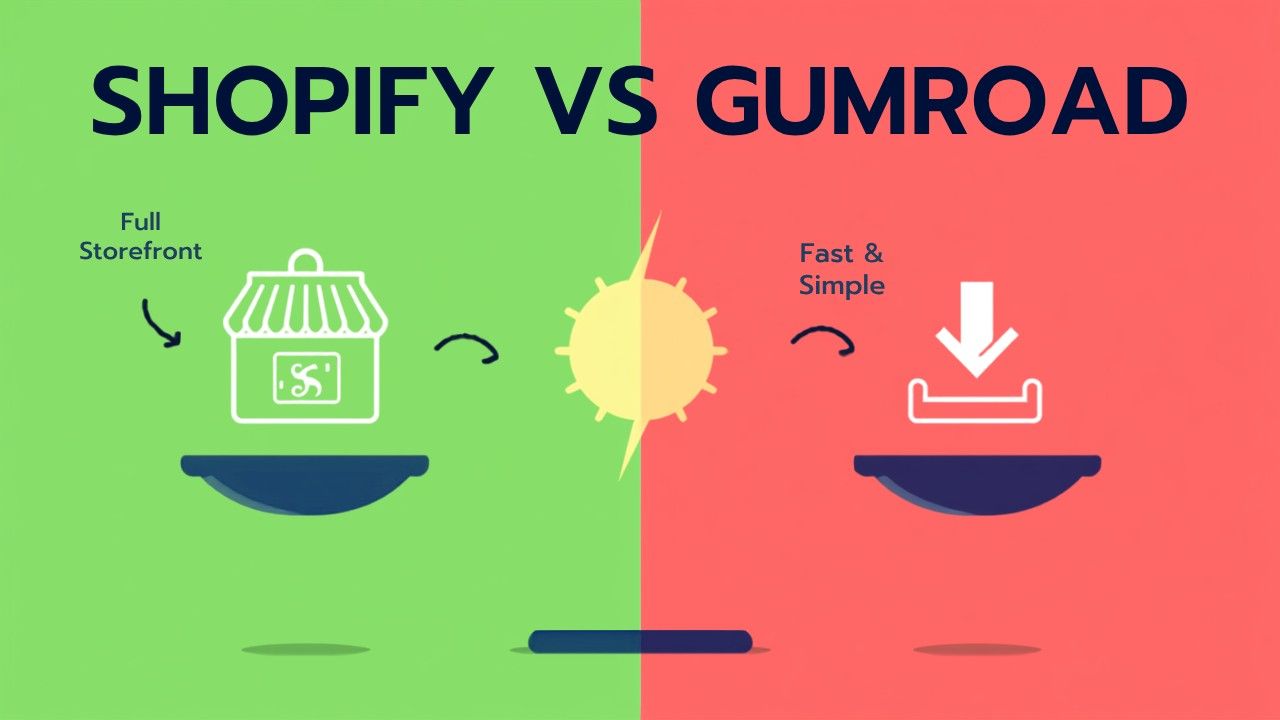
Let’s actually compare them, not as a feature checklist, but as two different bets on how your business grows.
Gumroad was built for creators who want to start selling in an afternoon. Upload a file, set a price, share a link. That’s close to the whole workflow.
Shopify was built as a full storefront system. It handles digital products fine, but it was designed to also handle physical inventory, subscriptions, multi-channel sales, and a growing catalog. That difference in origin shapes almost everything else on this list.
Gumroad wins here without much argument. You can have a product live in under 15 minutes, no coding, no theme decisions, no app installs.
Shopify takes longer to set up properly. You’re choosing a theme, configuring a digital delivery app (since digital downloads aren’t native to Shopify out of the box), and building out pages that feel like a real store rather than a template.
If you just want to test whether people will pay for something you made, that setup gap matters. A weekend project doesn’t need a full storefront.
Gumroad charges a percentage per sale instead of a flat monthly fee. That’s appealing when you’re starting out and don’t know if you’ll sell five copies or five hundred.
Shopify charges a monthly subscription, plus payment processing fees. It’s cheaper per transaction once you’re selling in volume, but it’s a fixed cost even in months where sales are slow.
Here’s the math that actually matters: if you’re doing under a few thousand dollars a month, Gumroad’s per-sale model usually costs less overall. Once you cross into consistent, higher-volume sales, Shopify’s flat fee starts working in your favor.
This is where a lot of creators eventually get frustrated with Gumroad. Your product page lives on Gumroad’s domain, with Gumroad’s layout, surrounded by Gumroad’s branding cues. It works, but it doesn’t feel fully like your business.
Shopify gives you a real, fully branded storefront on your own domain. You control the design, the checkout experience, and how customers perceive your brand from the first click.
If you’re building something you want people to recognize and return to, that ownership adds up over time.
This is the deciding factor for a lot of sellers, and it’s worth thinking through honestly.
If digital products are the entire business, one ebook, one course, done. Gumroad’s simplicity is hard to beat.
If digital products are the starting point and you’re planning to add merchandise, physical goods, bundles, subscriptions, or a broader catalog later, Shopify scales into that without forcing a platform switch down the line. Setting it up correctly for digital downloads from day one, rather than bolting it on later, tends to save a lot of rework. If you’re going that route, walking through how to sell digital products on Shopify before you configure delivery apps and checkout flow will save you from redoing the setup twice.
This isn’t a niche corner of ecommerce anymore. According to Grand View Research’s creator economy market analysis, the global creator economy was valued at over $250 billion in 2025, with platforms like Shopify increasingly enabling creators to sell courses, memberships, and digital products directly to their audience.
That growth is exactly why the “which platform” question has gotten more complicated. A few years ago, most digital product sellers were solo creators. Now, plenty are running small teams, managing multiple product lines, and thinking about scale from the start.
Run through these before you commit:
Here’s something worth sitting with: many sellers don’t fail because they chose the wrong platform. They fail because the platform was never the actual bottleneck.
As digital sellers grow past the “one product” stage, they run into a different kind of problem. Manual processes pile up. Tools stop talking to each other. What worked fine for one ebook starts breaking down once there are five products, three price tiers, and a growing list of customers to manage.
That’s not a Shopify problem or a Gumroad problem. It’s a scaling problem, and it shows up regardless of which platform you picked. Recognizing it early, before the workarounds pile up, saves a lot of frustration later.
There’s no universal winner between Shopify and Gumroad. One is built for speed and simplicity; the other for control and growth. The right choice depends less on which platform has more features and more on where your business actually is right now.
If you’re testing an idea with a single product and no team, Gumroad will help you sell faster with less overhead. If you’re already thinking beyond one product, or you care about owning your brand experience end-to-end, Shopify is the platform that won’t box you in later.
The mistake worth avoiding isn’t picking the “wrong” one. It’s picking either one without being honest about which stage you’re actually at.

© 2025 Crivva - Hosted by Airy Hosting Managed Website Hosting.